
OpenVINO™ is an open source toolkit for optimizing and deploying AI inference
C++ aicomputer-visiondeep-learningdeploy-aidiffusion-modelsgenerative-aigood-first-issueinferencellm-inferencenatural-language-processingnlpopenvinooptimize-aiperformance-boostrecommendation-systemspeech-recognitionstable-diffusiontransformersyolo
Update to 2026 Links (#34323)
whitneyfoster6f2492828618
diff --git a/CMakeLists.txt b/CMakeLists.txtindex 94ed7fa6b7b..8d234c44aef 100644--- a/CMakeLists.txt+++ b/CMakeLists.txt@@ -38,7 +38,7 @@ set(CMAKE_POLICY_VERSION_MINIMUM 3.5)project(OpenVINODESCRIPTION "OpenVINO toolkit"- HOMEPAGE_URL "https://docs.openvino.ai/2025/index.html"+ HOMEPAGE_URL "https://docs.openvino.ai/2026/index.html"LANGUAGES C CXX)find_package(OpenVINODeveloperScripts REQUIREDdiff --git a/CONTRIBUTING.md b/CONTRIBUTING.mdindex b92fa0113ab..f9454424301 100644--- a/CONTRIBUTING.md+++ b/CONTRIBUTING.md@@ -56,7 +56,7 @@ discussions, or PR communication), read and follow this policy.Since the market of computing devices is constantly evolving, OpenVINO is always open to extendingits support for new hardware. If you want to run inference on a device that is currently not supported,you can see how to develop a new plugin for it in the- [Plugin Developer Guide](https://docs.openvino.ai/2025/documentation/openvino-extensibility/openvino-plugin-library.html).+ [Plugin Developer Guide](https://docs.openvino.ai/2026/documentation/openvino-extensibility/openvino-plugin-library.html).### Improve documentationdiff --git a/README.md b/README.mdindex 606698830cd..1fe404d3c1f 100644--- a/README.md+++ b/README.md@@ -6,7 +6,7 @@ Open-source software toolkit for optimizing and deploying deep learning models.</h3><p align="center">- <a href="https://docs.openvino.ai/2025/index.html"><b>Documentation</b></a> • <a href="https://blog.openvino.ai"><b>Blog</b></a> • <a href="https://docs.openvino.ai/2025/about-openvino/key-features.html"><b>Key Features</b></a> • <a href="https://docs.openvino.ai/2025/get-started/learn-openvino.html"><b>Tutorials</b></a> • <a href="https://docs.openvino.ai/2025/documentation/openvino-ecosystem.html"><b>Integrations</b></a> • <a href="https://www.intel.com/content/www/us/en/developer/tools/openvino-toolkit/model-hub.html"><b>Benchmarks</b></a> • <a href="https://github.com/openvinotoolkit/openvino.genai"><b>Generative AI</b></a>+ <a href="https://docs.openvino.ai/2026/index.html"><b>Documentation</b></a> • <a href="https://blog.openvino.ai"><b>Blog</b></a> • <a href="https://docs.openvino.ai/2026/about-openvino/key-features.html"><b>Key Features</b></a> • <a href="https://docs.openvino.ai/2026/get-started/learn-openvino.html"><b>Tutorials</b></a> • <a href="https://docs.openvino.ai/2026/documentation/openvino-ecosystem.html"><b>Integrations</b></a> • <a href="https://www.intel.com/content/www/us/en/developer/tools/openvino-toolkit/model-hub.html"><b>Benchmarks</b></a> • <a href="https://github.com/openvinotoolkit/openvino.genai"><b>Generative AI</b></a></p>[](https://badge.fury.io/py/openvino)@@ -24,22 +24,22 @@ Open-source software toolkit for optimizing and deploying deep learning models.- **Broad Platform Compatibility**: Reduce resource demands and efficiently deploy on a range of platforms from edge to cloud. OpenVINO™ supports inference on CPU (x86, ARM), GPU (Intel integrated & discrete GPU) and AI accelerators (Intel NPU).- **Community and Ecosystem**: Join an active community contributing to the enhancement of deep learning performance across various domains.-Check out the [OpenVINO Cheat Sheet](https://docs.openvino.ai/2025/_static/download/OpenVINO_Quick_Start_Guide.pdf) and [Key Features](https://docs.openvino.ai/2025/about-openvino/key-features.html) for a quick reference.+Check out the [OpenVINO Cheat Sheet](https://docs.openvino.ai/2026/_static/download/OpenVINO_Quick_Start_Guide.pdf) and [Key Features](https://docs.openvino.ai/2026/about-openvino/key-features.html) for a quick reference.## Installation-[Get your preferred distribution of OpenVINO](https://docs.openvino.ai/2025/get-started/install-openvino.html) or use this command for quick installation:+[Get your preferred distribution of OpenVINO](https://docs.openvino.ai/2026/get-started/install-openvino.html) or use this command for quick installation:```shpip install -U openvino```-Check [system requirements](https://docs.openvino.ai/2025/about-openvino/release-notes-openvino/system-requirements.html) and [supported devices](https://docs.openvino.ai/2025/documentation/compatibility-and-support/supported-devices.html) for detailed information.+Check [system requirements](https://docs.openvino.ai/2026/about-openvino/release-notes-openvino/system-requirements.html) and [supported devices](https://docs.openvino.ai/2026/documentation/compatibility-and-support/supported-devices.html) for detailed information.## Tutorials and Examples-[OpenVINO Quickstart example](https://docs.openvino.ai/2025/get-started.html) will walk you through the basics of deploying your first model.+[OpenVINO Quickstart example](https://docs.openvino.ai/2026/get-started.html) will walk you through the basics of deploying your first model.Learn how to optimize and deploy popular models with the [OpenVINO Notebooks](https://github.com/openvinotoolkit/openvino_notebooks)📚:- [Create an LLM-powered Chatbot using OpenVINO](https://github.com/openvinotoolkit/openvino_notebooks/blob/latest/notebooks/llm-chatbot/llm-chatbot-generate-api.ipynb)@@ -48,7 +48,7 @@ Learn how to optimize and deploy popular models with the [OpenVINO Notebooks](ht- [Multimodal assistant with LLaVa and OpenVINO](https://github.com/openvinotoolkit/openvino_notebooks/blob/latest/notebooks/llava-multimodal-chatbot/llava-multimodal-chatbot-genai.ipynb)- [Automatic speech recognition using Whisper and OpenVINO](https://github.com/openvinotoolkit/openvino_notebooks/blob/latest/notebooks/whisper-asr-genai/whisper-asr-genai.ipynb)-Discover more examples in the [OpenVINO Samples (Python & C++)](https://docs.openvino.ai/2025/get-started/learn-openvino/openvino-samples.html) and [Notebooks (Python)](https://docs.openvino.ai/2025/get-started/learn-openvino/interactive-tutorials-python.html).+Discover more examples in the [OpenVINO Samples (Python & C++)](https://docs.openvino.ai/2026/get-started/learn-openvino/openvino-samples.html) and [Notebooks (Python)](https://docs.openvino.ai/2026/get-started/learn-openvino/interactive-tutorials-python.html).Here are easy-to-follow code examples demonstrating how to run PyTorch and TensorFlow model inference using OpenVINO:@@ -96,11 +96,11 @@ data = np.random.rand(1, 224, 224, 3)output = compiled_model({0: data})```-OpenVINO supports the CPU, GPU, and NPU [devices](https://docs.openvino.ai/2025/openvino-workflow/running-inference/inference-devices-and-modes.html) and works with models from PyTorch, TensorFlow, ONNX, TensorFlow Lite, PaddlePaddle, and JAX/Flax [frameworks](https://docs.openvino.ai/2025/openvino-workflow/model-preparation.html). It includes [APIs](https://docs.openvino.ai/2025/api/api_reference.html) in C++, Python, C, NodeJS, and offers the GenAI API for optimized model pipelines and performance.+OpenVINO supports the CPU, GPU, and NPU [devices](https://docs.openvino.ai/2026/openvino-workflow/running-inference/inference-devices-and-modes.html) and works with models from PyTorch, TensorFlow, ONNX, TensorFlow Lite, PaddlePaddle, and JAX/Flax [frameworks](https://docs.openvino.ai/2026/openvino-workflow/model-preparation.html). It includes [APIs](https://docs.openvino.ai/2026/api/api_reference.html) in C++, Python, C, NodeJS, and offers the GenAI API for optimized model pipelines and performance.## Generative AI with OpenVINO-Get started with the OpenVINO GenAI [installation](https://docs.openvino.ai/2025/get-started/install-openvino/install-openvino-genai.html) and refer to the [detailed guide](https://docs.openvino.ai/2025/openvino-workflow-generative/inference-with-genai.html) to explore the capabilities of Generative AI using OpenVINO.+Get started with the OpenVINO GenAI [installation](https://docs.openvino.ai/2026/get-started/install-openvino/install-openvino-genai.html) and refer to the [detailed guide](https://docs.openvino.ai/2026/openvino-workflow-generative/generative-inference.html) to explore the capabilities of Generative AI using OpenVINO.Learn how to run LLMs and GenAI with [Samples](https://github.com/openvinotoolkit/openvino.genai/tree/master/samples) in the [OpenVINO™ GenAI repo](https://github.com/openvinotoolkit/openvino.genai). See GenAI in action with Jupyter notebooks: [LLM-powered Chatbot](https://github.com/openvinotoolkit/openvino_notebooks/tree/latest/notebooks/llm-chatbot) and [LLM Instruction-following pipeline](https://github.com/openvinotoolkit/openvino_notebooks/tree/latest/notebooks/llm-question-answering).@@ -122,7 +122,7 @@ Learn how to run LLMs and GenAI with [Samples](https://github.com/openvinotoolki### Integrations- [🤗Optimum Intel](https://github.com/huggingface/optimum-intel) - grab and use models leveraging OpenVINO within the Hugging Face API.-- [Torch.compile](https://docs.openvino.ai/2025/openvino-workflow/torch-compile.html) - use OpenVINO for Python-native applications by JIT-compiling code into optimized kernels.+- [Torch.compile](https://docs.openvino.ai/2026/openvino-workflow/torch-compile.html) - use OpenVINO for Python-native applications by JIT-compiling code into optimized kernels.- [ExecuTorch](https://github.com/pytorch/executorch/blob/main/backends/openvino/README.md) - use ExecuTorch with OpenVINO to optimize and run AI models efficiently.- [OpenVINO LLMs inference and serving with vLLM](https://github.com/vllm-project/vllm-openvino) - enhance vLLM's fast and easy model serving with the OpenVINO backend.- [OpenVINO Execution Provider for ONNX Runtime](https://onnxruntime.ai/docs/execution-providers/OpenVINO-ExecutionProvider.html) - use OpenVINO as a backend with your existing ONNX Runtime code.@@ -134,7 +134,7 @@ Check out the [Awesome OpenVINO](https://github.com/openvinotoolkit/awesome-open## Performance-Explore [OpenVINO Performance Benchmarks](https://docs.openvino.ai/2025/about-openvino/performance-benchmarks.html) to discover the optimal hardware configurations and plan your AI deployment based on verified data.+Explore [OpenVINO Performance Benchmarks](https://docs.openvino.ai/2026/about-openvino/performance-benchmarks.html) to discover the optimal hardware configurations and plan your AI deployment based on verified data.## Contribution and Support@@ -150,7 +150,7 @@ You can ask questions and get support on:## Resources-* [Release Notes](https://docs.openvino.ai/2025/about-openvino/release-notes-openvino.html)+* [Release Notes](https://docs.openvino.ai/2026/about-openvino/release-notes-openvino.html)* [OpenVINO Blog](https://blog.openvino.ai/)* [OpenVINO™ toolkit on Medium](https://medium.com/@openvino)@@ -165,7 +165,7 @@ You can opt-out at any time by running the command:opt_in_out --opt_out```-More Information is available at [OpenVINO™ Telemetry](https://docs.openvino.ai/2025/about-openvino/additional-resources/telemetry.html).+More Information is available at [OpenVINO™ Telemetry](https://docs.openvino.ai/2026/about-openvino/additional-resources/telemetry.html).## Licensediff --git a/docs/RELEASE.MD b/docs/RELEASE.MDindex 5f7769e06b5..d51652899eb 100644--- a/docs/RELEASE.MD+++ b/docs/RELEASE.MD@@ -13,7 +13,7 @@ This phase takes 2-4 weeks and involves scoping the backlog, prioritizing it, an### Execution (development of new features)- [OpenVINO Contributing Guide](https://github.com/openvinotoolkit/openvino/blob/master/CONTRIBUTING.md)-- [Code Contribution Guide](https://docs.openvino.ai/2025/about-openvino/contributing/code-contribution-guide.html)+- [Code Contribution Guide](https://docs.openvino.ai/2026/about-openvino/contributing/code-contribution-guide.html)- [OpenVINO First Good Issue](https://github.com/openvinotoolkit/openvino/issues/17502)### Stabilization (Feature Freeze, Code Freeze milestones)@@ -25,5 +25,5 @@ This phase takes 2-4 weeks and involves scoping the backlog, prioritizing it, an- After Code Freeze, the testing team can perform final regression testing to ensure that recent changes have not introduced new bugs and that the software meets the required quality standards.### Distribution-- OpenVINO has different types of build distribution: Regular releases, Long-Term Support, Pre-release releases, Nightly builds. Read more here: [OpenVINO Release Policy](https://docs.openvino.ai/2025/about-openvino/release-notes-openvino/release-policy.html)+- OpenVINO has different types of build distribution: Regular releases, Long-Term Support, Pre-release releases, Nightly builds. Read more here: [OpenVINO Release Policy](https://docs.openvino.ai/2026/about-openvino/release-notes-openvino/release-policy.html)- Different distribution channels are supported. Explore different options here: [OpenVINO Download](https://www.intel.com/content/www/us/en/developer/tools/openvino-toolkit/download.html)diff --git a/docs/articles_en/about-openvino/contributing.rst b/docs/articles_en/about-openvino/contributing.rstindex 430b5cd1ef1..91fcbca83ad 100644--- a/docs/articles_en/about-openvino/contributing.rst+++ b/docs/articles_en/about-openvino/contributing.rst@@ -89,7 +89,7 @@ PR. This way, it will be easier for other developers to track changes.If you want to run inference on a device that is currently not supported, youcan see how to develop a new plugin for it in the-`Plugin Developer Guide <https://docs.openvino.ai/2025/documentation/openvino-extensibility/openvino-plugin-library.html>`__.+`Plugin Developer Guide <https://docs.openvino.ai/2026/documentation/openvino-extensibility/openvino-plugin-library.html>`__.:fas:`file-alt` Improve documentationdiff --git a/docs/articles_en/about-openvino/key-features.rst b/docs/articles_en/about-openvino/key-features.rstindex 9aab39245ff..3007cd255af 100644--- a/docs/articles_en/about-openvino/key-features.rst+++ b/docs/articles_en/about-openvino/key-features.rst@@ -17,7 +17,7 @@ Easy Integration| With the OpenVINO GenAI, you can run generative models with just a few lines of code.Check out the GenAI guide for instructions on how to do it.-| `Python / C++ / C / NodeJS APIs <https://docs.openvino.ai/2025/api/api_reference.html>`__+| `Python / C++ / C / NodeJS APIs <https://docs.openvino.ai/2026/api/api_reference.html>`__| OpenVINO offers the C++ API as a complete set of available methods. For less resource-criticalsolutions, the Python API provides almost full coverage, while C and NodeJS ones are limitedto the methods most basic for their typical environments. The NodeJS API, is still in itsdiff --git a/docs/articles_en/about-openvino/openvino-ecosystem/openvino-project.rst b/docs/articles_en/about-openvino/openvino-ecosystem/openvino-project.rstindex 5b28470fb52..7ec04c4b26c 100644--- a/docs/articles_en/about-openvino/openvino-ecosystem/openvino-project.rst+++ b/docs/articles_en/about-openvino/openvino-ecosystem/openvino-project.rst@@ -16,7 +16,7 @@ hosted in repositories under the OpenVINO project:| **GenAI**| :bdg-link-dark:`GitHub <https://github.com/openvinotoolkit/openvino.genai>`- :bdg-link-success:`User Guide <https://docs.openvino.ai/2025/openvino-workflow-generative/inference-with-genai.html>`+ :bdg-link-success:`User Guide <https://docs.openvino.ai/2026/openvino-workflow-generative/inference-with-genai.html>`OpenVINO™ GenAI Library simplifies running inference of generative AImodels. Check the LLM-powered Chatbot Jupyter notebook to see how GenAI works.@@ -24,7 +24,7 @@ models. Check the LLM-powered Chatbot Jupyter notebook to see how GenAI works.| **Neural Network Compression Framework**| :bdg-link-dark:`GitHub <https://github.com/openvinotoolkit/nncf>`- :bdg-link-success:`User Guide <https://docs.openvino.ai/2025/openvino-workflow/model-optimization.html>`+ :bdg-link-success:`User Guide <https://docs.openvino.ai/2026/openvino-workflow/model-optimization.html>`A suite of advanced algorithms for Neural Network inference optimization with minimal accuracydrop. NNCF applies quantization and sparsity algorithms to PyTorch models during training.@@ -32,7 +32,7 @@ drop. NNCF applies quantization and sparsity algorithms to PyTorch models during| **OpenVINO Model Server**| :bdg-link-dark:`GitHub <https://github.com/openvinotoolkit/model_server>`- :bdg-link-success:`User Guide <https://docs.openvino.ai/2025/model-server/ovms_what_is_openvino_model_server.html>`+ :bdg-link-success:`User Guide <https://docs.openvino.ai/2026/model-server/ovms_what_is_openvino_model_server.html>`A high-performance system that can be used to access the host models via request to the modelserver.@@ -40,14 +40,14 @@ server.| **OpenVINO Notebooks**| :bdg-link-dark:`GitHub <https://github.com/openvinotoolkit/openvino_notebooks>`- :bdg-link-success:`Jupyter Notebook Collection <https://docs.openvino.ai/2025/get-started/learn-openvino/interactive-tutorials-python.html>`+ :bdg-link-success:`Jupyter Notebook Collection <https://docs.openvino.ai/2026/get-started/learn-openvino/interactive-tutorials-python.html>`A collection of Jupyter notebooks for learning and experimenting with the OpenVINO™ Toolkit.|hr|| **OpenVINO Test Drive**| :bdg-link-dark:`GitHub <https://github.com/openvinotoolkit/openvino_testdrive>`- :bdg-link-success:`Overview Page <https://docs.openvino.ai/2025/documentation/openvino-ecosystem/openvino-project/openvino-test-drive.html>`+ :bdg-link-success:`Overview Page <https://docs.openvino.ai/2026/documentation/openvino-ecosystem/openvino-project/openvino-test-drive.html>`A cross-platform graphic user interface application for running and testing generative andvision AI models on computers or edge devices.@@ -56,7 +56,7 @@ vision AI models on computers or edge devices.| **Tokenizers**| :bdg-link-dark:`GitHub <https://github.com/openvinotoolkit/openvino_tokenizers>`- :bdg-link-success:`User Guide <https://docs.openvino.ai/2025/openvino-workflow-generative/ov-tokenizers.html>`+ :bdg-link-success:`User Guide <https://docs.openvino.ai/2026/openvino-workflow-generative/ov-tokenizers.html>`OpenVINO Tokenizers add text processing operations to OpenVINO.|hr|diff --git a/docs/articles_en/about-openvino/performance-benchmarks/generative-ai-performance.rst b/docs/articles_en/about-openvino/performance-benchmarks/generative-ai-performance.rstindex 73a46a14232..0ca0dde7e08 100644--- a/docs/articles_en/about-openvino/performance-benchmarks/generative-ai-performance.rst+++ b/docs/articles_en/about-openvino/performance-benchmarks/generative-ai-performance.rst@@ -57,7 +57,7 @@ The tables below list the key performance indicators for inference on built-in G.. grid-item::- .. button-link:: https://docs.openvino.ai/2025/_static/download/benchmark_genai_platform_list.pdf+ .. button-link:: https://docs.openvino.ai/2026/_static/download/benchmark_genai_platform_list.pdf:color: primary:outline::expand:diff --git a/docs/articles_en/documentation/openvino-extensibility/openvino-plugin-library.rst b/docs/articles_en/documentation/openvino-extensibility/openvino-plugin-library.rstindex b318695faae..1e6a4bfd81f 100644--- a/docs/articles_en/documentation/openvino-extensibility/openvino-plugin-library.rst+++ b/docs/articles_en/documentation/openvino-extensibility/openvino-plugin-library.rst@@ -94,6 +94,6 @@ Detailed GuidesAPI References##############-* `OpenVINO Plugin API <https://docs.openvino.ai/2025/api/c_cpp_api/group__ov__dev__api.html>`__-* `OpenVINO Transformation API <https://docs.openvino.ai/2025/api/c_cpp_api/group__ie__transformation__api.html>`__+* `OpenVINO Plugin API <https://docs.openvino.ai/2026/api/c_cpp_api/group__ov__dev__api.html>`__+* `OpenVINO Transformation API <https://docs.openvino.ai/2026/api/c_cpp_api/group__ie__transformation__api.html>`__diff --git a/docs/articles_en/documentation/openvino-extensibility/openvino-plugin-library/plugin-api-references.rst b/docs/articles_en/documentation/openvino-extensibility/openvino-plugin-library/plugin-api-references.rstindex ed20af46be3..4b14a197dcf 100644--- a/docs/articles_en/documentation/openvino-extensibility/openvino-plugin-library/plugin-api-references.rst+++ b/docs/articles_en/documentation/openvino-extensibility/openvino-plugin-library/plugin-api-references.rst@@ -15,6 +15,6 @@ Plugin API ReferenceThe guides below provides extra API references needed for OpenVINO plugin development:-* `OpenVINO Plugin API <https://docs.openvino.ai/2025/api/c_cpp_api/group__ov__dev__api.html>`__-* `OpenVINO Transformation API <https://docs.openvino.ai/2025/api/c_cpp_api/group__ie__transformation__api.html>`__+* `OpenVINO Plugin API <https://docs.openvino.ai/2026/api/c_cpp_api/group__ov__dev__api.html>`__+* `OpenVINO Transformation API <https://docs.openvino.ai/2026/api/c_cpp_api/group__ie__transformation__api.html>`__diff --git a/docs/articles_en/get-started.rst b/docs/articles_en/get-started.rstindex 994a49e63de..5fbe7ff14d1 100644--- a/docs/articles_en/get-started.rst+++ b/docs/articles_en/get-started.rst@@ -29,7 +29,7 @@ GET STARTEDFor a quick reference, check out-`the Quick Start Guide [pdf] <https://docs.openvino.ai/2025/_static/download/OpenVINO_Quick_Start_Guide.pdf>`__+`the Quick Start Guide [pdf] <https://docs.openvino.ai/2026/_static/download/OpenVINO_Quick_Start_Guide.pdf>`__.. _quick-start-example:diff --git a/docs/articles_en/get-started/install-openvino/install-openvino-npm.rst b/docs/articles_en/get-started/install-openvino/install-openvino-npm.rstindex bab314e071a..7cde3072cae 100644--- a/docs/articles_en/get-started/install-openvino/install-openvino-npm.rst+++ b/docs/articles_en/get-started/install-openvino/install-openvino-npm.rst@@ -32,7 +32,7 @@ Installing OpenVINO Node.js.. note::The *openvino-node* npm package runs in Node.js environment only and provides- a subset of `OpenVINO Runtime C++ API <https://docs.openvino.ai/2025/api/c_cpp_api/group__ov__cpp__api.html>`__.+ a subset of `OpenVINO Runtime C++ API <https://docs.openvino.ai/2026/api/c_cpp_api/group__ov__cpp__api.html>`__.What's Next?####################diff --git a/docs/articles_en/get-started/learn-openvino/openvino-samples/hello-classification.rst b/docs/articles_en/get-started/learn-openvino/openvino-samples/hello-classification.rstindex 3bd11cf883d..5f975e43bd4 100644--- a/docs/articles_en/get-started/learn-openvino/openvino-samples/hello-classification.rst+++ b/docs/articles_en/get-started/learn-openvino/openvino-samples/hello-classification.rst@@ -258,7 +258,7 @@ Additional Resources- :doc:`Get Started with Samples <get-started-demos>`- :doc:`Using OpenVINO Samples <../openvino-samples>`- :doc:`Convert a Model <../../../openvino-workflow/model-preparation/convert-model-to-ir>`-- `OpenVINO Runtime C API <https://docs.openvino.ai/2025/api/c_cpp_api/group__ov__c__api.html>`__+- `OpenVINO Runtime C API <https://docs.openvino.ai/2026/api/c_cpp_api/group__ov__c__api.html>`__- `Hello Classification Python Sample on Github <https://github.com/openvinotoolkit/openvino/blob/master/samples/python/hello_classification/README.md>`__- `Hello Classification C++ Sample on Github <https://github.com/openvinotoolkit/openvino/blob/master/samples/cpp/hello_classification/README.md>`__- `Hello Classification C Sample on Github <https://github.com/openvinotoolkit/openvino/blob/master/samples/c/hello_classification/README.md>`__diff --git a/docs/articles_en/get-started/learn-openvino/openvino-samples/hello-nv12-input-classification.rst b/docs/articles_en/get-started/learn-openvino/openvino-samples/hello-nv12-input-classification.rstindex 30c16edee51..31811f245a4 100644--- a/docs/articles_en/get-started/learn-openvino/openvino-samples/hello-nv12-input-classification.rst+++ b/docs/articles_en/get-started/learn-openvino/openvino-samples/hello-nv12-input-classification.rst@@ -209,6 +209,6 @@ Additional Resources- :doc:`Get Started with Samples <get-started-demos>`- :doc:`Using OpenVINO Samples <../openvino-samples>`- :doc:`Convert a Model <../../../openvino-workflow/model-preparation/convert-model-to-ir>`-- `API Reference <https://docs.openvino.ai/2025/api/api_reference.html>`__+- `API Reference <https://docs.openvino.ai/2026/api/api_reference.html>`__- `Hello NV12 Input Classification C++ Sample on Github <https://github.com/openvinotoolkit/openvino/blob/master/samples/cpp/hello_nv12_input_classification/README.md>`__- `Hello NV12 Input Classification C Sample on Github <https://github.com/openvinotoolkit/openvino/blob/master/samples/c/hello_nv12_input_classification/README.md>`__diff --git a/docs/articles_en/openvino-workflow-generative.rst b/docs/articles_en/openvino-workflow-generative.rstindex 54a9f8ff82c..6faf5792bd3 100644--- a/docs/articles_en/openvino-workflow-generative.rst+++ b/docs/articles_en/openvino-workflow-generative.rst@@ -38,7 +38,7 @@ options:text generation loop, tokenization, and scheduling, offering ease of use and highperformance.- `Check out the OpenVINO GenAI Quick-start Guide [PDF] <https://docs.openvino.ai/2025/_static/download/GenAI_Quick_Start_Guide.pdf>`__+ `Check out the OpenVINO GenAI Quick-start Guide [PDF] <https://docs.openvino.ai/2026/_static/download/GenAI_Quick_Start_Guide.pdf>`__.. tab-item:: Optimum Intel (Hugging Face integration)diff --git a/docs/articles_en/openvino-workflow-generative/inference-with-genai.rst b/docs/articles_en/openvino-workflow-generative/inference-with-genai.rstindex c497e916c7f..5b764f984ae 100644--- a/docs/articles_en/openvino-workflow-generative/inference-with-genai.rst+++ b/docs/articles_en/openvino-workflow-generative/inference-with-genai.rst@@ -1210,7 +1210,7 @@ The use case described here regards the following OpenVINO GenAI API classes:* streamer_base - an abstract base class for creating streamers.* tokenizer - the tokenizer class for text encoding and decoding.-Learn more from the `GenAI API reference <https://docs.openvino.ai/2025/api/genai_api/api.html>`__.+Learn more from the `GenAI API reference <https://docs.openvino.ai/2026/api/genai_api/api.html>`__.Additional Resources####################diff --git a/docs/articles_en/openvino-workflow/deployment-locally/integrate-openvino-with-ubuntu-snap.rst b/docs/articles_en/openvino-workflow/deployment-locally/integrate-openvino-with-ubuntu-snap.rstindex 3a7ffb7c991..2921a2fa3cb 100644--- a/docs/articles_en/openvino-workflow/deployment-locally/integrate-openvino-with-ubuntu-snap.rst+++ b/docs/articles_en/openvino-workflow/deployment-locally/integrate-openvino-with-ubuntu-snap.rst@@ -152,11 +152,11 @@ Method 3 (Recommended): User Application Snap based on OpenVINO Debian Packages###############################################################################OpenVINO toolkit is also distributed via the-`APT repository <https://docs.openvino.ai/2025/get-started/install-openvino/install-openvino-apt.html>`__,+`APT repository <https://docs.openvino.ai/2026/get-started/install-openvino/install-openvino-apt.html>`__,which can be used in the snaps. Third-party apt repositories can be added to the snap'ssnapcraft.yaml (`see the snapcraft guide <https://snapcraft.io/docs/package-repositories>`__).-1. Download the `GPG-PUB-KEY-INTEL-SW-PRODUCTS.PUB <https://docs.openvino.ai/2025/get-started/install-openvino/install-openvino-apt.html#:~:text=Install%20the%20GPG,SW%2DPRODUCTS.PUB>`__:+1. Download the `GPG-PUB-KEY-INTEL-SW-PRODUCTS.PUB <https://docs.openvino.ai/2026/get-started/install-openvino/install-openvino-apt.html#:~:text=Install%20the%20GPG,SW%2DPRODUCTS.PUB>`__:.. code-block:: shdiff --git a/docs/articles_en/openvino-workflow/model-optimization-guide/quantizing-models-post-training/basic-quantization-flow.rst b/docs/articles_en/openvino-workflow/model-optimization-guide/quantizing-models-post-training/basic-quantization-flow.rstindex 0dff58d601e..6d0abc13e73 100644--- a/docs/articles_en/openvino-workflow/model-optimization-guide/quantizing-models-post-training/basic-quantization-flow.rst+++ b/docs/articles_en/openvino-workflow/model-optimization-guide/quantizing-models-post-training/basic-quantization-flow.rst@@ -128,7 +128,7 @@ If you have not already installed OpenVINO developer tools, install it with ``pi:language: python:fragment: [inference]-TorchFX models can utilize OpenVINO optimizations using `torch.compile(..., backend="openvino") <https://docs.openvino.ai/2025/openvino-workflow/torch-compile.html>`__ functionality:+TorchFX models can utilize OpenVINO optimizations using `torch.compile(..., backend="openvino") <https://docs.openvino.ai/2026/openvino-workflow/torch-compile.html>`__ functionality:.. tab-set::diff --git a/docs/articles_en/openvino-workflow/running-inference/inference-devices-and-modes/gpu-device.rst b/docs/articles_en/openvino-workflow/running-inference/inference-devices-and-modes/gpu-device.rstindex 7dec9df8fb7..ea1ea49d3d7 100644--- a/docs/articles_en/openvino-workflow/running-inference/inference-devices-and-modes/gpu-device.rst+++ b/docs/articles_en/openvino-workflow/running-inference/inference-devices-and-modes/gpu-device.rst@@ -397,7 +397,7 @@ Supported PropertiesThe plugin supports the properties listed below.-- For more details on the properties, see the `Device Properties <https://docs.openvino.ai/2025/api/c_cpp_api/group__ov__runtime__cpp__prop__api.html>`__.+- For more details on the properties, see the `Device Properties <https://docs.openvino.ai/2026/api/c_cpp_api/group__ov__runtime__cpp__prop__api.html>`__.- For more details on usage of the properties, see the :doc:`Query Device Properties - Configuration <query-device-properties>`.- To check the exact list of available properties on target device, you can run :doc:`Hello Query Device C++ Sample <../../../get-started/learn-openvino/openvino-samples/hello-query-device>`.diff --git a/docs/articles_en/openvino-workflow/running-inference/inference-devices-and-modes/gpu-device/remote-tensor-api-gpu-plugin.rst b/docs/articles_en/openvino-workflow/running-inference/inference-devices-and-modes/gpu-device/remote-tensor-api-gpu-plugin.rstindex 37c9261085b..adac7c64a9e 100644--- a/docs/articles_en/openvino-workflow/running-inference/inference-devices-and-modes/gpu-device/remote-tensor-api-gpu-plugin.rst+++ b/docs/articles_en/openvino-workflow/running-inference/inference-devices-and-modes/gpu-device/remote-tensor-api-gpu-plugin.rst@@ -621,7 +621,7 @@ Two types of map entries are possible: descriptor and container.Descriptor sets the expected structure and possible parameter values of the map.For possible low-level properties and their description, refer to the header file:-`remote_properties.hpp <https://github.com/openvinotoolkit/openvino/blob/releases/2025/0/src/inference/include/openvino/runtime/intel_gpu/remote_properties.hpp>`__.+`remote_properties.hpp <https://github.com/openvinotoolkit/openvino/blob/releases/2026/0/src/inference/include/openvino/runtime/intel_gpu/remote_properties.hpp>`__.Examples###########################################################@@ -669,6 +669,6 @@ To see pseudo-code of usage examples, refer to the sections below.See Also#######################################-* `ov::Core <https://docs.openvino.ai/2025/api/c_cpp_api/classov_1_1_core.html>`__-* `ov::RemoteTensor <https://docs.openvino.ai/2025/api/c_cpp_api/classov_1_1_remote_tensor.html>`__+* `ov::Core <https://docs.openvino.ai/2026/api/c_cpp_api/classov_1_1_core.html>`__+* `ov::RemoteTensor <https://docs.openvino.ai/2026/api/c_cpp_api/classov_1_1_remote_tensor.html>`__diff --git a/docs/articles_en/openvino-workflow/running-inference/inference-devices-and-modes/hetero-execution.rst b/docs/articles_en/openvino-workflow/running-inference/inference-devices-and-modes/hetero-execution.rstindex 3a644adb158..3235f3515db 100644--- a/docs/articles_en/openvino-workflow/running-inference/inference-devices-and-modes/hetero-execution.rst+++ b/docs/articles_en/openvino-workflow/running-inference/inference-devices-and-modes/hetero-execution.rst@@ -16,8 +16,8 @@ Its purpose is to:Execution via the heterogeneous mode can be divided into two independent steps:-1. Setting hardware affinity to operations (`ov::Core::query_model <https://docs.openvino.ai/2025/api/c_cpp_api/classov_1_1_core.html#class-ov-core>`__ is used internally by the Hetero device).-2. Compiling a model to the Heterogeneous device assumes splitting the model to parts, compiling them on the specified devices (via `ov::device::priorities <https://docs.openvino.ai/2025/api/c_cpp_api/structov_1_1device_1_1_priorities.html>`__), and executing them in the Heterogeneous mode. The model is split to subgraphs in accordance with the affinities, where a set of connected operations with the same affinity is to be a dedicated subgraph. Each subgraph is compiled on a dedicated device and multiple `ov::CompiledModel <https://docs.openvino.ai/2025/api/c_cpp_api/classov_1_1_compiled_model.html#class-ov-compiledmodel>`__ objects are made, which are connected via automatically allocated intermediate tensors.+1. Setting hardware affinity to operations (`ov::Core::query_model <https://docs.openvino.ai/2026/api/c_cpp_api/classov_1_1_core.html#class-ov-core>`__ is used internally by the Hetero device).+2. Compiling a model to the Heterogeneous device assumes splitting the model to parts, compiling them on the specified devices (via `ov::device::priorities <https://docs.openvino.ai/2026/api/c_cpp_api/structov_1_1device_1_1_priorities.html>`__), and executing them in the Heterogeneous mode. The model is split to subgraphs in accordance with the affinities, where a set of connected operations with the same affinity is to be a dedicated subgraph. Each subgraph is compiled on a dedicated device and multiple `ov::CompiledModel <https://docs.openvino.ai/2026/api/c_cpp_api/classov_1_1_compiled_model.html#class-ov-compiledmodel>`__ objects are made, which are connected via automatically allocated intermediate tensors.If you set pipeline parallelism (via ``ov::hint::model_distribution_policy``), the model is split into multiple stages, and each stage is assigned to a different device. The output of one stage is fed as input to the next stage.@@ -51,7 +51,7 @@ Manual and Automatic Modes for Assigning AffinitiesThe Manual Mode+++++++++++++++++++++-It assumes setting affinities explicitly for all operations in the model using `ov::Node::get_rt_info <https://docs.openvino.ai/2025/api/c_cpp_api/classov_1_1_node.html#class-ov-node>`__ with the ``"affinity"`` key.+It assumes setting affinities explicitly for all operations in the model using `ov::Node::get_rt_info <https://docs.openvino.ai/2026/api/c_cpp_api/classov_1_1_node.html#class-ov-node>`__ with the ``"affinity"`` key.If you assign specific operation to a specific device, make sure that the device actually supports the operation.Randomly selecting operations and setting affinities may lead to decrease in model accuracy. To avoid that, try to set the related operations or subgraphs of this operation to the same affinity, such as the constant operation that will be folded into this operation.@@ -158,12 +158,12 @@ Importantly, the automatic mode will not work if any operation in a model has it.. note::- `ov::Core::query_model <https://docs.openvino.ai/2025/api/c_cpp_api/classov_1_1_core.html#_CPPv4NK2ov4Core11query_modelERKNSt10shared_ptrIKN2ov5ModelEEERKNSt6stringERK6AnyMap>`__ does not depend on affinities set by a user. Instead, it queries for an operation support based on device capabilities.+ `ov::Core::query_model <https://docs.openvino.ai/2026/api/c_cpp_api/classov_1_1_core.html#_CPPv4NK2ov4Core11query_modelERKNSt10shared_ptrIKN2ov5ModelEEERKNSt6stringERK6AnyMap>`__ does not depend on affinities set by a user. Instead, it queries for an operation support based on device capabilities.Configure fallback devices##########################-If you want different devices in Hetero execution to have different device-specific configuration options, you can use the special helper property `ov::device::properties <https://docs.openvino.ai/2025/api/c_cpp_api/structov_1_1device_1_1_properties.html#struct-ov-device-properties>`__:+If you want different devices in Hetero execution to have different device-specific configuration options, you can use the special helper property `ov::device::properties <https://docs.openvino.ai/2026/api/c_cpp_api/structov_1_1device_1_1_properties.html#struct-ov-device-properties>`__:.. tab-set::diff --git a/docs/articles_en/openvino-workflow/running-inference/inference-devices-and-modes/npu-device/remote-tensor-api-npu-plugin.rst b/docs/articles_en/openvino-workflow/running-inference/inference-devices-and-modes/npu-device/remote-tensor-api-npu-plugin.rstindex 9aa46aa82c1..0408db5835d 100644--- a/docs/articles_en/openvino-workflow/running-inference/inference-devices-and-modes/npu-device/remote-tensor-api-npu-plugin.rst+++ b/docs/articles_en/openvino-workflow/running-inference/inference-devices-and-modes/npu-device/remote-tensor-api-npu-plugin.rst@@ -160,6 +160,6 @@ For possible low-level properties and their description, refer to the header filAdditional Resources####################-* `ov::Core <https://docs.openvino.ai/2025/api/c_cpp_api/classov_1_1_core.html>`__-* `ov::RemoteTensor <https://docs.openvino.ai/2025/api/c_cpp_api/classov_1_1_remote_tensor.html>`__+* `ov::Core <https://docs.openvino.ai/2026/api/c_cpp_api/classov_1_1_core.html>`__+* `ov::RemoteTensor <https://docs.openvino.ai/2026/api/c_cpp_api/classov_1_1_remote_tensor.html>`__diff --git a/docs/articles_en/openvino-workflow/running-inference/inference-devices-and-modes/query-device-properties.rst b/docs/articles_en/openvino-workflow/running-inference/inference-devices-and-modes/query-device-properties.rstindex 5a634799783..04875b2a119 100644--- a/docs/articles_en/openvino-workflow/running-inference/inference-devices-and-modes/query-device-properties.rst+++ b/docs/articles_en/openvino-workflow/running-inference/inference-devices-and-modes/query-device-properties.rst@@ -88,7 +88,7 @@ The ``ov::CompiledModel`` class is also extended to support the properties:* ``ov::CompiledModel::set_property``For documentation about OpenVINO common device-independent properties, refer to-`properties.hpp (GitHub) <https://github.com/openvinotoolkit/openvino/blob/releases/2025/0/src/inference/include/openvino/runtime/properties.hpp>`__.+`properties.hpp (GitHub) <https://github.com/openvinotoolkit/openvino/blob/releases/2026/0/src/inference/include/openvino/runtime/properties.hpp>`__.Device-specific configuration keys can be found in a corresponding device folders,for example, ``openvino/runtime/intel_gpu/properties.hpp``.diff --git a/docs/articles_en/openvino-workflow/running-inference/model-input-output/changing-input-shape.rst b/docs/articles_en/openvino-workflow/running-inference/model-input-output/changing-input-shape.rstindex b18600c224f..719e56b46b2 100644--- a/docs/articles_en/openvino-workflow/running-inference/model-input-output/changing-input-shape.rst+++ b/docs/articles_en/openvino-workflow/running-inference/model-input-output/changing-input-shape.rst@@ -21,7 +21,7 @@ The reshape method########################The reshape method is used as ``ov::Model::reshape`` in C++ and-`Model.reshape <https://docs.openvino.ai/2025/api/ie_python_api/_autosummary/openvino.Model.html#openvino.Model.reshape>`__+`Model.reshape <https://docs.openvino.ai/2026/api/ie_python_api/_autosummary/openvino.Model.html#openvino.Model.reshape>`__in Python. The method updates input shapes and propagates them down to the outputsof the model through all intermediate layers. The code below is an example of howto set a new batch size with the ``reshape`` method:@@ -206,8 +206,8 @@ Additional Resources####################* :doc:`Extensibility documentation <../../../documentation/openvino-extensibility>` - describes a special mechanism in OpenVINO that allows adding support of shape inference for custom operations.-* `ov::Model::reshape <https://docs.openvino.ai/2025/api/c_cpp_api/group__ov__model__c__api.html#_CPPv416ov_model_reshapePK10ov_model_tPPKcPK18ov_partial_shape_t6size_t>`__ - in OpenVINO Runtime C++ API-* `Model.reshape <https://docs.openvino.ai/2025/api/ie_python_api/_autosummary/openvino.Model.html#openvino.Model.reshape>`__ - in OpenVINO Runtime Python API.+* `ov::Model::reshape <https://docs.openvino.ai/2026/api/c_cpp_api/group__ov__model__c__api.html#_CPPv416ov_model_reshapePK10ov_model_tPPKcPK18ov_partial_shape_t6size_t>`__ - in OpenVINO Runtime C++ API+* `Model.reshape <https://docs.openvino.ai/2026/api/ie_python_api/_autosummary/openvino.Model.html#openvino.Model.reshape>`__ - in OpenVINO Runtime Python API.* :doc:`Dynamic Shapes <dynamic-shapes>`* :doc:`OpenVINO samples <../../../get-started/learn-openvino/openvino-samples>`* :doc:`Preprocessing API <../optimize-inference/optimize-preprocessing>`diff --git a/docs/articles_en/openvino-workflow/running-inference/model-input-output/dynamic-shapes.rst b/docs/articles_en/openvino-workflow/running-inference/model-input-output/dynamic-shapes.rstindex 6e55b75ca28..04f2d689794 100644--- a/docs/articles_en/openvino-workflow/running-inference/model-input-output/dynamic-shapes.rst+++ b/docs/articles_en/openvino-workflow/running-inference/model-input-output/dynamic-shapes.rst@@ -177,7 +177,7 @@ The lower and/or upper bounds of a dynamic dimension can also be specified. They.. tab-item:: C:sync: c- The dimension bounds can be coded as arguments for `ov_dimension <https://docs.openvino.ai/2025/api/c_cpp_api/structov__dimension.html>`__, as shown in these examples:+ The dimension bounds can be coded as arguments for `ov_dimension <https://docs.openvino.ai/2026/api/c_cpp_api/structov__dimension.html>`__, as shown in these examples:.. doxygensnippet:: docs/articles_en/assets/snippets/ov_dynamic_shapes.c:language: cppdiff --git a/docs/articles_en/openvino-workflow/running-inference/optimize-inference/optimize-preprocessing/preprocessing-api-details/integrate-save-preprocessing-use-case.rst b/docs/articles_en/openvino-workflow/running-inference/optimize-inference/optimize-preprocessing/preprocessing-api-details/integrate-save-preprocessing-use-case.rstindex fe42e1d7351..40eaebb63de 100644--- a/docs/articles_en/openvino-workflow/running-inference/optimize-inference/optimize-preprocessing/preprocessing-api-details/integrate-save-preprocessing-use-case.rst+++ b/docs/articles_en/openvino-workflow/running-inference/optimize-inference/optimize-preprocessing/preprocessing-api-details/integrate-save-preprocessing-use-case.rst@@ -102,7 +102,7 @@ Additional Resources* :doc:`Layout API overview <../layout-api-overview>`* :doc:`Model Caching Overview <../../optimizing-latency/model-caching-overview>`* :doc:`Model Preparation <../../../../model-preparation>`-* The `ov::preprocess::PrePostProcessor <https://docs.openvino.ai/2025/api/c_cpp_api/classov_1_1preprocess_1_1_pre_post_processor.html>`__ C++ class documentation-* The `ov::pass::Serialize <https://docs.openvino.ai/2025/api/c_cpp_api/classov_1_1pass_1_1_serialize.html>`__ - pass to serialize model to XML/BIN+* The `ov::preprocess::PrePostProcessor <https://docs.openvino.ai/2026/api/c_cpp_api/classov_1_1preprocess_1_1_pre_post_processor.html>`__ C++ class documentation+* The `ov::pass::Serialize <https://docs.openvino.ai/2026/api/c_cpp_api/classov_1_1pass_1_1_serialize.html>`__ - pass to serialize model to XML/BIN* The ``ov::set_batch`` - update batch dimension for a given modeldiff --git a/docs/articles_en/openvino-workflow/running-inference/optimize-inference/optimizing-latency/model-caching-overview.rst b/docs/articles_en/openvino-workflow/running-inference/optimize-inference/optimizing-latency/model-caching-overview.rstindex 5e43502c381..b88d2a6ab8f 100644--- a/docs/articles_en/openvino-workflow/running-inference/optimize-inference/optimizing-latency/model-caching-overview.rst+++ b/docs/articles_en/openvino-workflow/running-inference/optimize-inference/optimizing-latency/model-caching-overview.rst@@ -14,13 +14,13 @@ a common workflow consists of the following steps:1. | **Create a Core object**:| First step to manage available devices and read model objects2. | **Read the Intermediate Representation**:- | Read an Intermediate Representation file into the `ov::Model <https://docs.openvino.ai/2025/api/c_cpp_api/classov_1_1_model.html>`__ object+ | Read an Intermediate Representation file into the `ov::Model <https://docs.openvino.ai/2026/api/c_cpp_api/classov_1_1_model.html>`__ object3. | **Prepare inputs and outputs**:| If needed, manipulate precision, memory layout, size or color format4. | **Set configuration**:| Add device-specific loading configurations to the device5. | **Compile and Load Network to device**:- | Use the `ov::Core::compile_model() <https://docs.openvino.ai/2025/api/c_cpp_api/classov_1_1_core.html>`__ method with a specific device+ | Use the `ov::Core::compile_model() <https://docs.openvino.ai/2026/api/c_cpp_api/classov_1_1_core.html>`__ method with a specific device6. | **Set input data**:| Specify input tensor7. | **Execute**:diff --git a/docs/articles_en/openvino-workflow/torch-compile.rst b/docs/articles_en/openvino-workflow/torch-compile.rstindex 98b67a73aaf..7b15221aab1 100644--- a/docs/articles_en/openvino-workflow/torch-compile.rst+++ b/docs/articles_en/openvino-workflow/torch-compile.rst@@ -334,7 +334,7 @@ Model Quantization and Weights CompressionModel quantization and weights compression are effective methods for accelerating model inference and reducing memory consumption, with minimal impact on model accuracy. The `torch.compile` OpenVINO backend supports two key model optimization APIs:-1. Neural Network Compression Framework (`NNCF <https://docs.openvino.ai/2025/openvino-workflow/model-optimization.html>`__). NNCF offers advanced algorithms for post-training quantization and weights compression in the OpenVINO toolkit.+1. Neural Network Compression Framework (`NNCF <https://docs.openvino.ai/2026/openvino-workflow/model-optimization.html>`__). NNCF offers advanced algorithms for post-training quantization and weights compression in the OpenVINO toolkit.2. PyTorch 2 export quantization. A general-purpose API designed for quantizing models captured by ``torch.export``.@@ -344,7 +344,7 @@ NNCF is the recommended approach for model quantization and weights compression.NNCF Model Optimization Support (Preview)+++++++++++++++++++++++++++++++++++++++++++++-The Neural Network Compression Framework (`NNCF <https://docs.openvino.ai/2025/openvino-workflow/model-optimization.html>`__) implements advanced quantization and weights compression algorithms, which can be applied to ``torch.fx.GraphModule`` to speed up inference+The Neural Network Compression Framework (`NNCF <https://docs.openvino.ai/2026/openvino-workflow/model-optimization.html>`__) implements advanced quantization and weights compression algorithms, which can be applied to ``torch.fx.GraphModule`` to speed up inferenceand decrease memory consumption.Model quantization example:@@ -381,7 +381,7 @@ Model weights compression example:NNCF unlocks the full potential of low-precision OpenVINO kernels due to the placement of quantizers designed specifically for the OpenVINO.Advanced algorithms like ``SmoothQuant`` or ``BiasCorrection`` allow further metrics improvement while minimizing the outputs discrepancies between the original and compressed models.-For further details, please see the `documentation <https://docs.openvino.ai/2025/openvino-workflow/model-optimization.html>`__+For further details, please see the `documentation <https://docs.openvino.ai/2026/openvino-workflow/model-optimization.html>`__and a `tutorial <https://github.com/openvinotoolkit/nncf/tree/develop/examples/post_training_quantization/torch_fx/resnet18>`__.Support for PyTorch 2 export quantization (Preview)diff --git a/docs/dev/cmake_options_for_custom_compilation.md b/docs/dev/cmake_options_for_custom_compilation.mdindex dbb96df01e5..9226c6fdf98 100644--- a/docs/dev/cmake_options_for_custom_compilation.md+++ b/docs/dev/cmake_options_for_custom_compilation.md@@ -183,7 +183,7 @@ In this case OpenVINO CMake scripts take `TBBROOT` environment variable into acc[pugixml]:https://pugixml.org/[ONNX]:https://onnx.ai/[protobuf]:https://github.com/protocolbuffers/protobuf-[OpenVINO Runtime Introduction]:https://docs.openvino.ai/2025/openvino-workflow/running-inference.html+[OpenVINO Runtime Introduction]:https://docs.openvino.ai/2026/openvino-workflow/running-inference.html[PDPD]:https://github.com/PaddlePaddle/Paddle[TensorFlow]:https://www.tensorflow.org/[TensorFlow Lite]:https://www.tensorflow.org/litediff --git a/docs/dev/debug_capabilities.md b/docs/dev/debug_capabilities.mdindex b12e8eefee2..37e72b3292f 100644--- a/docs/dev/debug_capabilities.md+++ b/docs/dev/debug_capabilities.md@@ -2,7 +2,7 @@OpenVINO components provides different debug capabilities, to get more information please read:-* [OpenVINO Model Debug Capabilities](https://docs.openvino.ai/2025/openvino-workflow/running-inference/model-representation.html#model-debugging-capabilities)+* [OpenVINO Model Debug Capabilities](https://docs.openvino.ai/2026/openvino-workflow/running-inference/model-representation.html#model-debugging-capabilities)* [OpenVINO Pass Manager Debug Capabilities](#todo)## See alsodiff --git a/docs/dev/index.md b/docs/dev/index.mdindex 1177d633a46..19ca4026c20 100644--- a/docs/dev/index.md+++ b/docs/dev/index.md@@ -101,7 +101,7 @@ The OpenVINO Repository includes the following components. Click on the componenOpenVINO Components include:- * [OpenVINO™ Runtime](https://docs.openvino.ai/2025/openvino-workflow/running-inference.html) - is a set of C++ libraries with C and Python bindings providing a common API to deliver inference solutions on the platform of your choice.+ * [OpenVINO™ Runtime](https://docs.openvino.ai/2026/openvino-workflow/running-inference.html) - is a set of C++ libraries with C and Python bindings providing a common API to deliver inference solutions on the platform of your choice.* [core](../../src/core) - provides the base API for model representation and modification.* [inference](../../src/inference) - provides an API to infer models on the device.* [transformations](../../src/common/transformations) - contains the set of common transformations which are used in OpenVINO plugins.@@ -109,9 +109,9 @@ OpenVINO Components include:* [bindings](../../src/bindings) - contains all available OpenVINO bindings which are maintained by the OpenVINO team.* [c](../../src/bindings/c) - C API for OpenVINO™ Runtime* [python](../../src/bindings/python) - Python API for OpenVINO™ Runtime-* [Plugins](../../src/plugins) - contains OpenVINO plugins which are maintained in open-source by the OpenVINO team. For more information, take a look at the [list of supported devices](https://docs.openvino.ai/2025/documentation/compatibility-and-support/supported-devices.html).+* [Plugins](../../src/plugins) - contains OpenVINO plugins which are maintained in open-source by the OpenVINO team. For more information, take a look at the [list of supported devices](https://docs.openvino.ai/2026/documentation/compatibility-and-support/supported-devices.html).* [Frontends](../../src/frontends) - contains available OpenVINO frontends that allow reading models from the native framework format.-* [OpenVINO Model Converter (OVC)](https://docs.openvino.ai/2025/openvino-workflow/model-preparation.html) - is a cross-platform command-line tool that facilitates the transition between training and deployment environments, and adjusts deep learning models for optimal execution on end-point target devices.+* [OpenVINO Model Converter (OVC)](https://docs.openvino.ai/2026/openvino-workflow/model-preparation.html) - is a cross-platform command-line tool that facilitates the transition between training and deployment environments, and adjusts deep learning models for optimal execution on end-point target devices.* [Samples](https://github.com/openvinotoolkit/openvino/tree/master/samples) - applications in C, C++ and Python languages that show basic OpenVINO use cases.#### OpenVINO Component Structurediff --git a/docs/openvino_sphinx_theme/openvino_sphinx_theme/templates/navbar-nav.html b/docs/openvino_sphinx_theme/openvino_sphinx_theme/templates/navbar-nav.htmlindex 324a174efd1..41a8f2696d3 100644--- a/docs/openvino_sphinx_theme/openvino_sphinx_theme/templates/navbar-nav.html+++ b/docs/openvino_sphinx_theme/openvino_sphinx_theme/templates/navbar-nav.html@@ -40,7 +40,7 @@<li class="toctree-l1 nav-item"><a class="reference external nav-link"- href="https://docs.openvino.ai/2025/about-openvino/performance-benchmarks.html">+ href="https://docs.openvino.ai/2026/about-openvino/performance-benchmarks.html">Performance</a></li>diff --git a/docs/snippets/src/main.cpp b/docs/snippets/src/main.cppindex 115dcb8ef33..5a6aa07de9b 100644--- a/docs/snippets/src/main.cpp+++ b/docs/snippets/src/main.cpp@@ -42,7 +42,7 @@ ov::CompiledModel compiled_model = core.compile_model("model.tflite", "AUTO");auto create_model = []() {std::shared_ptr<ov::Model> model;// To construct a model, please follow- // https://docs.openvino.ai/2025/openvino-workflow/running-inference/model-representation.html+ // https://docs.openvino.ai/2026/openvino-workflow/running-inference/model-representation.htmlreturn model;};std::shared_ptr<ov::Model> model = create_model();diff --git a/docs/snippets/src/main.py b/docs/snippets/src/main.pyindex 00ff4702305..17ce957d778 100644--- a/docs/snippets/src/main.py+++ b/docs/snippets/src/main.py@@ -30,7 +30,7 @@ def create_model():# This example shows how to create ov::Function## To construct a model, please follow- # https://docs.openvino.ai/2025/openvino-workflow/running-inference/model-representation.html+ # https://docs.openvino.ai/2026/openvino-workflow/running-inference/model-representation.htmldata = ov.opset8.parameter([3, 1, 2], ov.Type.f32)res = ov.opset8.result(data)return ov.Model([res], [data], "model")diff --git a/docs/sphinx_setup/_static/html/banner_data.json b/docs/sphinx_setup/_static/html/banner_data.jsonindex 3ddbbe3ce97..b9a23752734 100644--- a/docs/sphinx_setup/_static/html/banner_data.json+++ b/docs/sphinx_setup/_static/html/banner_data.json@@ -1,5 +1,5 @@{- "p": "This page is a nightly version. It may be incomplete or faulty in both content and functionality. <a href='https://docs.openvino.ai/'>Go to the most recent official documentation version, 2025.</a>",+ "p": "This page is a nightly version. It may be incomplete or faulty in both content and functionality. <a href='https://docs.openvino.ai/'>Go to the most recent official documentation version.</a>","version": "1","style": "warning","_styles": "warning info critical"diff --git a/docs/sphinx_setup/_static/html/footer.html b/docs/sphinx_setup/_static/html/footer.htmlindex a00f00b16ae..a54498b683e 100644--- a/docs/sphinx_setup/_static/html/footer.html+++ b/docs/sphinx_setup/_static/html/footer.html@@ -106,17 +106,17 @@<div class="footer-list"><div class="footer-link-list"><ul class="no-bullets">- <lh>©2025 Intel Corporation</lh>+ <lh>©2026 Intel Corporation</lh></ul><ul class="no-bullets"><lh>OpenVINO</lh>- <li><a href="https://docs.openvino.ai/2025/about-openvino/additional-resources/telemetry.html" alt="telemetry">OpenVINO™ Telemetry</a></li>- <li><a href="https://docs.openvino.ai/2025/about-openvino/additional-resources/glossary.html" alt="glossary">Glossary</a></li>+ <li><a href="https://docs.openvino.ai/2026/about-openvino/additional-resources/telemetry.html" alt="telemetry">OpenVINO™ Telemetry</a></li>+ <li><a href="https://docs.openvino.ai/2026/about-openvino/additional-resources/glossary.html" alt="glossary">Glossary</a></li><li><a href="https://www.intel.com/content/www/us/en/internet-of-things/ai-in-production/success-stories.html" alt="stories" target="_blank">Case Studies</a></li></ul><ul class="no-bullets"><lh>Legal</lh>- <li><a href="https://docs.openvino.ai/2025/about-openvino/additional-resources/terms-of-use.html" alt="terms of use">Terms of Use</a></li>+ <li><a href="https://docs.openvino.ai/2026/about-openvino/additional-resources/terms-of-use.html" alt="terms of use">Terms of Use</a></li><li><a href="https://www.intel.com/content/www/us/en/artificial-intelligence/responsible-ai.html" alt="responsible ai" target="_blank">Responsible AI</a></li></ul><ul class="no-bullets">diff --git a/docs/sphinx_setup/conf.py b/docs/sphinx_setup/conf.pyindex 904d6b795bd..fd3bded1516 100644--- a/docs/sphinx_setup/conf.py+++ b/docs/sphinx_setup/conf.py@@ -1,3 +1,6 @@+# Copyright (C) 2018-2026 Intel Corporation+# SPDX-License-Identifier: Apache-2.0+# Configuration file for the Sphinx documentation builder.## For the full list of built-in configuration values, see the documentation:@@ -14,7 +17,7 @@ from json import JSONDecodeErrorfrom sphinx.ext.autodoc import ClassDocumenterproject = 'OpenVINO™'-copyright = '2025, Intel®'+copyright = '2026, Intel®'author = 'Intel®'language = 'en'@@ -66,7 +69,7 @@ source_suffix = {}-# html_baseurl = 'https://docs.openvino.ai/2025/'+# html_baseurl = 'https://docs.openvino.ai/2026/'# -- Sitemap configuration ---------------------------------------------------diff --git a/docs/sphinx_setup/index.rst b/docs/sphinx_setup/index.rstindex 07e52527cb3..cb611bdeec7 100644--- a/docs/sphinx_setup/index.rst+++ b/docs/sphinx_setup/index.rst@@ -1,5 +1,5 @@============================-OpenVINO 2025.3+OpenVINO 2026.0============================.. container::@@ -15,7 +15,7 @@ OpenVINO 2025.3<li id="ov-homepage-slide2" class="splide__slide"><p class="ov-homepage-slide-title">OpenVINO GenAI</p><p class="ov-homepage-slide-subtitle">Simplify GenAI model deployment!</p>- <a class="ov-homepage-banner-btn" href="https://docs.openvino.ai/2025/openvino-workflow-generative/inference-with-genai.html">Check out our guide</a>+ <a class="ov-homepage-banner-btn" href="https://docs.openvino.ai/2026/openvino-workflow-generative/inference-with-genai.html">Check out our guide</a></li><li id="ov-homepage-slide1" class="splide__slide"><p class="ov-homepage-slide-title">OpenVINO models on Hugging Face!</p>@@ -30,7 +30,7 @@ OpenVINO 2025.3<li id="ov-homepage-slide4" class="splide__slide"><p class="ov-homepage-slide-title">OpenVINO via PyTorch 2.0 torch.compile()</p><p class="ov-homepage-slide-subtitle">Use OpenVINO directly in PyTorch-native applications!</p>- <a class="ov-homepage-banner-btn" href="https://docs.openvino.ai/2025/openvino-workflow/torch-compile.html">Learn more</a>+ <a class="ov-homepage-banner-btn" href="https://docs.openvino.ai/2026/openvino-workflow/torch-compile.html">Learn more</a></li></ul></div>@@ -64,9 +64,9 @@ There are three main tools in OpenVINO to meet all your deployment needs:|| For a quick ramp-up, check out the- `OpenVINO Toolkit Cheat Sheet [PDF] <https://docs.openvino.ai/2025/_static/download/OpenVINO_Quick_Start_Guide.pdf>`__+ `OpenVINO Toolkit Cheat Sheet [PDF] <https://docs.openvino.ai/2026/_static/download/OpenVINO_Quick_Start_Guide.pdf>`__and the- `OpenVINO GenAI Quick-start Guide [PDF] <https://docs.openvino.ai/2025/_static/download/GenAI_Quick_Start_Guide.pdf>`__+ `OpenVINO GenAI Quick-start Guide [PDF] <https://docs.openvino.ai/2026/_static/download/GenAI_Quick_Start_Guide.pdf>`__|.. image:: ./assets/images/openvino-overview-diagram.jpgdiff --git a/samples/c/hello_classification/README.md b/samples/c/hello_classification/README.mdindex fb23e3aaede..03144364e3e 100644--- a/samples/c/hello_classification/README.md+++ b/samples/c/hello_classification/README.md@@ -2,7 +2,7 @@This sample demonstrates how to execute an inference of image classification networks like AlexNet and GoogLeNet using Synchronous Inference Request API and input auto-resize feature.-For more detailed information on how this sample works, check the dedicated [article](https://docs.openvino.ai/2025/get-started/learn-openvino/openvino-samples/hello-classification.html)+For more detailed information on how this sample works, check the dedicated [article](https://docs.openvino.ai/2026/get-started/learn-openvino/openvino-samples/hello-classification.html)## Requirements@@ -10,9 +10,9 @@ For more detailed information on how this sample works, check the dedicated [art| ---------------------------| ----------------------------------------------------------------------------------------------------------------------------------------------------------------------------|| Model Format | OpenVINO Intermediate Representation (\*.xml + \*.bin), ONNX (\*.onnx) || Validated images | The sample uses OpenCV\* to [read input image](https://docs.opencv.org/master/d4/da8/group__imgcodecs.html#ga288b8b3da0892bd651fce07b3bbd3a56) (\*.bmp, \*.png) |-| Supported devices | [All](https://docs.openvino.ai/2025/get-started/learn-openvino/openvino-samples/hello-classification.html) |-| Other language realization | [C++](https://docs.openvino.ai/2025/get-started/learn-openvino/openvino-samples/hello-classification.html), |-| | [Python](https://docs.openvino.ai/2025/get-started/learn-openvino/openvino-samples/hello-classification.html) |+| Supported devices | [All](https://docs.openvino.ai/2026/get-started/learn-openvino/openvino-samples/hello-classification.html) |+| Other language realization | [C++](https://docs.openvino.ai/2026/get-started/learn-openvino/openvino-samples/hello-classification.html), |+| | [Python](https://docs.openvino.ai/2026/get-started/learn-openvino/openvino-samples/hello-classification.html) |Hello Classification C sample application demonstrates how to use the C API from OpenVINO in applications.diff --git a/samples/c/hello_nv12_input_classification/README.md b/samples/c/hello_nv12_input_classification/README.mdindex 1bed94b0fb2..cc715fb0968 100644--- a/samples/c/hello_nv12_input_classification/README.md+++ b/samples/c/hello_nv12_input_classification/README.md@@ -4,7 +4,7 @@ This sample demonstrates how to execute an inference of image classification netHello NV12 Input Classification C Sample demonstrates how to use the NV12 automatic input pre-processing API in your applications.-For more detailed information on how this sample works, check the dedicated [article](https://docs.openvino.ai/2025/get-started/learn-openvino/openvino-samples/hello-nv12-input-classification.html)+For more detailed information on how this sample works, check the dedicated [article](https://docs.openvino.ai/2026/get-started/learn-openvino/openvino-samples/hello-nv12-input-classification.html)## Requirements@@ -12,8 +12,8 @@ For more detailed information on how this sample works, check the dedicated [art| ----------------------------| ---------------------------------------------------------------------------------------------------------------------|| Model Format | OpenVINO Intermediate Representation (\*.xml + \*.bin), ONNX (\*.onnx) || Validated images | An uncompressed image in the NV12 color format - \*.yuv |-| Supported devices | [All](https://docs.openvino.ai/2025/documentation/compatibility-and-support/supported-devices.html) |-| Other language realization | [C++](https://docs.openvino.ai/2025/get-started/learn-openvino/openvino-samples/hello-nv12-input-classification.html) |+| Supported devices | [All](https://docs.openvino.ai/2026/documentation/compatibility-and-support/supported-devices.html) |+| Other language realization | [C++](https://docs.openvino.ai/2026/get-started/learn-openvino/openvino-samples/hello-nv12-input-classification.html) |The following C++ API is used in the application:@@ -27,6 +27,6 @@ The following C++ API is used in the application:| | ``ov_preprocess_preprocess_steps_convert_color`` | |-Basic OpenVINO API is covered by [Hello Classification C sample](https://docs.openvino.ai/2025/get-started/learn-openvino/openvino-samples/hello-classification.html).+Basic OpenVINO API is covered by [Hello Classification C sample](https://docs.openvino.ai/2026/get-started/learn-openvino/openvino-samples/hello-classification.html).diff --git a/samples/cpp/CMakeLists.txt b/samples/cpp/CMakeLists.txtindex 7a7748e6fe1..25d85ba2130 100644--- a/samples/cpp/CMakeLists.txt+++ b/samples/cpp/CMakeLists.txt@@ -18,7 +18,7 @@ endif()project(SamplesDESCRIPTION "OpenVINO Samples"- HOMEPAGE_URL "https://docs.openvino.ai/2025/get-started/learn-openvino/openvino-samples.html"+ HOMEPAGE_URL "https://docs.openvino.ai/2026/get-started/learn-openvino/openvino-samples.html"LANGUAGES C CXX)get_property(OV_GENERATOR_MULTI_CONFIG GLOBAL PROPERTY GENERATOR_IS_MULTI_CONFIG)diff --git a/samples/cpp/benchmark/sync_benchmark/README.md b/samples/cpp/benchmark/sync_benchmark/README.mdindex 81d742e0e2c..40fcf121ecb 100644--- a/samples/cpp/benchmark/sync_benchmark/README.md+++ b/samples/cpp/benchmark/sync_benchmark/README.md@@ -2,7 +2,7 @@This sample demonstrates how to estimate performance of a model using Synchronous Inference Request API. It makes sense to use synchronous inference only in latency oriented scenarios. Models with static input shapes are supported. Unlike [demos](https://github.com/openvinotoolkit/open_model_zoo/tree/master/demos) this sample doesn't have other configurable command line arguments. Feel free to modify sample's source code to try out different options.-For more detailed information on how this sample works, check the dedicated [article](https://docs.openvino.ai/2025/get-started/learn-openvino/openvino-samples/sync-benchmark.html)+For more detailed information on how this sample works, check the dedicated [article](https://docs.openvino.ai/2026/get-started/learn-openvino/openvino-samples/sync-benchmark.html)## Requirements@@ -12,8 +12,8 @@ For more detailed information on how this sample works, check the dedicated [art| | [face-detection-0200](https://github.com/openvinotoolkit/open_model_zoo/tree/master/models/intel/face-detection-0200) || Model Format | OpenVINO™ toolkit Intermediate Representation || | (\*.xml + \*.bin), ONNX (\*.onnx) |-| Supported devices | [All](https://docs.openvino.ai/2025/documentation/compatibility-and-support/supported-devices.html) |-| Other language realization | [Python](https://docs.openvino.ai/2025/get-started/learn-openvino/openvino-samples/sync-benchmark.html) |+| Supported devices | [All](https://docs.openvino.ai/2026/documentation/compatibility-and-support/supported-devices.html) |+| Other language realization | [Python](https://docs.openvino.ai/2026/get-started/learn-openvino/openvino-samples/sync-benchmark.html) |The following C++ API is used in the application:diff --git a/samples/cpp/benchmark/throughput_benchmark/README.md b/samples/cpp/benchmark/throughput_benchmark/README.mdindex b70c847bf3e..caf8cba2d0a 100644--- a/samples/cpp/benchmark/throughput_benchmark/README.md+++ b/samples/cpp/benchmark/throughput_benchmark/README.md@@ -2,9 +2,9 @@This sample demonstrates how to estimate performance of a model using Asynchronous Inference Request API in throughput mode. Unlike [demos](https://github.com/openvinotoolkit/open_model_zoo/tree/master/demos) this sample doesn't have other configurable command line arguments. Feel free to modify sample's source code to try out different options.-The reported results may deviate from what [benchmark_app](https://docs.openvino.ai/2025/get-started/learn-openvino/openvino-samples/benchmark-tool.html) reports. One example is model input precision for computer vision tasks. benchmark_app sets ``uint8``, while the sample uses default model precision which is usually ``float32``.+The reported results may deviate from what [benchmark_app](https://docs.openvino.ai/2026/get-started/learn-openvino/openvino-samples/benchmark-tool.html) reports. One example is model input precision for computer vision tasks. benchmark_app sets ``uint8``, while the sample uses default model precision which is usually ``float32``.-For more detailed information on how this sample works, check the dedicated [article](https://docs.openvino.ai/2025/get-started/learn-openvino/openvino-samples/throughput-benchmark.html)+For more detailed information on how this sample works, check the dedicated [article](https://docs.openvino.ai/2026/get-started/learn-openvino/openvino-samples/throughput-benchmark.html)## Requirements@@ -14,8 +14,8 @@ For more detailed information on how this sample works, check the dedicated [art| | [face-detection-](https://github.com/openvinotoolkit/open_model_zoo/tree/master/models/intel/face-detection-0200) || Model Format | OpenVINO™ toolkit Intermediate Representation || | (\*.xml + \*.bin), ONNX (\*.onnx) |-| Supported devices | [All](https://docs.openvino.ai/2025/documentation/compatibility-and-support/supported-devices.html) |-| Other language realization | [Python](https://docs.openvino.ai/2025/get-started/learn-openvino/openvino-samples/throughput-benchmark.html) |+| Supported devices | [All](https://docs.openvino.ai/2026/documentation/compatibility-and-support/supported-devices.html) |+| Other language realization | [Python](https://docs.openvino.ai/2026/get-started/learn-openvino/openvino-samples/throughput-benchmark.html) |The following C++ API is used in the application:diff --git a/samples/cpp/benchmark_app/README.md b/samples/cpp/benchmark_app/README.mdindex 71999344655..e3bb1ae6052 100644--- a/samples/cpp/benchmark_app/README.md+++ b/samples/cpp/benchmark_app/README.md@@ -2,14 +2,14 @@This page demonstrates how to use the Benchmark C++ Tool to estimate deep learning inference performance on supported devices.-> **NOTE**: This page describes usage of the C++ implementation of the Benchmark Tool. For the Python implementation, refer to the [Benchmark Python Tool](https://docs.openvino.ai/2025/get-started/learn-openvino/openvino-samples/benchmark-tool.html) page. The Python version is recommended for benchmarking models that will be used in Python applications, and the C++ version is recommended for benchmarking models that will be used in C++ applications. Both tools have a similar command interface and backend.+> **NOTE**: This page describes usage of the C++ implementation of the Benchmark Tool. For the Python implementation, refer to the [Benchmark Python Tool](https://docs.openvino.ai/2026/get-started/learn-openvino/openvino-samples/benchmark-tool.html) page. The Python version is recommended for benchmarking models that will be used in Python applications, and the C++ version is recommended for benchmarking models that will be used in C++ applications. Both tools have a similar command interface and backend.-For more detailed information on how this sample works, check the dedicated [article](https://docs.openvino.ai/2025/get-started/learn-openvino/openvino-samples/benchmark-tool.html)+For more detailed information on how this sample works, check the dedicated [article](https://docs.openvino.ai/2026/get-started/learn-openvino/openvino-samples/benchmark-tool.html)## Requriements-To use the C++ benchmark_app, you must first build it following the [Build the Sample Applications](https://docs.openvino.ai/2025/get-started/learn-openvino/openvino-samples.html) instructions and then set up paths and environment variables by following the [Get Ready for Running the Sample Applications](https://docs.openvino.ai/2025/get-started/learn-openvino/openvino-samples/get-started-demos.html) instructions. Navigate to the directory where the benchmark_app C++ sample binary was built.+To use the C++ benchmark_app, you must first build it following the [Build the Sample Applications](https://docs.openvino.ai/2026/get-started/learn-openvino/openvino-samples.html) instructions and then set up paths and environment variables by following the [Get Ready for Running the Sample Applications](https://docs.openvino.ai/2026/get-started/learn-openvino/openvino-samples/get-started-demos.html) instructions. Navigate to the directory where the benchmark_app C++ sample binary was built.-> **NOTE**: If you installed OpenVINO Runtime using PyPI or Anaconda Cloud, only the [Benchmark Python Tool](https://docs.openvino.ai/2025/get-started/learn-openvino/openvino-samples/benchmark-tool.html) is available, and you should follow the usage instructions on that page instead.+> **NOTE**: If you installed OpenVINO Runtime using PyPI or Anaconda Cloud, only the [Benchmark Python Tool](https://docs.openvino.ai/2026/get-started/learn-openvino/openvino-samples/benchmark-tool.html) is available, and you should follow the usage instructions on that page instead.-The benchmarking application works with models in the OpenVINO IR, TensorFlow, TensorFlow Lite, PaddlePaddle, PyTorch and ONNX formats. If you need it, OpenVINO also allows you to [convert your models](https://docs.openvino.ai/2025/documentation/openvino-workflow/model-preparation/convert-model-to-ir.html).+The benchmarking application works with models in the OpenVINO IR, TensorFlow, TensorFlow Lite, PaddlePaddle, PyTorch and ONNX formats. If you need it, OpenVINO also allows you to [convert your models](https://docs.openvino.ai/2026/documentation/openvino-workflow/model-preparation/convert-model-to-ir.html).diff --git a/samples/cpp/classification_sample_async/README.md b/samples/cpp/classification_sample_async/README.mdindex a636bf57011..53748555315 100644--- a/samples/cpp/classification_sample_async/README.md+++ b/samples/cpp/classification_sample_async/README.md@@ -6,15 +6,15 @@ Models with only one input and output are supported.In addition to regular images, the sample also supports single-channel ``ubyte`` images as an input for LeNet model.-For more detailed information on how this sample works, check the dedicated [article](https://docs.openvino.ai/2025/get-started/learn-openvino/openvino-samples/image-classification-async.html)+For more detailed information on how this sample works, check the dedicated [article](https://docs.openvino.ai/2026/get-started/learn-openvino/openvino-samples/image-classification-async.html)## Requirements| Options | Values || ---------------------------| -------------------------------------------------------------------------------------------------------------------------------------|| Model Format | OpenVINO™ toolkit Intermediate Representation (\*.xml + \*.bin), ONNX (\*.onnx) |-| Supported devices | [All](https://docs.openvino.ai/2025/documentation/compatibility-and-support/supported-devices.html) |-| Other language realization | [Python](https://docs.openvino.ai/2025/get-started/learn-openvino/openvino-samples/image-classification-async.html) |+| Supported devices | [All](https://docs.openvino.ai/2026/documentation/compatibility-and-support/supported-devices.html) |+| Other language realization | [Python](https://docs.openvino.ai/2026/get-started/learn-openvino/openvino-samples/image-classification-async.html) |The following C++ API is used in the application:diff --git a/samples/cpp/hello_classification/README.md b/samples/cpp/hello_classification/README.mdindex c58ad50e627..755857ee42d 100644--- a/samples/cpp/hello_classification/README.md+++ b/samples/cpp/hello_classification/README.md@@ -4,15 +4,15 @@ This sample demonstrates how to do inference of image classification models usinModels with only one input and output are supported.-For more detailed information on how this sample works, check the dedicated [article](https://docs.openvino.ai/2025/get-started/learn-openvino/openvino-samples/hello-classification.html)+For more detailed information on how this sample works, check the dedicated [article](https://docs.openvino.ai/2026/get-started/learn-openvino/openvino-samples/hello-classification.html)## Requirements| Options | Values || ----------------------------| ------------------------------------------------------------------------------------------------------------------------------|| Model Format | OpenVINO™ toolkit Intermediate Representation (\*.xml + \*.bin), ONNX (\*.onnx) |-| Supported devices | [All](https://docs.openvino.ai/2025/documentation/compatibility-and-support/supported-devices.html) |-| Other language realization | [Python, C](https://docs.openvino.ai/2025/get-started/learn-openvino/openvino-samples/hello-classification.html), |+| Supported devices | [All](https://docs.openvino.ai/2026/documentation/compatibility-and-support/supported-devices.html) |+| Other language realization | [Python, C](https://docs.openvino.ai/2026/get-started/learn-openvino/openvino-samples/hello-classification.html), |The following C++ API is used in the application:diff --git a/samples/cpp/hello_nv12_input_classification/README.md b/samples/cpp/hello_nv12_input_classification/README.mdindex bdecd6d9c74..58f3c2d4fc1 100644--- a/samples/cpp/hello_nv12_input_classification/README.md+++ b/samples/cpp/hello_nv12_input_classification/README.md@@ -2,7 +2,7 @@This sample demonstrates how to execute an inference of image classification models with images in NV12 color format using Synchronous Inference Request API.-For more detailed information on how this sample works, check the dedicated [article](https://docs.openvino.ai/2025/get-started/learn-openvino/openvino-samples/hello-nv12-input-classification.html)+For more detailed information on how this sample works, check the dedicated [article](https://docs.openvino.ai/2026/get-started/learn-openvino/openvino-samples/hello-nv12-input-classification.html)## Requirements@@ -10,8 +10,8 @@ For more detailed information on how this sample works, check the dedicated [art| ----------------------------| --------------------------------------------------------------------------------------------------------------------------------|| Model Format | OpenVINO™ toolkit Intermediate Representation (\*.xml + \*.bin), ONNX (\*.onnx) || Validated images | An uncompressed image in the NV12 color format - \*.yuv |-| Supported devices | [All](https://docs.openvino.ai/2025/documentation/compatibility-and-support/supported-devices.html) |-| Other language realization | [C](https://docs.openvino.ai/2025/get-started/learn-openvino/openvino-samples/hello-nv12-input-classification.html) |+| Supported devices | [All](https://docs.openvino.ai/2026/documentation/compatibility-and-support/supported-devices.html) |+| Other language realization | [C](https://docs.openvino.ai/2026/get-started/learn-openvino/openvino-samples/hello-nv12-input-classification.html) |The following C++ API is used in the application:@@ -26,5 +26,5 @@ The following C++ API is used in the application:| | ``ov::preprocess::PreProcessSteps::convert_color`` | |-Basic OpenVINO™ Runtime API is covered by [Hello Classification C++ sample](https://docs.openvino.ai/2025/get-started/learn-openvino/openvino-samples/hello-classification.html).+Basic OpenVINO™ Runtime API is covered by [Hello Classification C++ sample](https://docs.openvino.ai/2026/get-started/learn-openvino/openvino-samples/hello-classification.html).diff --git a/samples/cpp/hello_query_device/README.md b/samples/cpp/hello_query_device/README.mdindex 0df06d17083..b8520136c93 100644--- a/samples/cpp/hello_query_device/README.md+++ b/samples/cpp/hello_query_device/README.md@@ -1,15 +1,15 @@# Hello Query Device C++ Sample-This sample demonstrates how to execute an query OpenVINO™ Runtime devices, prints their metrics and default configuration values, using [Properties API](https://docs.openvino.ai/2025/openvino-workflow/running-inference/inference-devices-and-modes/query-device-properties.html).+This sample demonstrates how to execute an query OpenVINO™ Runtime devices, prints their metrics and default configuration values, using [Properties API](https://docs.openvino.ai/2026/openvino-workflow/running-inference/inference-devices-and-modes/query-device-properties.html).-For more detailed information on how this sample works, check the dedicated [article](https://docs.openvino.ai/2025/get-started/learn-openvino/openvino-samples/hello-query-device.html)+For more detailed information on how this sample works, check the dedicated [article](https://docs.openvino.ai/2026/get-started/learn-openvino/openvino-samples/hello-query-device.html)## Requirements| Options | Values || ------------------------------| ----------------------------------------------------------------------------------------------------------------------------|-| Supported devices | [All](https://docs.openvino.ai/2025/documentation/compatibility-and-support/supported-devices.html) |-| Other language realization | [Python](https://docs.openvino.ai/2025/get-started/learn-openvino/openvino-samples/hello-query-device.html) |+| Supported devices | [All](https://docs.openvino.ai/2026/documentation/compatibility-and-support/supported-devices.html) |+| Other language realization | [Python](https://docs.openvino.ai/2026/get-started/learn-openvino/openvino-samples/hello-query-device.html) |The following C++ API is used in the application:@@ -18,4 +18,4 @@ The following C++ API is used in the application:| Available Devices | ``ov::Core::get_available_devices``, | Get available devices information and configuration for inference || | ``ov::Core::get_property`` | |-Basic OpenVINO™ Runtime API is covered by [Hello Classification C++ sample](https://docs.openvino.ai/2025/get-started/learn-openvino/openvino-samples/hello-classification.html).+Basic OpenVINO™ Runtime API is covered by [Hello Classification C++ sample](https://docs.openvino.ai/2026/get-started/learn-openvino/openvino-samples/hello-classification.html).diff --git a/samples/cpp/hello_reshape_ssd/README.md b/samples/cpp/hello_reshape_ssd/README.mdindex bddac6d50fa..93685f0b6b0 100644--- a/samples/cpp/hello_reshape_ssd/README.md+++ b/samples/cpp/hello_reshape_ssd/README.md@@ -1,9 +1,9 @@# Hello Reshape SSD C++ Sample-This sample demonstrates how to do synchronous inference of object detection models using [input reshape feature](https://docs.openvino.ai/2025/openvino-workflow/running-inference/model-input-output/changing-input-shape.html).+This sample demonstrates how to do synchronous inference of object detection models using [input reshape feature](https://docs.openvino.ai/2026/openvino-workflow/running-inference/model-input-output/changing-input-shape.html).Models with only one input and output are supported.-For more detailed information on how this sample works, check the dedicated [article](https://docs.openvino.ai/2025/get-started/learn-openvino/openvino-samples/hello-reshape-ssd.html)+For more detailed information on how this sample works, check the dedicated [article](https://docs.openvino.ai/2026/get-started/learn-openvino/openvino-samples/hello-reshape-ssd.html)## Requirements@@ -11,8 +11,8 @@ For more detailed information on how this sample works, check the dedicated [art| ----------------------------| -----------------------------------------------------------------------------------------------------------------------------------------|| Validated Models | [person-detection-retail-0013](https://github.com/openvinotoolkit/open_model_zoo/tree/master/models/intel/person-detection-retail-0013) || Model Format | OpenVINO™ toolkit Intermediate Representation (\*.xml + \*.bin), ONNX (\*.onnx) |-| Supported devices | [All](https://docs.openvino.ai/2025/documentation/compatibility-and-support/supported-devices.html) |-| Other language realization | [Python](https://docs.openvino.ai/2025/get-started/learn-openvino/openvino-samples/hello-reshape-ssd.html) |+| Supported devices | [All](https://docs.openvino.ai/2026/documentation/compatibility-and-support/supported-devices.html) |+| Other language realization | [Python](https://docs.openvino.ai/2026/get-started/learn-openvino/openvino-samples/hello-reshape-ssd.html) |The following C++ API is used in the application:@@ -29,4 +29,4 @@ The following C++ API is used in the application:| | ``ov::preprocess::PreProcessSteps::convert_layout`` | |-Basic OpenVINO™ Runtime API is covered by [Hello Classification C++ sample](https://docs.openvino.ai/2025/get-started/learn-openvino/openvino-samples/hello-classification.html).+Basic OpenVINO™ Runtime API is covered by [Hello Classification C++ sample](https://docs.openvino.ai/2026/get-started/learn-openvino/openvino-samples/hello-classification.html).diff --git a/samples/cpp/model_creation_sample/README.md b/samples/cpp/model_creation_sample/README.mdindex b2496686fe3..7c29e598773 100644--- a/samples/cpp/model_creation_sample/README.md+++ b/samples/cpp/model_creation_sample/README.md@@ -1,10 +1,10 @@# Model Creation C++ Sample-This sample demonstrates how to execute an synchronous inference using [model](https://docs.openvino.ai/2025/openvino-workflow/running-inference/model-representation.html) built on the fly which uses weights from LeNet classification model, which is known to work well on digit classification tasks.+This sample demonstrates how to execute an synchronous inference using [model](https://docs.openvino.ai/2026/openvino-workflow/running-inference/model-representation.html) built on the fly which uses weights from LeNet classification model, which is known to work well on digit classification tasks.You do not need an XML file to create a model. The API of ov::Model allows creating a model on the fly from the source code.-For more detailed information on how this sample works, check the dedicated [article](https://docs.openvino.ai/2025/get-started/learn-openvino/openvino-samples/model-creation.html)+For more detailed information on how this sample works, check the dedicated [article](https://docs.openvino.ai/2026/get-started/learn-openvino/openvino-samples/model-creation.html)## Requirements@@ -13,8 +13,8 @@ For more detailed information on how this sample works, check the dedicated [art| Validated Models | LeNet || Model Format | model weights file (\*.bin) || Validated images | single-channel ``MNIST ubyte`` images |-| Supported devices | [All](https://docs.openvino.ai/2025/documentation/compatibility-and-support/supported-devices.html) |-| Other language realization | [Python](https://docs.openvino.ai/2025/get-started/learn-openvino/openvino-samples/model-creation.html) |+| Supported devices | [All](https://docs.openvino.ai/2026/documentation/compatibility-and-support/supported-devices.html) |+| Other language realization | [Python](https://docs.openvino.ai/2026/get-started/learn-openvino/openvino-samples/model-creation.html) |The following C++ API is used in the application:@@ -43,4 +43,4 @@ The following C++ API is used in the application:| | ``ov::Model``, | || | ``ov::ParameterVector::vector`` | |-Basic OpenVINO™ Runtime API is covered by [Hello Classification C++ sample](https://docs.openvino.ai/2025/get-started/learn-openvino/openvino-samples/hello-classification.html).+Basic OpenVINO™ Runtime API is covered by [Hello Classification C++ sample](https://docs.openvino.ai/2026/get-started/learn-openvino/openvino-samples/hello-classification.html).diff --git a/samples/python/benchmark/bert_benchmark/README.md b/samples/python/benchmark/bert_benchmark/README.mdindex a75fcfa3332..a6d51908ea4 100644--- a/samples/python/benchmark/bert_benchmark/README.md+++ b/samples/python/benchmark/bert_benchmark/README.md@@ -2,7 +2,7 @@This sample demonstrates how to estimate performance of a Bert model using Asynchronous Inference Request API. Unlike [demos](https://github.com/openvinotoolkit/open_model_zoo/tree/master/demos) this sample doesn't have configurable command line arguments. Feel free to modify sample's source code to try out different options.-For more detailed information on how this sample works, check the dedicated [article](https://docs.openvino.ai/2025/get-started/learn-openvino/openvino-samples/bert-benchmark.html)+For more detailed information on how this sample works, check the dedicated [article](https://docs.openvino.ai/2026/get-started/learn-openvino/openvino-samples/bert-benchmark.html)The sample downloads a model and a tokenizer, export the model to onnx, reads the exported model and reshapes it to enforce dynamic input shapes, compiles the resulting model, downloads a dataset and runs benchmarking on the dataset.diff --git a/samples/python/benchmark/sync_benchmark/README.md b/samples/python/benchmark/sync_benchmark/README.mdindex c8dd7940d70..767ffaf80e0 100644--- a/samples/python/benchmark/sync_benchmark/README.md+++ b/samples/python/benchmark/sync_benchmark/README.md@@ -2,7 +2,7 @@This sample demonstrates how to estimate performance of a model using Synchronous Inference Request API. It makes sense to use synchronous inference only in latency oriented scenarios. Models with static input shapes are supported. Unlike [demos](https://github.com/openvinotoolkit/open_model_zoo/tree/master/demos) this sample doesn't have other configurable command line arguments. Feel free to modify sample's source code to try out different options.-For more detailed information on how this sample works, check the dedicated [article](https://docs.openvino.ai/2025/get-started/learn-openvino/openvino-samples/sync-benchmark.html)+For more detailed information on how this sample works, check the dedicated [article](https://docs.openvino.ai/2026/get-started/learn-openvino/openvino-samples/sync-benchmark.html)## Requirements@@ -12,8 +12,8 @@ For more detailed information on how this sample works, check the dedicated [art| | [face-detection-0200](https://github.com/openvinotoolkit/open_model_zoo/tree/master/models/intel/face-detection-0200) || Model Format | OpenVINO™ toolkit Intermediate Representation || | (\*.xml + \*.bin), ONNX (\*.onnx) |-| Supported devices | [All](https://docs.openvino.ai/2025/documentation/compatibility-and-support/supported-devices.html) |-| Other language realization | [C++](https://docs.openvino.ai/2025/get-started/learn-openvino/openvino-samples/sync-benchmark.html) |+| Supported devices | [All](https://docs.openvino.ai/2026/documentation/compatibility-and-support/supported-devices.html) |+| Other language realization | [C++](https://docs.openvino.ai/2026/get-started/learn-openvino/openvino-samples/sync-benchmark.html) |The following Python API is used in the application:diff --git a/samples/python/benchmark/throughput_benchmark/README.md b/samples/python/benchmark/throughput_benchmark/README.mdindex 64b87e04640..a3e4a06272c 100644--- a/samples/python/benchmark/throughput_benchmark/README.md+++ b/samples/python/benchmark/throughput_benchmark/README.md@@ -2,9 +2,9 @@This sample demonstrates how to estimate performance of a model using Asynchronous Inference Request API in throughput mode. Unlike [demos](https://github.com/openvinotoolkit/open_model_zoo/tree/master/demos) this sample doesn't have other configurable command line arguments. Feel free to modify sample's source code to try out different options.-The reported results may deviate from what [benchmark_app](https://docs.openvino.ai/2025/get-started/learn-openvino/openvino-samples/benchmark-tool.html) reports. One example is model input precision for computer vision tasks. benchmark_app sets uint8, while the sample uses default model precision which is usually float32.+The reported results may deviate from what [benchmark_app](https://docs.openvino.ai/2026/get-started/learn-openvino/openvino-samples/benchmark-tool.html) reports. One example is model input precision for computer vision tasks. benchmark_app sets uint8, while the sample uses default model precision which is usually float32.-For more detailed information on how this sample works, check the dedicated [article](https://docs.openvino.ai/2025/get-started/learn-openvino/openvino-samples/sync-benchmark.html)+For more detailed information on how this sample works, check the dedicated [article](https://docs.openvino.ai/2026/get-started/learn-openvino/openvino-samples/sync-benchmark.html)## Requirements@@ -14,8 +14,8 @@ For more detailed information on how this sample works, check the dedicated [art| | [face-detection-0200](https://github.com/openvinotoolkit/open_model_zoo/tree/master/models/intel/face-detection-0200) || Model Format | OpenVINO™ toolkit Intermediate Representation || | (\*.xml + \*.bin), ONNX (\*.onnx) |-| Supported devices | [All](https://docs.openvino.ai/2025/documentation/compatibility-and-support/supported-devices.html) |-| Other language realization | [C++](https://docs.openvino.ai/2025/get-started/learn-openvino/openvino-samples/sync-benchmark.html) |+| Supported devices | [All](https://docs.openvino.ai/2026/documentation/compatibility-and-support/supported-devices.html) |+| Other language realization | [C++](https://docs.openvino.ai/2026/get-started/learn-openvino/openvino-samples/sync-benchmark.html) |The following Python API is used in the application:diff --git a/samples/python/classification_sample_async/README.md b/samples/python/classification_sample_async/README.mdindex 4cd432e6d11..f28895c29ce 100644--- a/samples/python/classification_sample_async/README.md+++ b/samples/python/classification_sample_async/README.md@@ -4,24 +4,24 @@ This sample demonstrates how to do inference of image classification models usinModels with only 1 input and output are supported.-For more detailed information on how this sample works, check the dedicated [article](https://docs.openvino.ai/2025/get-started/learn-openvino/openvino-samples/image-classification-async.html)+For more detailed information on how this sample works, check the dedicated [article](https://docs.openvino.ai/2026/get-started/learn-openvino/openvino-samples/image-classification-async.html)## Requirements| Options | Values || ---------------------------| -----------------------------------------------------------------------------------------------------------------|| Model Format | OpenVINO™ toolkit Intermediate Representation (.xml + .bin), ONNX (.onnx) |-| Supported devices | [All](https://docs.openvino.ai/2025/documentation/compatibility-and-support/supported-devices.html) |-| Other language realization | [C++](https://docs.openvino.ai/2025/get-started/learn-openvino/openvino-samples/image-classification-async.html) |+| Supported devices | [All](https://docs.openvino.ai/2026/documentation/compatibility-and-support/supported-devices.html) |+| Other language realization | [C++](https://docs.openvino.ai/2026/get-started/learn-openvino/openvino-samples/image-classification-async.html) |The following Python API is used in the application:| Feature | API | Description || -------------------| ------------------------------------------------------------------------------------------------------------------------------------------------------------------------------------------------------|---------------------------|-| Asynchronous Infer | [openvino.AsyncInferQueue](https://docs.openvino.ai/2025/api/ie_python_api/_autosummary/openvino.AsyncInferQueue.html), | Do asynchronous inference |-| | [openvino.AsyncInferQueue.set_callback](https://docs.openvino.ai/2025/api/ie_python_api/_autosummary/openvino.AsyncInferQueue.html#openvino.AsyncInferQueue.set_callback), | |-| | [openvino.AsyncInferQueue.start_async](https://docs.openvino.ai/2025/api/ie_python_api/_autosummary/openvino.AsyncInferQueue.html#openvino.AsyncInferQueue.start_async), | |-| | [openvino.AsyncInferQueue.wait_all](https://docs.openvino.ai/2025/api/ie_python_api/_autosummary/openvino.AsyncInferQueue.html#openvino.AsyncInferQueue.wait_all), | |-| | [openvino.InferRequest.results](https://docs.openvino.ai/2025/api/ie_python_api/_autosummary/openvino.InferRequest.html#openvino.InferRequest.results) | |+| Asynchronous Infer | [openvino.AsyncInferQueue](https://docs.openvino.ai/2026/api/ie_python_api/_autosummary/openvino.AsyncInferQueue.html), | Do asynchronous inference |+| | [openvino.AsyncInferQueue.set_callback](https://docs.openvino.ai/2026/api/ie_python_api/_autosummary/openvino.AsyncInferQueue.html#openvino.AsyncInferQueue.set_callback), | |+| | [openvino.AsyncInferQueue.start_async](https://docs.openvino.ai/2026/api/ie_python_api/_autosummary/openvino.AsyncInferQueue.html#openvino.AsyncInferQueue.start_async), | |+| | [openvino.AsyncInferQueue.wait_all](https://docs.openvino.ai/2026/api/ie_python_api/_autosummary/openvino.AsyncInferQueue.html#openvino.AsyncInferQueue.wait_all), | |+| | [openvino.InferRequest.results](https://docs.openvino.ai/2026/api/ie_python_api/_autosummary/openvino.InferRequest.html#openvino.InferRequest.results) | |-Basic OpenVINO™ Runtime API is covered by [Hello Classification Python Sample](https://docs.openvino.ai/2025/get-started/learn-openvino/openvino-samples/hello-classification.html).+Basic OpenVINO™ Runtime API is covered by [Hello Classification Python Sample](https://docs.openvino.ai/2026/get-started/learn-openvino/openvino-samples/hello-classification.html).diff --git a/samples/python/hello_classification/README.md b/samples/python/hello_classification/README.mdindex 729affbb6a8..b93289d9474 100644--- a/samples/python/hello_classification/README.md+++ b/samples/python/hello_classification/README.md@@ -4,32 +4,32 @@ This sample demonstrates how to do inference of image classification models usinModels with only 1 input and output are supported.-For more detailed information on how this sample works, check the dedicated [article](https://docs.openvino.ai/2025/get-started/learn-openvino/openvino-samples/hello-classification.html)+For more detailed information on how this sample works, check the dedicated [article](https://docs.openvino.ai/2026/get-started/learn-openvino/openvino-samples/hello-classification.html)## Requirements| Options | Values || ----------------------------| ----------------------------------------------------------------------------------------------------------------------|| Model Format | OpenVINO™ toolkit Intermediate Representation (.xml + .bin), ONNX (.onnx) |-| Supported devices | [All](https://docs.openvino.ai/2025/documentation/compatibility-and-support/supported-devices.html) |-| Other language realization | [C++, C](https://docs.openvino.ai/2025/get-started/learn-openvino/openvino-samples/hello-classification.html), |+| Supported devices | [All](https://docs.openvino.ai/2026/documentation/compatibility-and-support/supported-devices.html) |+| Other language realization | [C++, C](https://docs.openvino.ai/2026/get-started/learn-openvino/openvino-samples/hello-classification.html), |The following Python API is used in the application:| Feature | API | Description || ------------------| --------------------------------------------------------------------------------------------------------------------------------------------------------------------------------------------------------------------------------------|-----------------------------------------------------------------------------------------------------------------|-| Basic Infer Flow | [openvino.Core](https://docs.openvino.ai/2025/api/ie_python_api/_autosummary/openvino.Core.html) , | |-| | [openvino.Core.read_model](https://docs.openvino.ai/2025/api/ie_python_api/_autosummary/openvino.Core.html#openvino.Core.read_model), | |-| | [openvino.Core.compile_model](https://docs.openvino.ai/2025/api/ie_python_api/_autosummary/openvino.Core.html#openvino.Core.compile_model) | Common API to do inference |-| Synchronous Infer | [openvino.CompiledModel.infer_new_request](https://docs.openvino.ai/2025/api/ie_python_api/_autosummary/openvino.CompiledModel.html#openvino.CompiledModel.infer_new_request), | Do synchronous inference |-| Model Operations | [openvino.Model.inputs](https://docs.openvino.ai/2025/api/ie_python_api/_autosummary/openvino.Model.html#openvino.Model.inputs), | Managing of model |-| | [openvino.Model.outputs](https://docs.openvino.ai/2025/api/ie_python_api/_autosummary/openvino.Model.html#openvino.Model.outputs), | |-| Preprocessing | [openvino.preprocess.PrePostProcessor](https://docs.openvino.ai/2025/api/ie_python_api/_autosummary/openvino.preprocess.PrePostProcessor.html), | Set image of the original size as input for a model with other input size. |-| | [openvino.preprocess.InputTensorInfo.set_element_type](https://docs.openvino.ai/2025/api/ie_python_api/_autosummary/openvino.preprocess.PrePostProcessor.html#openvino.preprocess.InputTensorInfo.set_element_type), | Resize and layout conversions will be performed automatically by the corresponding plugin just before inference |-| | [openvino.preprocess.InputTensorInfo.set_layout](https://docs.openvino.ai/2025/api/ie_python_api/_autosummary/openvino.preprocess.PrePostProcessor.html#openvino.preprocess.InputTensorInfo.set_layout), | |-| | [openvino.preprocess.InputTensorInfo.set_spatial_static_shape](https://docs.openvino.ai/2025/api/ie_python_api/_autosummary/openvino.preprocess.PrePostProcessor.html#openvino.preprocess.InputTensorInfo.set_spatial_static_shape), | |-| | [openvino.preprocess.PreProcessSteps.resize](https://docs.openvino.ai/2025/api/ie_python_api/_autosummary/openvino.preprocess.PreProcessSteps.html#openvino.preprocess.PreProcessSteps.resize), | |-| | [openvino.preprocess.InputModelInfo.set_layout](https://docs.openvino.ai/2025/api/ie_python_api/_autosummary/openvino.preprocess.InputModelInfo.html#openvino.preprocess.InputModelInfo.set_layout), | |-| | [openvino.preprocess.OutputTensorInfo.set_element_type](https://docs.openvino.ai/2025/api/ie_python_api/_autosummary/openvino.preprocess.OutputTensorInfo.html#openvino.preprocess.OutputTensorInfo.set_element_type), | |-| | [openvino.preprocess.PrePostProcessor.build](https://docs.openvino.ai/2025/api/ie_python_api/_autosummary/openvino.preprocess.PrePostProcessor.html#openvino.preprocess.PrePostProcessor.build) | |+| Basic Infer Flow | [openvino.Core](https://docs.openvino.ai/2026/api/ie_python_api/_autosummary/openvino.Core.html) , | |+| | [openvino.Core.read_model](https://docs.openvino.ai/2026/api/ie_python_api/_autosummary/openvino.Core.html#openvino.Core.read_model), | |+| | [openvino.Core.compile_model](https://docs.openvino.ai/2026/api/ie_python_api/_autosummary/openvino.Core.html#openvino.Core.compile_model) | Common API to do inference |+| Synchronous Infer | [openvino.CompiledModel.infer_new_request](https://docs.openvino.ai/2026/api/ie_python_api/_autosummary/openvino.CompiledModel.html#openvino.CompiledModel.infer_new_request), | Do synchronous inference |+| Model Operations | [openvino.Model.inputs](https://docs.openvino.ai/2026/api/ie_python_api/_autosummary/openvino.Model.html#openvino.Model.inputs), | Managing of model |+| | [openvino.Model.outputs](https://docs.openvino.ai/2026/api/ie_python_api/_autosummary/openvino.Model.html#openvino.Model.outputs), | |+| Preprocessing | [openvino.preprocess.PrePostProcessor](https://docs.openvino.ai/2026/api/ie_python_api/_autosummary/openvino.preprocess.PrePostProcessor.html), | Set image of the original size as input for a model with other input size. |+| | [openvino.preprocess.InputTensorInfo.set_element_type](https://docs.openvino.ai/2026/api/ie_python_api/_autosummary/openvino.preprocess.PrePostProcessor.html#openvino.preprocess.InputTensorInfo.set_element_type), | Resize and layout conversions will be performed automatically by the corresponding plugin just before inference |+| | [openvino.preprocess.InputTensorInfo.set_layout](https://docs.openvino.ai/2026/api/ie_python_api/_autosummary/openvino.preprocess.PrePostProcessor.html#openvino.preprocess.InputTensorInfo.set_layout), | |+| | [openvino.preprocess.InputTensorInfo.set_spatial_static_shape](https://docs.openvino.ai/2026/api/ie_python_api/_autosummary/openvino.preprocess.PrePostProcessor.html#openvino.preprocess.InputTensorInfo.set_spatial_static_shape), | |+| | [openvino.preprocess.PreProcessSteps.resize](https://docs.openvino.ai/2026/api/ie_python_api/_autosummary/openvino.preprocess.PreProcessSteps.html#openvino.preprocess.PreProcessSteps.resize), | |+| | [openvino.preprocess.InputModelInfo.set_layout](https://docs.openvino.ai/2026/api/ie_python_api/_autosummary/openvino.preprocess.InputModelInfo.html#openvino.preprocess.InputModelInfo.set_layout), | |+| | [openvino.preprocess.OutputTensorInfo.set_element_type](https://docs.openvino.ai/2026/api/ie_python_api/_autosummary/openvino.preprocess.OutputTensorInfo.html#openvino.preprocess.OutputTensorInfo.set_element_type), | |+| | [openvino.preprocess.PrePostProcessor.build](https://docs.openvino.ai/2026/api/ie_python_api/_autosummary/openvino.preprocess.PrePostProcessor.html#openvino.preprocess.PrePostProcessor.build) | |diff --git a/samples/python/hello_query_device/README.md b/samples/python/hello_query_device/README.mdindex 62528b3a651..1bb3490d5fb 100644--- a/samples/python/hello_query_device/README.md+++ b/samples/python/hello_query_device/README.md@@ -1,20 +1,20 @@# Hello Query Device Python Sample-This sample demonstrates how to show OpenVINO™ Runtime devices and prints their metrics and default configuration values using [Query Device API feature](https://docs.openvino.ai/2025/openvino-workflow/running-inference/inference-devices-and-modes/query-device-properties.html).+This sample demonstrates how to show OpenVINO™ Runtime devices and prints their metrics and default configuration values using [Query Device API feature](https://docs.openvino.ai/2026/openvino-workflow/running-inference/inference-devices-and-modes/query-device-properties.html).-For more detailed information on how this sample works, check the dedicated [article](https://docs.openvino.ai/2025/get-started/learn-openvino/openvino-samples/hello-query-device.html)+For more detailed information on how this sample works, check the dedicated [article](https://docs.openvino.ai/2026/get-started/learn-openvino/openvino-samples/hello-query-device.html)## Requirements| Options | Values || ----------------------------| --------------------------------------------------------------------------------------------------------|-| Supported devices | [All](https://docs.openvino.ai/2025/documentation/compatibility-and-support/supported-devices.html) |-| Other language realization | [C++](https://docs.openvino.ai/2025/get-started/learn-openvino/openvino-samples/hello-query-device.html) |+| Supported devices | [All](https://docs.openvino.ai/2026/documentation/compatibility-and-support/supported-devices.html) |+| Other language realization | [C++](https://docs.openvino.ai/2026/get-started/learn-openvino/openvino-samples/hello-query-device.html) |The following Python API is used in the application:| Feature | API | Description || --------------| ----------------------------------------------------------------------------------------------------------------------------------------------------------------------------------------|----------------------------------------|-| Basic | [openvino.Core](https://docs.openvino.ai/2025/api/ie_python_api/_autosummary/openvino.Core.html) | Common API |-| Query Device | [openvino.Core.available_devices](https://docs.openvino.ai/2025/api/ie_python_api/_autosummary/openvino.Core.html#openvino.Core.available_devices) , | Get device properties |+| Basic | [openvino.Core](https://docs.openvino.ai/2026/api/ie_python_api/_autosummary/openvino.Core.html) | Common API |+| Query Device | [openvino.Core.available_devices](https://docs.openvino.ai/2026/api/ie_python_api/_autosummary/openvino.Core.html#openvino.Core.available_devices) , | Get device properties |diff --git a/samples/python/hello_reshape_ssd/README.md b/samples/python/hello_reshape_ssd/README.mdindex fceaa9b222c..de14a2cf781 100644--- a/samples/python/hello_reshape_ssd/README.md+++ b/samples/python/hello_reshape_ssd/README.md@@ -1,6 +1,6 @@# Hello Reshape SSD Python Sample-This sample demonstrates how to do synchronous inference of object detection models using [Shape Inference feature](https://docs.openvino.ai/2025/openvino-workflow/running-inference/model-input-output/changing-input-shape.html).+This sample demonstrates how to do synchronous inference of object detection models using [Shape Inference feature](https://docs.openvino.ai/2026/openvino-workflow/running-inference/model-input-output/changing-input-shape.html).Models with only 1 input and output are supported.@@ -10,16 +10,16 @@ Models with only 1 input and output are supported.| ----------------------------| ---------------------------------------------------------------------------------------------------------|| Validated Layout | NCHW || Model Format | OpenVINO™ toolkit Intermediate Representation (.xml + .bin), ONNX (.onnx) |-| Supported devices | [All](https://docs.openvino.ai/2025/documentation/compatibility-and-support/supported-devices.html) |-| Other language realization | [C++](https://docs.openvino.ai/2025/get-started/learn-openvino/openvino-samples/hello-reshape-ssd.html) |+| Supported devices | [All](https://docs.openvino.ai/2026/documentation/compatibility-and-support/supported-devices.html) |+| Other language realization | [C++](https://docs.openvino.ai/2026/get-started/learn-openvino/openvino-samples/hello-reshape-ssd.html) |The following Python API is used in the application:| Feature | API | Description || -----------------| ---------------------------------------------------------------------------------------------------------------------------------------------------------------------------|----------------------|-| Model Operations | [openvino.Model.reshape](https://docs.openvino.ai/2025/api/ie_python_api/_autosummary/openvino.Model.html#openvino.Model.reshape), | Managing of model |-| | [openvino.Model.input](https://docs.openvino.ai/2025/api/ie_python_api/_autosummary/openvino.Model.html#openvino.Model.input), | |-| | [openvino.Output.get_any_name](https://docs.openvino.ai/2025/api/ie_python_api/_autosummary/openvino.Output.html#openvino.Output.get_any_name), | |-| | [openvino.PartialShape](https://docs.openvino.ai/2025/api/ie_python_api/_autosummary/openvino.PartialShape.html) | |+| Model Operations | [openvino.Model.reshape](https://docs.openvino.ai/2026/api/ie_python_api/_autosummary/openvino.Model.html#openvino.Model.reshape), | Managing of model |+| | [openvino.Model.input](https://docs.openvino.ai/2026/api/ie_python_api/_autosummary/openvino.Model.html#openvino.Model.input), | |+| | [openvino.Output.get_any_name](https://docs.openvino.ai/2026/api/ie_python_api/_autosummary/openvino.Output.html#openvino.Output.get_any_name), | |+| | [openvino.PartialShape](https://docs.openvino.ai/2026/api/ie_python_api/_autosummary/openvino.PartialShape.html) | |-Basic OpenVINO™ Runtime API is covered by [Hello Classification Python* Sample](https://docs.openvino.ai/2025/get-started/learn-openvino/openvino-samples/hello-classification.html).+Basic OpenVINO™ Runtime API is covered by [Hello Classification Python* Sample](https://docs.openvino.ai/2026/get-started/learn-openvino/openvino-samples/hello-classification.html).diff --git a/samples/python/model_creation_sample/README.md b/samples/python/model_creation_sample/README.mdindex 7d54c37f2eb..5ed12a999c5 100644--- a/samples/python/model_creation_sample/README.md+++ b/samples/python/model_creation_sample/README.md@@ -1,8 +1,8 @@# Model Creation Python Sample-This sample demonstrates how to run inference using a [model](https://docs.openvino.ai/2025/openvino-workflow/running-inference/model-representation.html) built on the fly that uses weights from the LeNet classification model, which is known to work well on digit classification tasks. You do not need an XML file, the model is created from the source code on the fly.+This sample demonstrates how to run inference using a [model](https://docs.openvino.ai/2026/openvino-workflow/running-inference/model-representation.html) built on the fly that uses weights from the LeNet classification model, which is known to work well on digit classification tasks. You do not need an XML file, the model is created from the source code on the fly.-For more detailed information on how this sample works, check the dedicated [article](https://docs.openvino.ai/2025/get-started/learn-openvino/openvino-samples/model-creation.html)+For more detailed information on how this sample works, check the dedicated [article](https://docs.openvino.ai/2026/get-started/learn-openvino/openvino-samples/model-creation.html)## Requirements@@ -10,24 +10,24 @@ For more detailed information on how this sample works, check the dedicated [art| ----------------------------| ------------------------------------------------------------------------------------------------------------|| Validated Models | LeNet || Model Format | Model weights file (\*.bin) |-| Supported devices | [All](https://docs.openvino.ai/2025/documentation/compatibility-and-support/supported-devices.html) |-| Other language realization | [C++](https://docs.openvino.ai/2025/get-started/learn-openvino/openvino-samples/model-creation.html) |+| Supported devices | [All](https://docs.openvino.ai/2026/documentation/compatibility-and-support/supported-devices.html) |+| Other language realization | [C++](https://docs.openvino.ai/2026/get-started/learn-openvino/openvino-samples/model-creation.html) |The following OpenVINO Python API is used in the application:| Feature | API | Description || ------------------| ----------------------------------------------------------------------------------------------------------------------------------------------------------|-----------------------------------------------------------|-| Model Operations | [openvino.Model](https://docs.openvino.ai/2025/api/ie_python_api/_autosummary/openvino.Model.html) , | Managing of model |-| | [openvino.set_batch](https://docs.openvino.ai/2025/api/ie_python_api/_autosummary/openvino.set_batch.html) , | |-| | [openvino.Model.input](https://docs.openvino.ai/2025/api/ie_python_api/_autosummary/openvino.Model.html#openvino.Model.input) | |-| Opset operations | [openvino.op.Parameter](https://docs.openvino.ai/2025/api/ie_python_api/_autosummary/openvino.op.Parameter.html), | Description of a model topology using OpenVINO Python API |-| | [openvino.op.Constant](https://docs.openvino.ai/2025/api/ie_python_api/_autosummary/openvino.op.Constant.html) , | |-| | [openvino.opset8.convolution](https://docs.openvino.ai/2025/api/ie_python_api/_autosummary/openvino.opset8.convolution.html) , | |-| | [openvino.opset8.add](https://docs.openvino.ai/2025/api/ie_python_api/_autosummary/openvino.opset8.add.html) , | |-| | [openvino.opset1.max_pool](https://docs.openvino.ai/2025/api/ie_python_api/_autosummary/openvino.opset1.max_pool.html) , | |-| | [openvino.opset8.reshape](https://docs.openvino.ai/2025/api/ie_python_api/_autosummary/openvino.opset8.reshape.html) , | |-| | [openvino.opset8.matmul](https://docs.openvino.ai/2025/api/ie_python_api/_autosummary/openvino.opset8.matmul.html) , | |-| | [openvino.opset8.relu](https://docs.openvino.ai/2025/api/ie_python_api/_autosummary/openvino.opset8.relu.html) , | |-| | [openvino.opset8.softmax](https://docs.openvino.ai/2025/api/ie_python_api/_autosummary/openvino.opset8.softmax.html) | |+| Model Operations | [openvino.Model](https://docs.openvino.ai/2026/api/ie_python_api/_autosummary/openvino.Model.html) , | Managing of model |+| | [openvino.set_batch](https://docs.openvino.ai/2026/api/ie_python_api/_autosummary/openvino.set_batch.html) , | |+| | [openvino.Model.input](https://docs.openvino.ai/2026/api/ie_python_api/_autosummary/openvino.Model.html#openvino.Model.input) | |+| Opset operations | [openvino.op.Parameter](https://docs.openvino.ai/2026/api/ie_python_api/_autosummary/openvino.op.Parameter.html), | Description of a model topology using OpenVINO Python API |+| | [openvino.op.Constant](https://docs.openvino.ai/2026/api/ie_python_api/_autosummary/openvino.op.Constant.html) , | |+| | [openvino.opset8.convolution](https://docs.openvino.ai/2026/api/ie_python_api/_autosummary/openvino.opset8.convolution.html) , | |+| | [openvino.opset8.add](https://docs.openvino.ai/2026/api/ie_python_api/_autosummary/openvino.opset8.add.html) , | |+| | [openvino.opset1.max_pool](https://docs.openvino.ai/2026/api/ie_python_api/_autosummary/openvino.opset1.max_pool.html) , | |+| | [openvino.opset8.reshape](https://docs.openvino.ai/2026/api/ie_python_api/_autosummary/openvino.opset8.reshape.html) , | |+| | [openvino.opset8.matmul](https://docs.openvino.ai/2026/api/ie_python_api/_autosummary/openvino.opset8.matmul.html) , | |+| | [openvino.opset8.relu](https://docs.openvino.ai/2026/api/ie_python_api/_autosummary/openvino.opset8.relu.html) , | |+| | [openvino.opset8.softmax](https://docs.openvino.ai/2026/api/ie_python_api/_autosummary/openvino.opset8.softmax.html) | |-Basic OpenVINO™ Runtime API is covered by [Hello Classification Python* Sample](https://docs.openvino.ai/2025/get-started/learn-openvino/openvino-samples/hello-classification.html).+Basic OpenVINO™ Runtime API is covered by [Hello Classification Python* Sample](https://docs.openvino.ai/2026/get-started/learn-openvino/openvino-samples/hello-classification.html).diff --git a/src/README.md b/src/README.mdindex ae301797d22..a88963aa458 100644--- a/src/README.md+++ b/src/README.md@@ -59,7 +59,7 @@ OpenVINO provides bindings for different languages. To get the full list of supp## Core developer topics* [OpenVINO architecture](./docs/architecture.md)- * [Plugin Development](https://docs.openvino.ai/2025/documentation/openvino-extensibility/openvino-plugin-library.html)+ * [Plugin Development](https://docs.openvino.ai/2026/documentation/openvino-extensibility/openvino-plugin-library.html)* [Thread safety](#todo)* [Performance](#todo)diff --git a/src/bindings/c/README.md b/src/bindings/c/README.mdindex 4d6ac003acc..7478a12d311 100644--- a/src/bindings/c/README.md+++ b/src/bindings/c/README.md@@ -25,14 +25,14 @@ People from the [openvino-c-api-maintainers](https://github.com/orgs/openvinotooOpenVINO C API has the following structure:* [docs](./docs) contains developer documentation for OpenVINO C APIs.- * [include](./include) contains all provided C API headers. [Learn more](https://docs.openvino.ai/2025/api/api_reference.html).+ * [include](./include) contains all provided C API headers. [Learn more](https://docs.openvino.ai/2026/api/api_reference.html).* [src](./src) contains the implementations of all C APIs.* [tests](./tests) contains all tests for OpenVINO C APIs. [Learn more](./docs/how_to_write_unit_test.md).## Tutorials-* [How to integrate OpenVINO C API with Your Application](https://docs.openvino.ai/2025/openvino-workflow/running-inference.html)+* [How to integrate OpenVINO C API with Your Application](https://docs.openvino.ai/2026/openvino-workflow/running-inference.html)* [How to wrap OpenVINO objects with C](./docs/how_to_wrap_openvino_objects_with_c.md)* [How to wrap OpenVINO interfaces with C](./docs/how_to_wrap_openvino_interfaces_with_c.md)* [Samples implemented by OpenVINO C API](../../../samples/c/)@@ -46,5 +46,5 @@ See [CONTRIBUTING](../../../CONTRIBUTING.md) for details.## See also* [OpenVINO™ README](../../../README.md)- * [OpenVINO Runtime C API User Guide](https://docs.openvino.ai/2025/openvino-workflow/running-inference.html)+ * [OpenVINO Runtime C API User Guide](https://docs.openvino.ai/2026/openvino-workflow/running-inference.html)diff --git a/src/bindings/c/docs/how_to_wrap_openvino_interfaces_with_c.md b/src/bindings/c/docs/how_to_wrap_openvino_interfaces_with_c.mdindex a84970594f2..2db67f133f1 100644--- a/src/bindings/c/docs/how_to_wrap_openvino_interfaces_with_c.md+++ b/src/bindings/c/docs/how_to_wrap_openvino_interfaces_with_c.md@@ -78,4 +78,4 @@ The tensor create needs to specify the shape info, so C shape need to be convert## See also* [OpenVINO™ README](../../../../README.md)* [C API developer guide](../README.md)- * [C API Reference](https://docs.openvino.ai/2025/api/api_reference.html)+ * [C API Reference](https://docs.openvino.ai/2026/api/api_reference.html)diff --git a/src/bindings/c/docs/how_to_wrap_openvino_objects_with_c.md b/src/bindings/c/docs/how_to_wrap_openvino_objects_with_c.mdindex e42ff8f6a68..42bdbaea1ff 100644--- a/src/bindings/c/docs/how_to_wrap_openvino_objects_with_c.md+++ b/src/bindings/c/docs/how_to_wrap_openvino_objects_with_c.md@@ -73,4 +73,4 @@ https://github.com/openvinotoolkit/openvino/blob/d96c25844d6cfd5ad131539c8a09282## See also* [OpenVINO™ README](../../../../README.md)* [C API developer guide](../README.md)- * [C API Reference](https://docs.openvino.ai/2025/api/api_reference.html)\ No newline at end of file+ * [C API Reference](https://docs.openvino.ai/2026/api/api_reference.html)\ No newline at end of filediff --git a/src/bindings/c/docs/how_to_write_unit_test.md b/src/bindings/c/docs/how_to_write_unit_test.mdindex 90fe663d194..d270a9dc067 100644--- a/src/bindings/c/docs/how_to_write_unit_test.md+++ b/src/bindings/c/docs/how_to_write_unit_test.md@@ -14,5 +14,5 @@ https://github.com/openvinotoolkit/openvino/blob/d96c25844d6cfd5ad131539c8a09282## See also* [OpenVINO™ README](../../../../README.md)* [C API developer guide](../README.md)- * [C API Reference](https://docs.openvino.ai/2025/api/api_reference.html)+ * [C API Reference](https://docs.openvino.ai/2026/api/api_reference.html)diff --git a/src/bindings/js/node/README.md b/src/bindings/js/node/README.mdindex ce3f1a184c6..222f96e6707 100644--- a/src/bindings/js/node/README.md+++ b/src/bindings/js/node/README.md@@ -23,7 +23,7 @@ const { addon: ov } = require("openvino-node");```Refer to the complete description of the `addon` API in the-[documentation](https://docs.openvino.ai/2025/api/nodejs_api/addon.html).+[documentation](https://docs.openvino.ai/2026/api/nodejs_api/addon.html).See the [samples](https://github.com/openvinotoolkit/openvino/blob/master/samples/js/node/README.md)for more details on how to use it.@@ -42,7 +42,7 @@ development with C++** component from## Documentation & Samples-- [OpenVINO™ Node.js API](https://docs.openvino.ai/2025/api/nodejs_api/nodejs_api.html)+- [OpenVINO™ Node.js API](https://docs.openvino.ai/2026/api/nodejs_api/nodejs_api.html)- [OpenVINO™ Node.js Bindings Examples of Usage](https://github.com/openvinotoolkit/openvino/blob/master/samples/js/node/README.md)## Live Samplediff --git a/src/bindings/python/README.md b/src/bindings/python/README.mdindex 7a371f43759..d8a87eb0a79 100644--- a/src/bindings/python/README.md+++ b/src/bindings/python/README.md@@ -42,8 +42,8 @@ If you want to contribute to OpenVINO Python API, here is the list of learning m* [OpenVINO™ README](../../../README.md)* [OpenVINO™ Core Components](../../README.md)-* [OpenVINO™ Python API Reference](https://docs.openvino.ai/2025/api/ie_python_api/api.html)-* [OpenVINO™ Python API Advanced Inference](https://docs.openvino.ai/2025/openvino-workflow/running-inference/python-api-advanced-inference.html)-* [OpenVINO™ Python API Exclusives](https://docs.openvino.ai/2025/openvino-workflow/running-inference/python-api-exclusives.html)+* [OpenVINO™ Python API Reference](https://docs.openvino.ai/2026/api/ie_python_api/api.html)+* [OpenVINO™ Python API Advanced Inference](https://docs.openvino.ai/2026/openvino-workflow/running-inference/python-api-advanced-inference.html)+* [OpenVINO™ Python API Exclusives](https://docs.openvino.ai/2026/openvino-workflow/running-inference/python-api-exclusives.html)* [pybind11 repository](https://github.com/pybind/pybind11)* [pybind11 documentation](https://pybind11.readthedocs.io/en/stable/)diff --git a/src/bindings/python/docs/build.md b/src/bindings/python/docs/build.mdindex 04fde71a10f..e2a801aaf4d 100644--- a/src/bindings/python/docs/build.md+++ b/src/bindings/python/docs/build.md@@ -25,7 +25,7 @@ This disables the Global Interpreter Lock (GIL) in the Python API, enabling freeOpenVINO can be built based on specific virtual environments such as [venv](https://docs.python.org/3/tutorial/venv.html), [virtualenv](https://virtualenv.pypa.io/en/latest/) or [pyenv](https://github.com/pyenv/pyenv). It is highly recommended to use virtual environments during development. They improve development process and allow better management of Python versions and packages.-*Note: Supported Python versions can be found in ["System Requirements"](https://docs.openvino.ai/2025/about-openvino/release-notes-openvino/system-requirements.html).*+*Note: Supported Python versions can be found in ["System Requirements"](https://docs.openvino.ai/2026/about-openvino/release-notes-openvino/system-requirements.html).*### Example: using pyenv with OpenVINO™ on Linux based systemdiff --git a/src/bindings/python/src/openvino/preprocess/README.md b/src/bindings/python/src/openvino/preprocess/README.mdindex f993632eff4..e6a2f8fee73 100644--- a/src/bindings/python/src/openvino/preprocess/README.md+++ b/src/bindings/python/src/openvino/preprocess/README.md@@ -55,6 +55,6 @@ If you have any questions, feature requests or want us to review your PRs, send* [OpenVINO™ README](../../../README.md)* [OpenVINO™ Core Components](../../README.md)-* [OpenVINO™ Python API Reference](https://docs.openvino.ai/2025/api/ie_python_api/api.html)-* [OpenVINO™ Python API Advanced Inference](https://docs.openvino.ai/2025/openvino-workflow/running-inference/python-api-advanced-inference.html)-* [OpenVINO™ Python API Exclusives](https://docs.openvino.ai/2025/openvino-workflow/running-inference/python-api-exclusives.html)+* [OpenVINO™ Python API Reference](https://docs.openvino.ai/2026/api/ie_python_api/api.html)+* [OpenVINO™ Python API Advanced Inference](https://docs.openvino.ai/2026/openvino-workflow/running-inference/python-api-advanced-inference.html)+* [OpenVINO™ Python API Exclusives](https://docs.openvino.ai/2026/openvino-workflow/running-inference/python-api-exclusives.html)diff --git a/src/core/README.md b/src/core/README.mdindex 3c6dbcd1bf9..25493697fba 100644--- a/src/core/README.md+++ b/src/core/README.md@@ -2,7 +2,7 @@OpenVINO Core is a part of OpenVINO Runtime library.The component is responsible for:- * Model representation - component provides classes for manipulation with models inside the OpenVINO Runtime. For more information please read [Model representation in OpenVINO Runtime User Guide](https://docs.openvino.ai/2025/openvino-workflow/running-inference/model-representation.html)+ * Model representation - component provides classes for manipulation with models inside the OpenVINO Runtime. For more information please read [Model representation in OpenVINO Runtime User Guide](https://docs.openvino.ai/2026/openvino-workflow/running-inference/model-representation.html)* Operation representation - contains all from the box supported OpenVINO operations and opsets. For more information read [Operations enabling flow guide](./docs/operation_enabling_flow.md).* Model modification - component provides base classes which allow to develop transformation passes for model modification. For more information read [Transformation enabling flow guide](#todo).@@ -26,7 +26,7 @@ OpenVINO Core has the next structure:## Tutorials* [How to add new operations](./docs/operation_enabling_flow.md).- * [How to add OpenVINO Extension](https://docs.openvino.ai/2025/documentation/openvino-extensibility.html). This document is based on the [template_extension](./template_extension/new/).+ * [How to add OpenVINO Extension](https://docs.openvino.ai/2026/documentation/openvino-extensibility.html). This document is based on the [template_extension](./template_extension/new/).* [How to debug the component](./docs/debug_capabilities.md).## See alsodiff --git a/src/core/docs/api_details.md b/src/core/docs/api_details.mdindex f273e6d935b..a6dcae5b43a 100644--- a/src/core/docs/api_details.md+++ b/src/core/docs/api_details.md@@ -17,7 +17,7 @@ OpenVINO Core API contains two folders:## Main structures for model representation-* `ov::Model` is located in [openvino/core/model.hpp](../include/openvino/core/model.hpp) and provides API for model representation. For more details, read [OpenVINO Model Representation Guide](https://docs.openvino.ai/2025/openvino-workflow/running-inference/model-representation.html).+* `ov::Model` is located in [openvino/core/model.hpp](../include/openvino/core/model.hpp) and provides API for model representation. For more details, read [OpenVINO Model Representation Guide](https://docs.openvino.ai/2026/openvino-workflow/running-inference/model-representation.html).* `ov::Node` is a base class for all OpenVINO operations, the class is located in the [openvino/core/node.hpp](../include/openvino/core/node.hpp).* `ov::Shape` and `ov::PartialShape` classes represent shapes in OpenVINO, these classes are located in the [openvino/core/shape.hpp](../include/openvino/core/shape.hpp) and [openvino/core/partial_shape.hpp](../include/openvino/core/partial_shape.hpp) respectively. For more information, read [OpenVINO Shapes representation](./shape_propagation.md#openvino-shapes-representation).* `ov::element::Type` class represents element type for OpenVINO Tensors and Operations. The class is located in the [openvino/core/type/element_type.hpp](../include/openvino/core/type/element_type.hpp).diff --git a/src/core/docs/debug_capabilities.md b/src/core/docs/debug_capabilities.mdindex c2267912fcf..5d37a67bb5f 100644--- a/src/core/docs/debug_capabilities.md+++ b/src/core/docs/debug_capabilities.md@@ -2,7 +2,7 @@OpenVINO Core contains a set of different debug capabilities that make developer life easier by collecting information about object statuses during OpenVINO Runtime execution and reporting this information to the developer.-* OpenVINO Model debug capabilities are described in the [OpenVINO Model User Guide](https://docs.openvino.ai/2025/openvino-workflow/running-inference/model-representation.html#model-debug-capabilities).+* OpenVINO Model debug capabilities are described in the [OpenVINO Model User Guide](https://docs.openvino.ai/2026/openvino-workflow/running-inference/model-representation.html#model-debug-capabilities).## See also* [OpenVINO™ Core README](../README.md)diff --git a/src/frontends/ir/README.md b/src/frontends/ir/README.mdindex d1eb03c9e7c..62fd074610e 100644--- a/src/frontends/ir/README.md+++ b/src/frontends/ir/README.md@@ -11,7 +11,7 @@ flowchart LRopenvino(openvino library)ir--Read ir---ir_feir_fe--Create ov::Model--->openvino- click ir "https://docs.openvino.ai/2025/documentation/openvino-ir-format/operation-sets.html"+ click ir "https://docs.openvino.ai/2026/documentation/openvino-ir-format/operation-sets.html"```The primary function of the OpenVINO IR Frontend is to load an OpenVINO IR into memory.diff --git a/src/frontends/paddle/README.md b/src/frontends/paddle/README.mdindex 2fe7be35e28..b327ef30ac6 100644--- a/src/frontends/paddle/README.md+++ b/src/frontends/paddle/README.md@@ -21,7 +21,7 @@ OpenVINO Paddle Frontend has the following structure:## Debug capabilities-Developers can use OpenVINO Model debug capabilities that are described in the [OpenVINO Model User Guide](https://docs.openvino.ai/2025/openvino-workflow/running-inference/model-representation.html#model-debug-capabilities).+Developers can use OpenVINO Model debug capabilities that are described in the [OpenVINO Model User Guide](https://docs.openvino.ai/2026/openvino-workflow/running-inference/model-representation.html#model-debug-capabilities).## Tutorialsdiff --git a/src/frontends/pytorch/README.md b/src/frontends/pytorch/README.mdindex 8c34b5017f2..f2f54b2e0df 100644--- a/src/frontends/pytorch/README.md+++ b/src/frontends/pytorch/README.md@@ -115,7 +115,7 @@ In rare cases, converting PyTorch operations requires transformation. The maindifference between transformation and translation is that transformation works on the graph ratherthan on the `NodeContext` of a single operation. This means that some functionalityprovided by `NodeContext` is not accessible in transformation and usually-requires working with `PtFramworkNode` directly. [General rules](https://docs.openvino.ai/2025/documentation/openvino-extensibility/transformation-api.html)+requires working with `PtFramworkNode` directly. [General rules](https://docs.openvino.ai/2026/documentation/openvino-extensibility/transformation-api.html)for writing transformations also apply to PT FE transformations.### PyTorch Frontend Layer Tests@@ -264,7 +264,7 @@ and we will see `torch.randn_like` function call on that line.Some operations can be translated incorrectly. For example PyTorch allow topass different data types in the operation while OpenVINO usually requires sametypes for all inputs of the operation (more information about what types-OpenVINO operation can accept can be found in [documentation](https://docs.openvino.ai/2025/documentation/openvino-ir-format/operation-sets/operation-specs.html)).+OpenVINO operation can accept can be found in [documentation](https://docs.openvino.ai/2026/documentation/openvino-ir-format/operation-sets/operation-specs.html)).PyTorch has set rules for types alignment, to solve this issue PyTorch Frontendhas `align_eltwise_input_types` helper function which aligns types of twoinputs. If this function is not used when needed or if it used incorrectly thatdiff --git a/src/frontends/tensorflow/README.md b/src/frontends/tensorflow/README.mdindex 1b17ead9608..c0275368744 100644--- a/src/frontends/tensorflow/README.md+++ b/src/frontends/tensorflow/README.md@@ -139,15 +139,15 @@ The main rules for loaders implementation:In rare cases, TensorFlow operation conversion requires two transformations (`Loader` and `Internal Transformation`).In the first step, `Loader` must convert a TF operation into [Internal Operation](../tensorflow_common/helper_ops) that is used temporarily by the conversion pipeline.-The internal operation implementation must also contain the `validate_and_infer_types()` method as similar to [OpenVINO Core](https://docs.openvino.ai/2025/api/c_cpp_api/group__ov__ops__cpp__api.html) operations.+The internal operation implementation must also contain the `validate_and_infer_types()` method as similar to [OpenVINO Core](https://docs.openvino.ai/2026/api/c_cpp_api/group__ov__ops__cpp__api.html) operations.Here is an example of an implementation for the internal operation `SparseSegmentOps`:https://github.com/openvinotoolkit/openvino/blob/994ac20d7fd7fc3ec415dbfa5f0bf6ad886a8162/src/frontends/tensorflow_common/include/helper_ops/sparse_segment_ops.hpp#L32-L67In the second step, `Internal Transformation` based on `ov::pass::MatcherPass` must convert sub-graphs with internal operations into sub-graphs consisting only of the OpenVINO opset.-For more information about `ov::pass::MatcherPass` based transformations and their development, read [Overview of Transformations API](https://docs.openvino.ai/2025/documentation/openvino-extensibility/transformation-api.html)-and [OpenVINO Matcher Pass](https://docs.openvino.ai/2025/documentation/openvino-extensibility/transformation-api/matcher-pass.html) documentation.+For more information about `ov::pass::MatcherPass` based transformations and their development, read [Overview of Transformations API](https://docs.openvino.ai/2026/documentation/openvino-extensibility/transformation-api.html)+and [OpenVINO Matcher Pass](https://docs.openvino.ai/2026/documentation/openvino-extensibility/transformation-api/matcher-pass.html) documentation.The internal transformation must be called in the `ov::frontend::tensorflow::FrontEnd::normalize()` method.It is important to check the order of applying internal transformations to avoid situations when some internal operationbreaks a graph pattern with an internal operation for another internal transformation.diff --git a/src/frontends/tensorflow/src/frontend.cpp b/src/frontends/tensorflow/src/frontend.cppindex 527d0fe0aed..4197f3d6fda 100644--- a/src/frontends/tensorflow/src/frontend.cpp+++ b/src/frontends/tensorflow/src/frontend.cpp@@ -102,7 +102,7 @@ ov::frontend::AdditionalErrorCallback make_tokenizer_callback() {"provides conversion extension(s): "<< unsupported_ops_from_tokenizers<< ". Install OpenVINO Tokenizers, refer to the documentation: "- "https://docs.openvino.ai/2025/openvino-workflow-generative/ov-tokenizers.html \n";+ "https://docs.openvino.ai/2026/openvino-workflow-generative/ov-tokenizers.html \n";}return additional_info.str();};diff --git a/src/inference/docs/api_details.md b/src/inference/docs/api_details.mdindex 2f8779cb08e..e381d123241 100644--- a/src/inference/docs/api_details.md+++ b/src/inference/docs/api_details.md@@ -8,12 +8,12 @@ OpenVINO Inference API contains two folders:Public OpenVINO Inference API defines global header [openvino/openvino.hpp](../include/openvino/openvino.hpp) which includes all common OpenVINO headers.All Inference components are placed inside the [openvino/runtime](../include/openvino/runtime) folder.-To learn more about the Inference API usage, read [How to integrate OpenVINO with your application](https://docs.openvino.ai/2025/openvino-workflow/running-inference.html).+To learn more about the Inference API usage, read [How to integrate OpenVINO with your application](https://docs.openvino.ai/2026/openvino-workflow/running-inference.html).The diagram with dependencies is presented on the [OpenVINO Architecture page](../../docs/architecture.md#openvino-inference-pipeline).## Components of OpenVINO Developer API-OpenVINO Developer API is required for OpenVINO plugin development. This process is described in the [OpenVINO Plugin Development Guide](https://docs.openvino.ai/2025/documentation/openvino-extensibility/openvino-plugin-library.html).+OpenVINO Developer API is required for OpenVINO plugin development. This process is described in the [OpenVINO Plugin Development Guide](https://docs.openvino.ai/2026/documentation/openvino-extensibility/openvino-plugin-library.html).## See also* [OpenVINO™ Core README](../README.md)diff --git a/src/plugins/auto/README.md b/src/plugins/auto/README.mdindex 1892c93b1c1..b659be394f3 100644--- a/src/plugins/auto/README.md+++ b/src/plugins/auto/README.md@@ -20,7 +20,7 @@ The AUTO plugin follows the OpenVINO™ plugin architecture and consists of seve* [src](./src/) - folder contains sources of the AUTO plugin.* [tests](./tests/) - tests for Auto Plugin components.-Learn more in the [OpenVINO™ Plugin Developer Guide](https://docs.openvino.ai/2025/documentation/openvino-extensibility/openvino-plugin-library.html).+Learn more in the [OpenVINO™ Plugin Developer Guide](https://docs.openvino.ai/2026/documentation/openvino-extensibility/openvino-plugin-library.html).## ArchitectureThe diagram below shows an overview of the components responsible for the basic inference flow:diff --git a/src/plugins/auto/docs/architecture.md b/src/plugins/auto/docs/architecture.mdindex 3a2d6735ced..207b60b88f6 100644--- a/src/plugins/auto/docs/architecture.md+++ b/src/plugins/auto/docs/architecture.md@@ -8,7 +8,7 @@ AUTO is a meta plugin in OpenVINO that doesn’t bind to a specific type of hardThe logic behind the choice is as follows:* Check what supported devices are available.-* Check performance hint of input setting (For detailed information of performance hint, please read more on the [ov::hint::PerformanceMode](https://docs.openvino.ai/2025/openvino-workflow/running-inference/optimize-inference/high-level-performance-hints.html)).+* Check performance hint of input setting (For detailed information of performance hint, please read more on the [ov::hint::PerformanceMode](https://docs.openvino.ai/2026/openvino-workflow/running-inference/optimize-inference/high-level-performance-hints.html)).* Check precisions of the input model.* Select the highest-priority device capable of supporting the given model for LATENCY hint and THROUGHPUT hint. Or Select all devices capable of supporting the given model for CUMULATIVE THROUGHPUT hint.* If model’s precision is FP32 but there is no device capable of supporting it, offload the model to a device supporting FP16.@@ -21,7 +21,7 @@ The AUTO plugin is also the default plugin for OpenVINO, if the user does not seCompiling the model to accelerator-optimized kernels may take some time. When AUTO selects one accelerator, it can start inference with the system's CPU by default, as it provides very low latency and can start inference with no additional delays. While the CPU is performing inference, AUTO continues to load the model to the device best suited for the purpose and transfers the task to it when ready.-+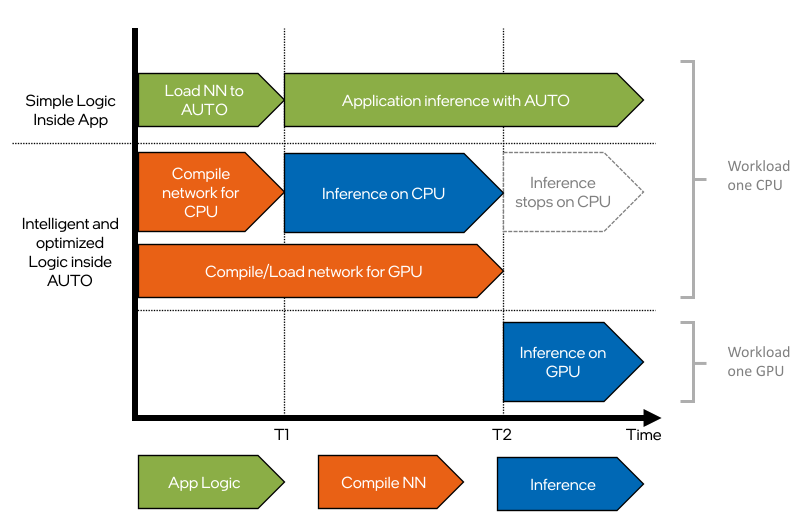The user can disable this acceleration feature by excluding CPU from the priority list or disabling `ov::intel_auto::enable_startup_fallback`. Its default value is `true`.diff --git a/src/plugins/auto/docs/integration.md b/src/plugins/auto/docs/integration.mdindex b720f461426..a6f67e371be 100644--- a/src/plugins/auto/docs/integration.md+++ b/src/plugins/auto/docs/integration.md@@ -1,7 +1,7 @@# AUTO Plugin Integration## Implement a New Plugin-Refer to [OpenVINO Plugin Developer Guide](https://docs.openvino.ai/2025/documentation/openvino-extensibility/openvino-plugin-library.html) for detailed information on how to implement a new plugin.+Refer to [OpenVINO Plugin Developer Guide](https://docs.openvino.ai/2026/documentation/openvino-extensibility/openvino-plugin-library.html) for detailed information on how to implement a new plugin.Query model method `ov::IPlugin::query_model()` is recommended as it is important for AUTO to quickly make decisions and save selection time.diff --git a/src/plugins/intel_cpu/docs/fake_quantize.md b/src/plugins/intel_cpu/docs/fake_quantize.mdindex b234c1f56b4..6be341e9fec 100644--- a/src/plugins/intel_cpu/docs/fake_quantize.md+++ b/src/plugins/intel_cpu/docs/fake_quantize.md@@ -1,5 +1,5 @@# FakeQuantize in OpenVINO-https://docs.openvino.ai/2025/documentation/openvino-ir-format/operation-sets/operation-specs/quantization/fake-quantize-1.html+https://docs.openvino.ai/2026/documentation/openvino-ir-format/operation-sets/operation-specs/quantization/fake-quantize-1.htmldefinition:```diff --git a/src/plugins/intel_cpu/docs/internal_cpu_plugin_optimization.md b/src/plugins/intel_cpu/docs/internal_cpu_plugin_optimization.mdindex 04cf62ba5a6..cbb57a65700 100644--- a/src/plugins/intel_cpu/docs/internal_cpu_plugin_optimization.md+++ b/src/plugins/intel_cpu/docs/internal_cpu_plugin_optimization.md@@ -3,7 +3,7 @@The CPU plugin supports several graph optimization algorithms, such as fusing or removing layers.Refer to the sections below for details.-> **NOTE**: For layer descriptions, see the [IR Notation Reference](https://docs.openvino.ai/2025/documentation/openvino-ir-format/operation-sets/available-opsets.html).+> **NOTE**: For layer descriptions, see the [IR Notation Reference](https://docs.openvino.ai/2026/documentation/openvino-ir-format/operation-sets/available-opsets.html).## Fusing Convolution and Simple Layersdiff --git a/src/plugins/intel_gpu/README.md b/src/plugins/intel_gpu/README.mdindex 9397cca3b58..5949f76632e 100644--- a/src/plugins/intel_gpu/README.md+++ b/src/plugins/intel_gpu/README.md@@ -31,7 +31,7 @@ GPU Plugin contains the following components:* [Run benchmark from device_mem](./docs/use_device_mem.md)## Documentation on dynamic-shape-This contents explain the internal implementation of dynamic shape support in the GPU Plugin. For general usage of dynamic shape and limitations of the GPU plugin, please refer to this link: [GPU Device — OpenVINO™ documentation - Version(2025)](https://docs.openvino.ai/2025/openvino-workflow/running-inference/inference-devices-and-modes/gpu-device.html#dynamic-shapes).+This contents explain the internal implementation of dynamic shape support in the GPU Plugin. For general usage of dynamic shape and limitations of the GPU plugin, please refer to this link: [GPU Device — OpenVINO™ documentation - Version(2026)](https://docs.openvino.ai/2026/openvino-workflow/running-inference/inference-devices-and-modes/gpu-device.html#dynamic-shapes).* [Overall flow for dynamic shape execution](./docs/dynamic_shape/overall_flow.md)* Implementation detailsdiff --git a/src/plugins/intel_gpu/docs/dynamic_shape/kv_cache.md b/src/plugins/intel_gpu/docs/dynamic_shape/kv_cache.mdindex 40f6ea3b4fe..6585fdf7971 100644--- a/src/plugins/intel_gpu/docs/dynamic_shape/kv_cache.md+++ b/src/plugins/intel_gpu/docs/dynamic_shape/kv_cache.md@@ -1,7 +1,7 @@# KV cache management in stateful model## Description-For auto-regressive transformer models, KV (key-value) cache plays a pivotal role to avoid duplicated computation for past tokens. In OpenVINO, management of the KV (key-value) cache differs between the [continuous batch (CB) pipeline](https://docs.openvino.ai/2025/model-server/ovms_demos_continuous_batching.html) and the non-CB pipeline.+For auto-regressive transformer models, KV (key-value) cache plays a pivotal role to avoid duplicated computation for past tokens. In OpenVINO, management of the KV (key-value) cache differs between the [continuous batch (CB) pipeline](https://docs.openvino.ai/2026/model-server/ovms_demos_continuous_batching.html) and the non-CB pipeline.In CB pipeline with openvino_genai, an SDPA (Scaled Dot Product Attention) operation in the OV IR (intermediate representation) is converted to a PagedAttention opertation. Then, the KV cache memories are managed by CB pipeline. CB pipeline is the default mode of openvino_genai for running LLMs.diff --git a/src/plugins/intel_gpu/docs/gpu_plugin_driver_troubleshooting.md b/src/plugins/intel_gpu/docs/gpu_plugin_driver_troubleshooting.mdindex 548d081fd19..5c17e69263c 100644--- a/src/plugins/intel_gpu/docs/gpu_plugin_driver_troubleshooting.md+++ b/src/plugins/intel_gpu/docs/gpu_plugin_driver_troubleshooting.md@@ -28,7 +28,7 @@ Some Intel® CPUs might not have integrated GPU, so if you want to run OpenVINO## 2. Make sure that OpenCL® Runtime is installed-OpenCL runtime is a part of the GPU driver on Windows, but on Linux it should be installed separately. For the installation tips, refer to [OpenVINO docs](https://docs.openvino.ai/2025/get-started/install-openvino/install-openvino-linux.html) and [OpenCL Compute Runtime docs](https://github.com/intel/compute-runtime/tree/master/opencl/doc).+OpenCL runtime is a part of the GPU driver on Windows, but on Linux it should be installed separately. For the installation tips, refer to [OpenVINO docs](https://docs.openvino.ai/2026/get-started/install-openvino/install-openvino-linux.html) and [OpenCL Compute Runtime docs](https://github.com/intel/compute-runtime/tree/master/opencl/doc).To get the support of Intel® Iris® Xe MAX Graphics with Linux, follow the [driver installation guide](https://dgpu-docs.intel.com/devices/iris-xe-max-graphics/index.html)## 3. Make sure that user has all required permissions to work with GPU device@@ -61,7 +61,7 @@ For more details, see the [OpenCL on Linux](https://github.com/bashbaug/OpenCLPa## 7. If you are using dGPU with XMX, ensure that HW_MATMUL feature is recognized-OpenVINO contains *hello_query_device* sample application: [link](https://docs.openvino.ai/2025/get-started/learn-openvino/openvino-samples/hello-query-device.html)+OpenVINO contains *hello_query_device* sample application: [link](https://docs.openvino.ai/2026/get-started/learn-openvino/openvino-samples/hello-query-device.html)With this option, you can check whether Intel XMX(Xe Matrix Extension) feature is properly recognized or not. This is a hardware feature to accelerate matrix operations and available on some discrete GPUs.diff --git a/src/plugins/intel_gpu/docs/source_code_structure.md b/src/plugins/intel_gpu/docs/source_code_structure.mdindex 531fe23d129..e93460fa554 100644--- a/src/plugins/intel_gpu/docs/source_code_structure.md+++ b/src/plugins/intel_gpu/docs/source_code_structure.md@@ -5,7 +5,7 @@ but at some point clDNN became a part of OpenVINO, so now it's a part of overallvia embedding of [oneDNN library](https://github.com/oneapi-src/oneDNN)OpenVINO GPU plugin is responsible for:- 1. [IE Plugin API](https://docs.openvino.ai/2025/documentation/openvino-extensibility/openvino-plugin-library.html) implementation.+ 1. [IE Plugin API](https://docs.openvino.ai/2026/documentation/openvino-extensibility/openvino-plugin-library.html) implementation.2. Translation of a model from common IE semantic (`ov::Function`) into plugin-specific one (`cldnn::topology`), which is then compiled intoGPU graph representation (`cldnn::network`).3. Implementation of OpenVINO operation set for Intel® GPU.diff --git a/src/plugins/intel_npu/tools/compile_tool/README.md b/src/plugins/intel_npu/tools/compile_tool/README.mdindex 20fb073277a..229bfd75c2b 100644--- a/src/plugins/intel_npu/tools/compile_tool/README.md+++ b/src/plugins/intel_npu/tools/compile_tool/README.md@@ -8,7 +8,7 @@ This page demonstrates how to use NPU Compile Tool to convert OpenVINO™ IntermCompile tool is a C++ application that enables you to compile a model for inference on a specific device and export the compiled representation to a binary file.With this tool, you can compile a model using supported OpenVINO Runtime devices on a machine that does not have the physical device connected, i.e. without NPU driver and Runtime loading, and then transfer a generated file to any machine with the target inference device available.-Using Compile Tool is not a basic approach to end-to-end execution and/or application but mostly suitable for debugging and validation and some specific use cases. If one is looking for the standard way of reducing application startup delays by exporting and reusing the compiled model automatically, refer to [Model Caching article](https://docs.openvino.ai/2025/openvino-workflow/running-inference/inference-devices-and-modes/npu-device.html#model-caching)+Using Compile Tool is not a basic approach to end-to-end execution and/or application but mostly suitable for debugging and validation and some specific use cases. If one is looking for the standard way of reducing application startup delays by exporting and reusing the compiled model automatically, refer to [Model Caching article](https://docs.openvino.ai/2026/openvino-workflow/running-inference/inference-devices-and-modes/npu-device.html#model-caching)## Workflow of the Compile tool@@ -25,7 +25,7 @@ If you need to configure a release package layout and have Compile Tool in it, u### Standalone build#### Prerequisites-* [OpenVINO™ Runtime release package](https://docs.openvino.ai/2025/get-started/install-openvino.html)+* [OpenVINO™ Runtime release package](https://docs.openvino.ai/2026/get-started/install-openvino.html)#### Build instructions1. Download and install OpenVINO™ Runtime package@@ -37,7 +37,7 @@ If you need to configure a release package layout and have Compile Tool in it, ucmake --install . --prefix <compile_tool_install_dir>```> Note 1: command line instruction might differ on different platforms (e.g. Windows cmd)- > Note 2: this example is based on OpenVINO Archive distribution. If you have chosen another installation method, specifying OpenVINO_DIR and calling `setupvars` script might not be needed. Refer [documentation](https://docs.openvino.ai/2025/get-started/install-openvino.html) for details.+ > Note 2: this example is based on OpenVINO Archive distribution. If you have chosen another installation method, specifying OpenVINO_DIR and calling `setupvars` script might not be needed. Refer [documentation](https://docs.openvino.ai/2026/get-started/install-openvino.html) for details.> Note 3: `<compile_tool_install_dir>` can be any directory on your filesystem that you want to use for installation including `<openvino_install_dir>` if you wish to extend OpenVINO package3. Verify the installation```sh@@ -45,7 +45,7 @@ If you need to configure a release package layout and have Compile Tool in it, u<compile_tool_install_dir>/tools/compile_tool/compile_tool -h```> Note 1: command line might differ depending on your platform- > Note 2: this example is based on OpenVINO Archive distribution. If you have chosen another installation method, calling setupvars might not be needed. Refer [documentation](https://docs.openvino.ai/2025/get-started/install-openvino.html) for details.+ > Note 2: this example is based on OpenVINO Archive distribution. If you have chosen another installation method, calling setupvars might not be needed. Refer [documentation](https://docs.openvino.ai/2026/get-started/install-openvino.html) for details.Successful build will show the information about Compile Tool CLI optionsdiff --git a/src/plugins/intel_npu/tools/single-image-test/README.md b/src/plugins/intel_npu/tools/single-image-test/README.mdindex b03d4ea75be..9801cd3b25b 100644--- a/src/plugins/intel_npu/tools/single-image-test/README.md+++ b/src/plugins/intel_npu/tools/single-image-test/README.md@@ -23,7 +23,7 @@ If you need to configure a release package layout and have Single Image Test in### Standalone build#### Prerequisites-* [OpenVINO™ Runtime release package](https://docs.openvino.ai/2025/get-started/install-openvino.html)+* [OpenVINO™ Runtime release package](https://docs.openvino.ai/2026/get-started/install-openvino.html)* [OpenCV: Open Source Computer Vision Library release package](https://opencv.org/get-started/)#### Build instructions@@ -38,7 +38,7 @@ If you need to configure a release package layout and have Single Image Test incmake --install . --prefix <sit_install_dir>```> Note 1: command line instruction might differ on different platforms (e.g. Windows cmd)- > Note 2: this example is based on OpenVINO Archive distribution. If you have chosen another installation method, specifying OpenVINO_DIR and calling setupvars might not be needed. Refer [documentation](https://docs.openvino.ai/2025/get-started/install-openvino.html) for details.+ > Note 2: this example is based on OpenVINO Archive distribution. If you have chosen another installation method, specifying OpenVINO_DIR and calling setupvars might not be needed. Refer [documentation](https://docs.openvino.ai/2026/get-started/install-openvino.html) for details.> Note 3: depending on OpenCV installation method, there might not be a need to specify OpenCV_DIR.> Note 4: depending on OpenCV version, cmake configs might be located somewhere else. You need to specify a directory that contains `OpenCVConfig.cmake` file> Note 5: `<sit_install_dir>` can be any directory on your filesystem that you want to use for installation including `<openvino_install_dir>` if you wish to extend OpenVINO package@@ -50,7 +50,7 @@ If you need to configure a release package layout and have Single Image Test in```> Note 1: command line might differ depending on your platform> Note 2: depending on OpenCV installation method, there might not be a need to call setupvars.- > Note 3: this example is based on OpenVINO Archive distribution. If you have chosen another installation method, calling setupvars might not be needed. Refer [documentation](https://docs.openvino.ai/2025/get-started/install-openvino.html) for details.+ > Note 3: this example is based on OpenVINO Archive distribution. If you have chosen another installation method, calling setupvars might not be needed. Refer [documentation](https://docs.openvino.ai/2026/get-started/install-openvino.html) for details.Successful build will show the information about Single Image Test Tool CLI optionsdiff --git a/src/plugins/proxy/README.md b/src/plugins/proxy/README.mdindex a78469cda30..e0ad32acdbc 100644--- a/src/plugins/proxy/README.md+++ b/src/plugins/proxy/README.md@@ -47,5 +47,5 @@ After the creation the proxy plugin has next properties:* [OpenVINO Core Components](../../README.md)* [OpenVINO Plugins](../README.md)* [Developer documentation](../../../docs/dev/index.md)- * [OpenVINO Plugin Developer Guide](https://docs.openvino.ai/2025/documentation/openvino-extensibility/openvino-plugin-library.html)+ * [OpenVINO Plugin Developer Guide](https://docs.openvino.ai/2026/documentation/openvino-extensibility/openvino-plugin-library.html)diff --git a/src/plugins/template/README.md b/src/plugins/template/README.mdindex b6e04e5aae2..c46fa076c0c 100644--- a/src/plugins/template/README.md+++ b/src/plugins/template/README.md@@ -35,11 +35,11 @@ $ make -j8## Tutorials-* [OpenVINO Plugin Developer Guide](https://docs.openvino.ai/2025/documentation/openvino-extensibility/openvino-plugin-library.html)+* [OpenVINO Plugin Developer Guide](https://docs.openvino.ai/2026/documentation/openvino-extensibility/openvino-plugin-library.html)## See also* [OpenVINO™ README](../../../README.md)* [OpenVINO Core Components](../../README.md)* [OpenVINO Plugins](../README.md)* [Developer documentation](../../../docs/dev/index.md)- * [OpenVINO Plugin Developer Guide](https://docs.openvino.ai/2025/documentation/openvino-extensibility/openvino-plugin-library.html)+ * [OpenVINO Plugin Developer Guide](https://docs.openvino.ai/2026/documentation/openvino-extensibility/openvino-plugin-library.html)diff --git a/tools/benchmark_tool/README.md b/tools/benchmark_tool/README.mdindex 043818c0285..05989db7bff 100644--- a/tools/benchmark_tool/README.md+++ b/tools/benchmark_tool/README.md@@ -2,13 +2,13 @@This page demonstrates how to use the Benchmark Python Tool to estimate deep learning inference performance on supported devices.-> **NOTE**: This page describes usage of the Python implementation of the Benchmark Tool. For the C++ implementation, refer to the [Benchmark C++ Tool](https://docs.openvino.ai/2025/get-started/learn-openvino/openvino-samples/benchmark-tool.html) page. The Python version is recommended for benchmarking models that will be used in Python applications, and the C++ version is recommended for benchmarking models that will be used in C++ applications. Both tools have a similar command interface and backend.+> **NOTE**: This page describes usage of the Python implementation of the Benchmark Tool. For the C++ implementation, refer to the [Benchmark C++ Tool](https://docs.openvino.ai/2026/get-started/learn-openvino/openvino-samples/benchmark-tool.html) page. The Python version is recommended for benchmarking models that will be used in Python applications, and the C++ version is recommended for benchmarking models that will be used in C++ applications. Both tools have a similar command interface and backend.-For more detailed information on how this sample works, check the dedicated [article](https://docs.openvino.ai/2025/get-started/learn-openvino/openvino-samples/benchmark-tool.html)+For more detailed information on how this sample works, check the dedicated [article](https://docs.openvino.ai/2026/get-started/learn-openvino/openvino-samples/benchmark-tool.html)## Requirements-The Python benchmark_app is automatically installed when you install OpenVINO Developer Tools using [PyPI](https://docs.openvino.ai/2025/get-started/install-openvino/install-openvino-pip.html) Before running ``benchmark_app``, make sure the ``openvino_env`` virtual environment is activated, and navigate to the directory where your model is located.+The Python benchmark_app is automatically installed when you install OpenVINO Developer Tools using [PyPI](https://docs.openvino.ai/2026/get-started/install-openvino/install-openvino-pip.html) Before running ``benchmark_app``, make sure the ``openvino_env`` virtual environment is activated, and navigate to the directory where your model is located.The benchmarking application works with models in the OpenVINO IR (``model.xml`` and ``model.bin``) and ONNX (``model.onnx``) formats.-Make sure to [convert your models](https://docs.openvino.ai/2025/openvino-workflow/model-preparation/convert-model-to-ir.html) if necessary.+Make sure to [convert your models](https://docs.openvino.ai/2026/openvino-workflow/model-preparation/convert-model-to-ir.html) if necessary.