
Self-improving AI Employees for everyone
Contributing to OpenCompany
OpenCompany is an open-source operating system for AI employees that use browsers, apps, tools, integrations, and the computer to complete work. The workflow editor and execution engine power those employees behind the scenes. For installation and everyday use, start with the README's guide for everyone.
This guide is a contributor's map to the codebase. It tells you where things live and where to start reading when you want to add a feature. For the full architecture tour, use DeepWiki or browse docs-internal/.
Contribution Workflow
- Fork the repository
- Create a feature branch
- Make your changes
- Submit a pull request
See SETUP.md for environment setup and SCRIPTS.md for the full scripts reference.
System Overview
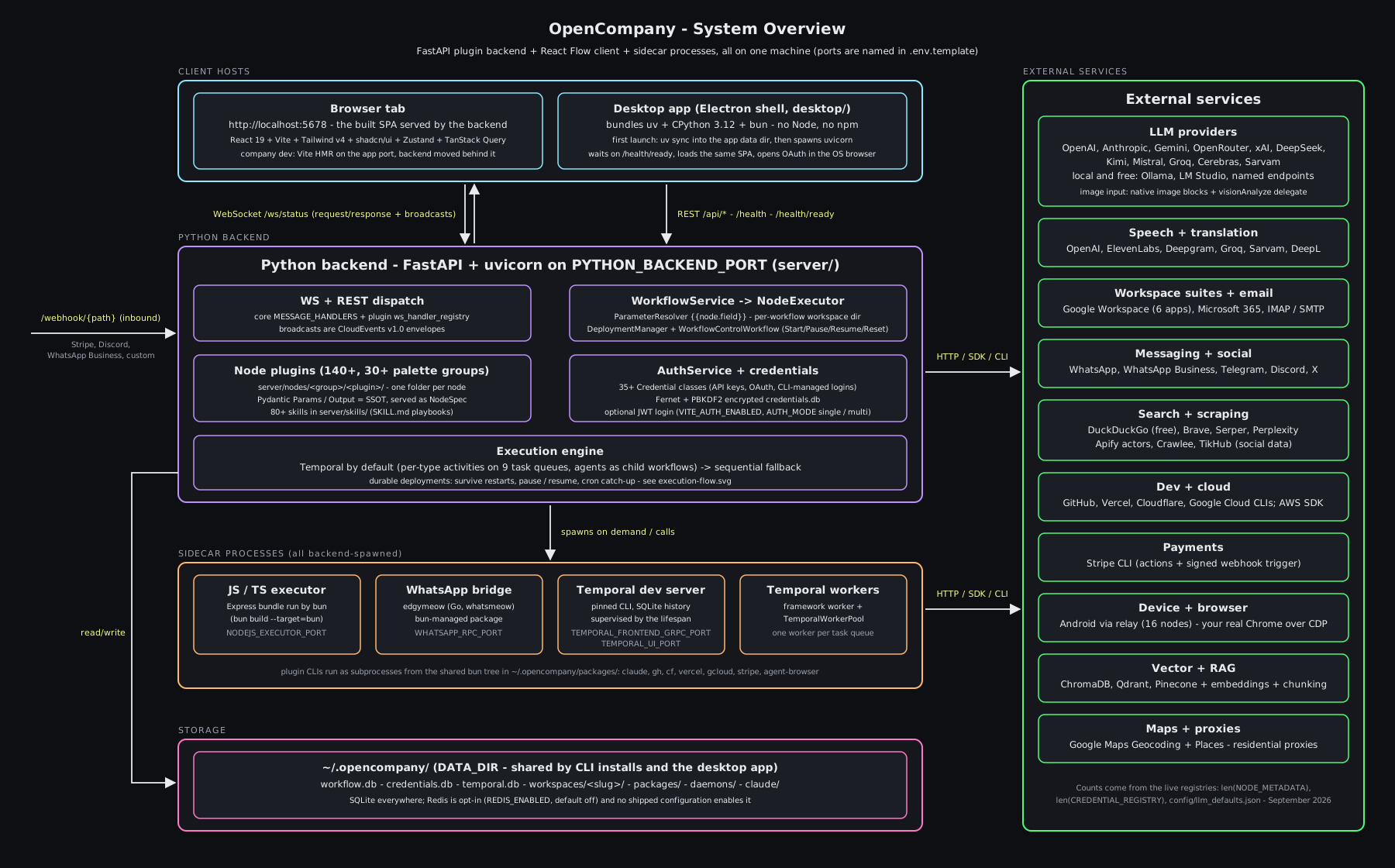
At a glance:
- 140+ workflow nodes across 33 populated palette groups (34 registered in
server/nodes/groups.py) (live count:len(services.node_registry.NODE_METADATA)after importingnodes— a bareserver/nodes/**/__init__.pyglob both over-counts helper packages and under-counts groups that hold several node types in one package) - Native LLM providers: 11 cloud providers, Ollama and LM Studio, plus any number of user-named OpenAI-compatible endpoints (llama.cpp, vLLM, a LiteLLM proxy) added in the Credentials Modal with no code. One standalone chat-model node per provider except xAI, which agent nodes select directly, plus
openaiCompatibleChatModelfor a named endpoint - Specialized AI agents with the Agent Teams delegation pattern — SSOT is the
AI_AGENT_TYPESfrozenset inserver/constants.py, which spans the base/specialized/team-lead agents plus the CLI-backed (claude_code_agent,rlm_agent) variants;codex_agentis a sibling CLI-agent plugin - WebSocket-first API replacing most REST endpoints (live handler count =
MESSAGE_HANDLERS+ plugin registries) - 78 built-in skills across 18 folders, editable in-UI with SKILL.md defaults on disk (live count:
find server/skills -name SKILL.md | wc -l) - Two execution modes with automatic fallback: Temporal distributed, sequential
How Workflows Execute
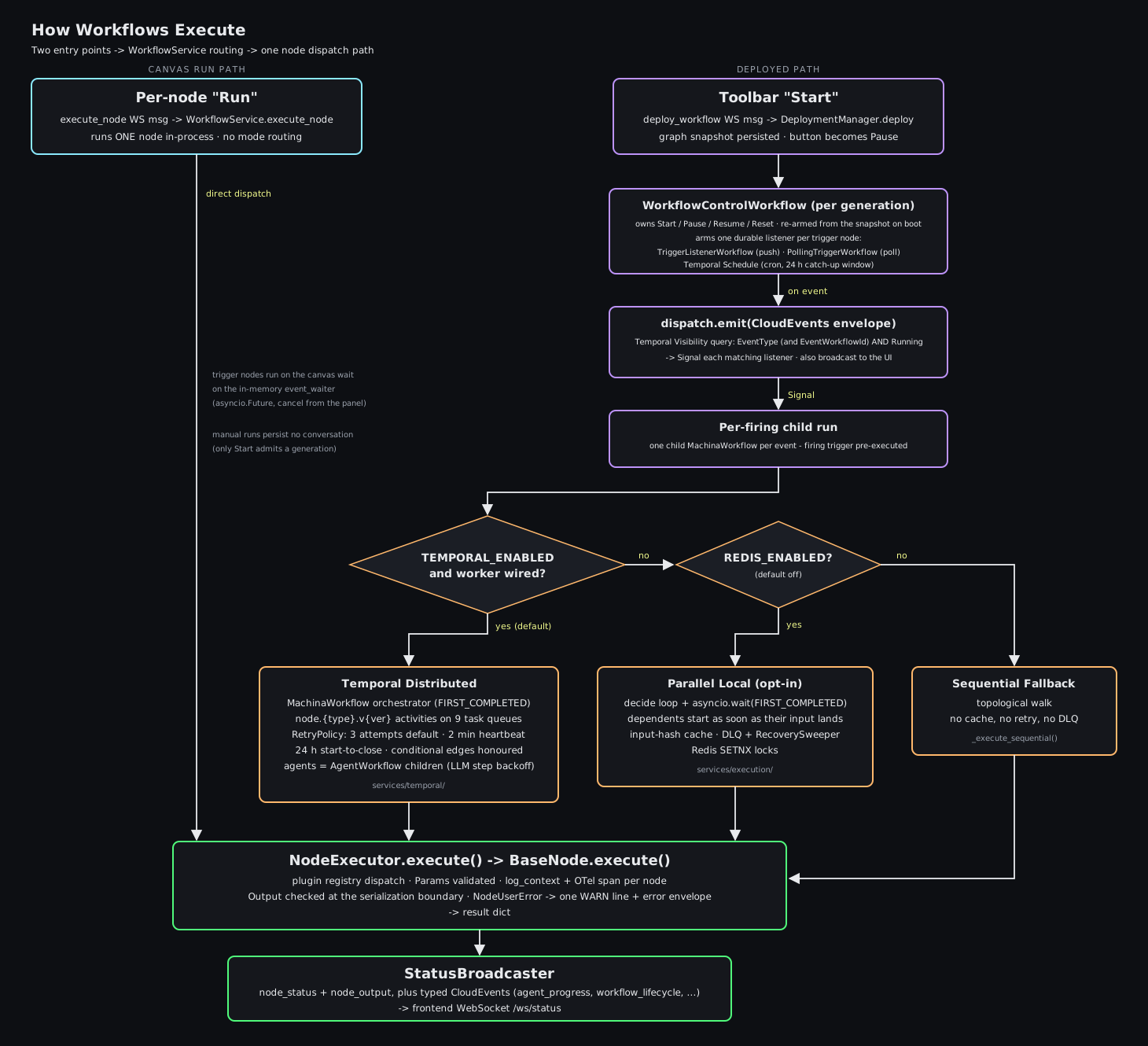
WorkflowService is a thin facade that routes each run through Temporal when available, falling back to a plain sequential walk otherwise. Every run has an isolated ExecutionContext with no shared global state. Nodes are scheduled continuously — when any node completes, its newly-ready dependents start immediately (FIRST_COMPLETED pattern) instead of waiting for a whole layer to finish.
Newly started Temporal generations use revision-ordered cooperative control: Stop closes admission across the execution tree, admitted work finishes with its bookkeeping, and Resume releases the same pending continuation. Signals queue events, completed Updates acknowledge control and root membership, and Queries expose read-only state. Preserve the legacy/version-marker command paths when editing Workflow code; validate them with native history replay.
Deep dives: DESIGN.md - TEMPORAL_ARCHITECTURE.md - temporal-workflow-control.md - event_framework.md
AI Agent System
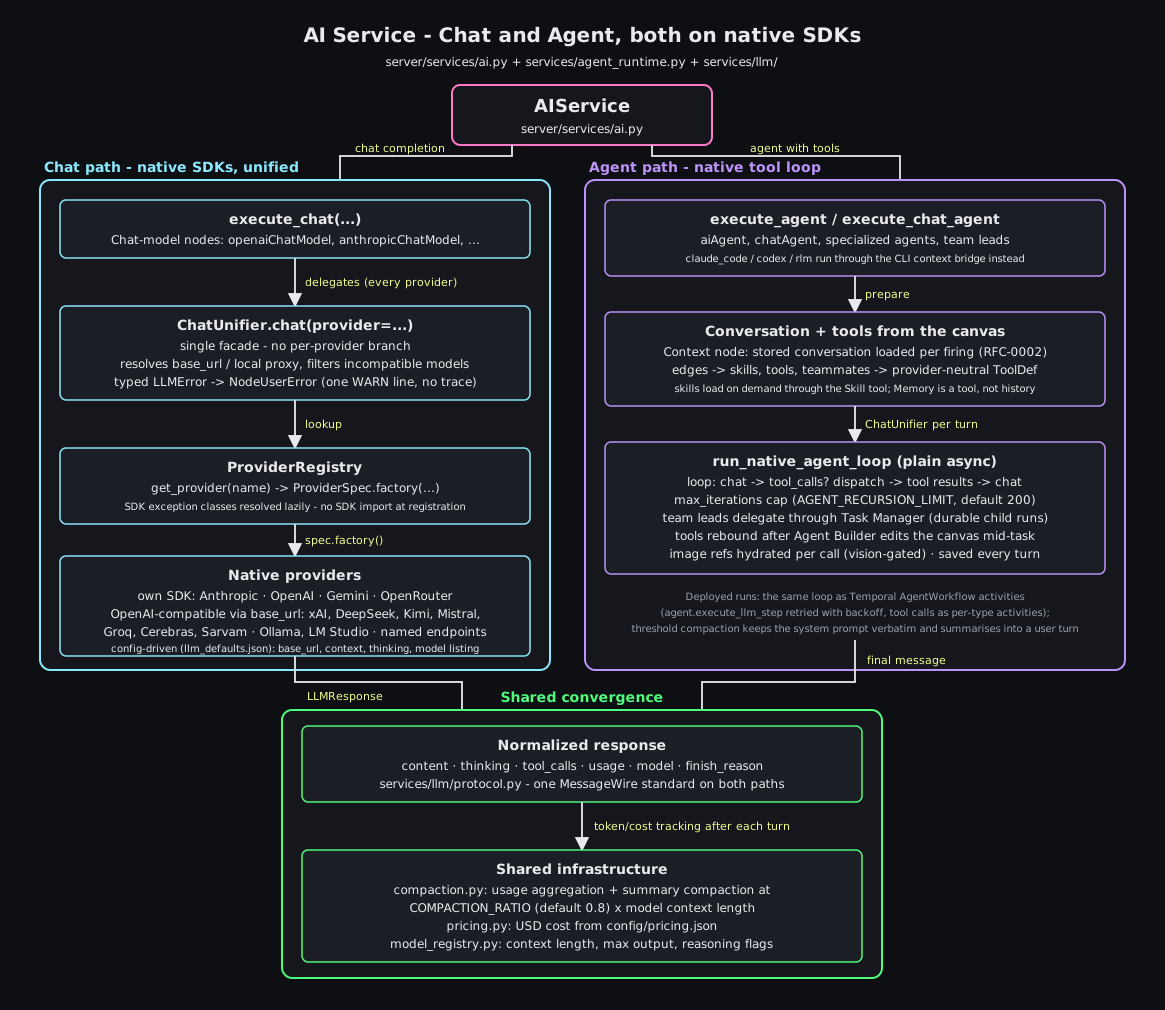
Direct chat completions and every new agent execution use the native SDK layer in services/llm/ through ChatUnifier. The shared run_native_agent_loop consumes lossless native messages and provider-neutral AgentToolSpec definitions; Groq, Cerebras, xAI, DeepSeek, Kimi, Mistral, the local servers and every named OpenAI-compatible endpoint ride the OpenAI-compatible client with provider-specific base_url values. LangChain has been removed; Temporal histories recorded before the native cutover are refused rather than replayed. Team leads (orchestrator_agent, ai_employee) receive an intrinsic Task Manager and may assign only agents connected to their input-teammates handle. Delegate descriptors stay internal. task_manager(assign_task) persists and returns queued; Temporal hands work to a detached DelegatedTaskWorkflow, while legacy execution reuses the same durable task record. Completion emits taskTrigger with owning execution context for a separate lead review. The RLM Agent uses a REPL-based recursive language model pattern. Long-running activities remain alive through activity heartbeats.
Deep dives: agent_architecture.md - native_llm_sdk.md - agent_teams.md - memory_compaction.md - cli_agent_framework.md
More Diagrams
Fourteen source-backed architecture and product-panel diagrams live next to the ones above in docs/diagrams/. Each carries the source files it was drawn from in its <desc>.
| Diagram | What it shows |
|---|---|
| System context | Who uses OpenCompany and which external capabilities it orchestrates |
| Runtime and trust topology | Browser, desktop and CLI clients, the authenticated REST / WebSocket / MCP / webhook surfaces, Temporal and the lazy sidecars |
| Workflow execution routing | Temporal, parallel and sequential branches converging on the NodeExecutor pipeline |
| Durable deployment and events | Generation snapshots, WorkflowControlWorkflow, push / poll / cron triggers, CloudEvents dispatch |
| Plugin, agent and team composition | How plugins become chat-model and agent nodes, assemble context, skills and tools, and form teams |
| Persistence and secret plane | workflow.db versus the encrypted credentials.db boundary |
| Workspace anatomy | Immutable id to mutable slug directories, contained I/O, CLI worktrees and materialized skills |
| Node configuration anatomy | The Input / Parameters / Output modal, local draft, save-before-run and correlated output |
| Credentials architecture | Server-owned catalogue, WebSocket handlers, AuthService and encrypted storage |
| Team operations | Task Manager lifecycle from blocked and queued through submission, review and finish |
| Agent context versus memory | The stored conversation (RFC-0002) beside the explicit Memory tool |
| Master Skill editor | Skill sources, the catalogue and instruction panes, expansion and runtime badges |
| Workspace files | The Gallery node panel: WebSocket listing, HTTP content and the FileRef output |
| Runtime observability dock | Chat, Console and Terminal producers, retention and the dock UI |


Repository Map
| Directory | What lives here | Start reading |
|---|---|---|
server/nodes/<category>/<node>/__init__.py |
Workflow node plugins (self-contained folders, NodeSpec + execute) — backend SSOT since Wave 11 | plugin_system.md, server/nodes/README.md |
client/src/components/ |
React Flow canvas, parameter panel, modals | CLAUDE.md |
server/services/ |
WorkflowService, NodeExecutor, AI service | DESIGN.md |
server/services/handlers/ |
Cross-cutting orchestration only (tools.py AI-tool dispatch + delegation, triggers.py, todo.py) — per-node handlers live inside the plugins since Wave 11 |
node_creation.md |
server/services/llm/ |
Native LLM SDK layer (every provider, plus named OpenAI-compatible endpoints) | native_llm_sdk.md |
server/services/execution/ |
Decide pattern, DLQ, recovery, conditions | DESIGN.md |
server/services/temporal/ |
Distributed execution via Temporal | TEMPORAL_ARCHITECTURE.md |
server/routers/websocket.py |
WebSocket endpoint + core MESSAGE_HANDLERS (plugins register more via ws_handler_registry) |
status_broadcaster.md |
server/core/ |
Cache, encryption, DI container, config | credentials_encryption.md |
server/skills/ |
Skill SKILL.md files, one folder per agent domain (live count: glob server/skills/**/SKILL.md) |
GUIDE.md |
server/config/ |
llm_defaults.json, pricing.json, model_registry.json, email_providers.json, google_apis.json, credential_providers.json, ai_cli_providers.json, node_allowlist.json | pricing_service.md, node_allowlist.md |
server/tests/ |
Contract-test invariants + per-category node tests + NodeTestHarness |
tests/nodes/_harness.py, tests/credentials/README.md |
client/src/ (styling + themes) |
Tailwind tokens, shadcn primitives, the theme contract | frontend_architecture.md, theme_system.md |
desktop/ |
Electron desktop shell — a standalone bun package (not a root workspace member) that bundles uv + Python + bun (no Node, no npm), provisions the backend venv on first launch and hosts the backend-served SPA in a native window | desktop_app.md, desktop_host_contract.md |
docs-internal/ |
In-repo architecture deep dives (50+ files) | Index below |
How to Contribute Features
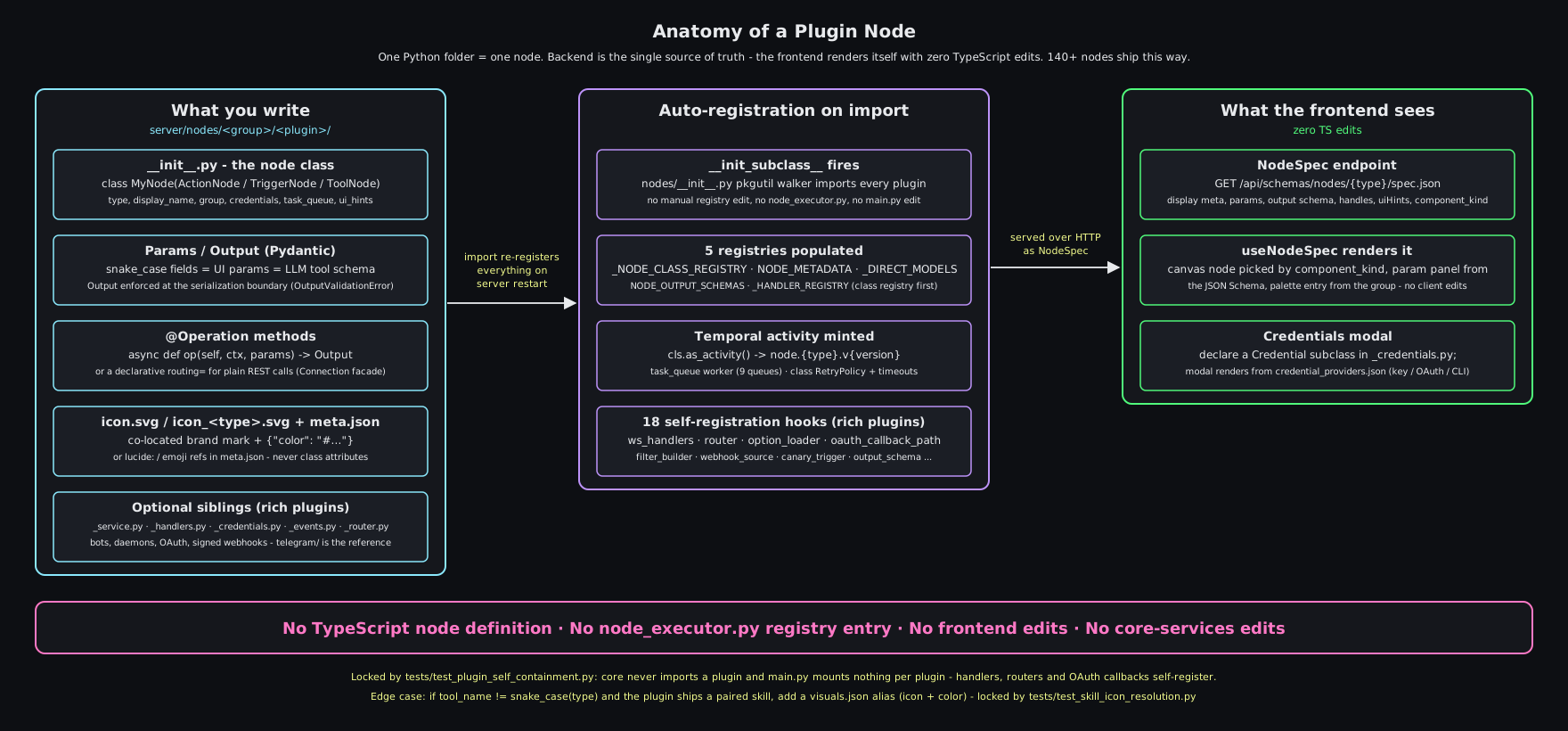
The diagram above shows the full lifecycle of a workflow node: one self-contained Python plugin folder that auto-registers on import and renders itself on the frontend with zero TypeScript edits. Use these recipes as a starting point:
Add a workflow node
- Start at node_creation.md (the decision tree routes action / trigger / tool / dual-purpose / agent work), copy the recipe from server/nodes/README.md, and reach for plugin_system.md as the deep reference
- One plugin folder:
server/nodes/<category>/<node>/__init__.py— subclassesActionNode/TriggerNode/ToolNode, declares PydanticParams/Output+@Operationmethods; auto-registers on import, zero frontend edits - Icon =
icon.svgin the folder, color =meta.json(never class attributes); raiseNodeUserErrorfor user-correctable failures - Add a behavioral test in
server/tests/nodes/test_<category>.py(the invariant suites cover the contract automatically — see Testing below)
Add an LLM provider
- Guide: native_llm_sdk.md → "Adding a New Provider"
- OpenAI-compatible (DeepSeek, Kimi, Mistral pattern): add the provider configuration to
server/config/llm_defaults.jsonand its name toservices/llm/providers/_compat.py::_COMPAT_PROVIDERS - Custom-SDK provider: new file in
server/services/llm/providers/that callsregister_provider(ProviderSpec(...))at module bottom (lazy factory +sdk_exception_refs; the legacyfactory.pywas removed —register_provideris the only entry point) - Chat-model node plugin:
server/nodes/model/<provider>_chat_model/__init__.py, plus a branch indetect_ai_provider(server/constants.py), or the node falls through to'openai'. Agent dropdowns need no edit: theirproviderfield is the loader-drivenProviderRef(nodes/agent/_provider.py), which lists every registered provider - A server the user runs (llama.cpp, vLLM, a LiteLLM proxy, another Ollama host) needs no code at all: it is a named endpoint added in the Credentials Modal (RFC-0003)
Add a dual-purpose tool (workflow node + AI tool)
- Guide: node_creation.md; live references: the whatsapp / twitter / stripe folders
- Plugin folder with
group: ['category', 'tool']andusable_as_tool = True; the PydanticParamsdoubles as the LLM-visible tool schema (keep it flat — no nested models /$defs) - If you give the tool a short
tool_namethat isn't<snake_case_of_node_type>AND ship a paired skill, add avisuals.jsonalias entry keyed by the tool name carrying icon and color — otherwise the Master Skill row renders blank (locked byserver/tests/test_skill_icon_resolution.py)
Add a specialized AI agent
- Guide: node_creation.md + agent_architecture.md
- Add the plugin under
server/nodes/agent/<name>/(extendsSpecializedAgentBasefromserver/nodes/agent/_specialized.py) - Single cross-cutting edit: add the agent's
typestring to theAI_AGENT_TYPESfrozenset inserver/constants.py— delegation dispatch imports that frozenset, nothing else to update - CLI-backed agents (Claude Code / Codex shape) follow cli_agent_framework.md
Add a skill
- Guide: GUIDE.md (folder structure, SKILL.md frontmatter, and the tool-naming contract that drives the skill's icon)
- New folder under
server/skills/<domain>/<skill-name>/SKILL.mdwith YAML frontmatter + markdown body
Add an event source / trigger (Wave 12)
- Guides: node_creation.md → Wave 12 recipe (authoring) → event_framework.md (Temporal routing + ops) → stripe_service.md (the reference implementation)
- Pick the source shape:
DaemonEventSource(CLI daemon),WebhookSource+WebhookTriggerNode(signed webhooks, with a verifier fromservices.events.verifiers), orPollingEventSource(API polling) - Register via
register_canary_trigger_type(node_type, cloudevent_type)+ emitWorkflowEvents viadispatch.emitfrom the plugin's_events.py; plugin-owned filters go throughregister_filter_builder— never hand-editevent_waiter.py(event_waiter_system.md is historical, pre-Wave-11)
Integrate a CLI-managed-auth service (Stripe / Vercel / GitHub shape)
- Guide: node_creation.md → "CLI-managed auth" recipe; references: stripe_service.md (two-step browser OAuth), vercel_service.md (device-flow variant), github_service.md (gh owns auth entirely)
- The external CLI owns the real tokens; the plugin writes marker tokens via
auth_service.store_oauth_tokens(provider, "cli-managed", "cli-managed")and broadcasts the genericcredential_catalogue_updatedevent — zero per-provider frontend code _install.pyauto-downloads the pinned CLI binary into the shared packages tree
Integrate an OAuth service
- Guides: plugin_system.md (Connection facade, credentials,
register_router/register_option_loader); live reference: server/nodes/google/ — 7 nodes sharing one OAuth connection via_oauth.py/_router.py/_auth_helper.py - (new_service_integration.md is archived — do not follow its steps)
Add a credential provider
- Declare a
Credentialsubclass in the plugin folder's_credentials.pyand add the provider entry toserver/config/credential_providers.json— the Credentials Modal renders it with no React edits - Guides: credentials_encryption.md (storage pipeline) + frontend_architecture.md → Credentials (the config-driven modal); the numbered invariants the tests cite live in the archived credentials_panel.md §5; test conventions in server/tests/credentials/README.md
Contribute frontend / a new theme
- Read frontend_architecture.md first (stack, token tiers, state-ownership boundary, the strict styling rules), then theme_system.md for the theme contract
- New themes follow theme_system.md → "Adding a new theme" (per-theme CSS file + tokens; no component code changes — that is the contract)
- New backend uiHint flags need two frontend-side edits:
INodeProperties.ts+ theknownset inserver/tests/test_node_spec.py
Testing Your Contribution
- Contract invariants run automatically.
server/tests/test_plugin_contract.pyandtest_node_spec.pyiterate every registered plugin and assert the declared shape — a new node is covered the moment it imports.test_plugin_self_containment.pyenforces the no-cross-plugin-imports rule;test_skill_icon_resolution.pyasserts every skill resolves an icon. - Behavioral tests live per category in
server/tests/nodes/test_<category>.py, driven throughNodeTestHarness(server/tests/nodes/_harness.py) — it executes any node viaNodeExecutorwith mocked services and asserts the result envelope. - Import sanity:
uv run pytest --collect-only(fromserver/) is the live plugin-count invariant — it fails if any plugin errors at import. - Credential tests follow the numbered-invariant style documented in server/tests/credentials/README.md.
- Temporal control tests include real SDK workflows with stub Activities, worker restart, Continue-As-New and captured-history replay. Run the control verification commands when changing admission gates, root enrollment, event queues or messaging. Replay hooks must remain deterministic and unchanged while replaying.
- Run everything:
uv run pytestfromserver/,bun run --filter react-flow-client testfrom the repo root,uv run pytest cli/testsfrom the repo root. - Desktop shell: from
desktop/,bun run typecheck && bun run test && bun run test:invariants(the last needsbun run stagefirst), andbun run build && bun run test:e2efor the Playwright Electron smoke. In an editor-hosted terminal unsetELECTRON_RUN_AS_NODEbefore launching Electron by hand.
Local Dev Quick Reference
Development from source uses bun (not npm) — the same bun that end users install with (bun add -g @zeenie-ai/opencompany) and that everything shipped runs on. The scripts/preinstall.js hook enforces this when bunfig.toml is present (it keys on the file plus a bun user agent; end-user bun add -g installs never trigger it — a global add runs no lifecycle scripts, and bunfig.toml is not shipped in the tarball anyway). Install bun once from https://bun.sh — Windows: powershell -c "irm bun.sh/install.ps1 | iex"; macOS/Linux: curl -fsSL https://bun.sh/install | bash.
bun install            # install workspace dependencies
bun run dev            # start the app (Vite HMR + backend; Temporal starts from the backend when TEMPORAL_ENABLED, WhatsApp only on demand)
bun run stop           # stop everything
bun run build          # production build
bun run --filter react-flow-client typecheck   # THE gate: TypeScript 7 (native Go). Same command CI runs.
bun run --filter react-flow-client typecheck:tsc # second opinion under tsc 5.9 — for triaging a red gate, not a substitute
uv run pytest          # run backend tests (from server/, uv-managed venv)
The desktop shell has its own package: cd desktop && bun install && bun run stage && bun run dev (see desktop/README.md). It is not a root workspace member, so root bun install does not touch it.
server/uv.lock is committed. After changing server/pyproject.toml, run uv lock in server/ and commit the lock too; CI fails with uv lock --check otherwise, and the desktop app installs from the lock with --frozen.
Known differences from pnpm (the workspace migrated from pnpm@9 to [email protected]):
- No strict-peer-dependencies equivalent. bun never errors on peer conflicts, so the check that kept client
typescriptinside typescript-eslint's peer range is gone from install time — the CLI test locking clienttypescriptto^5(cli/tests/test_release_pipeline_config.py) is now the only guard. - Dependabot is disabled (no PRs of any kind). Alerts still show in the Security tab; remediation is a hand bump, through the top-level
overridesblock in the rootpackage.jsonfor transitive JS pins (the pins formerly underpnpm.overrides) oruv lock --upgrade-packagefor the server. See ci_cd.md "Dependency update policy". --bunis not enabled anywhere — but Node is dev/CI-only now. Everything shipped runs on bun: thecompanyshim (bin/cli.js,#!/usr/bin/env bun), the JS executor sidecar (bun build --target=bunbundle), the plugin CLIsbun added into~/.opencompany/packages/(server/core/js_runtime.py) and the end-user install itself. Node (CI installs 22) is kept only so bun can run vite / vitest / eslint / playwright / electron-builder on it via their node shebangs when it is present — vitest and eslint have open bugs on the bun runtime (oven-sh/bun#20762, #13346) — andcompany buildreports Node as optional (bun runs the build tools itself when it is absent). A trial of--bunforvite devonly remains a documented follow-up; never for vitest/eslint.
Full setup and scripts reference: SETUP.md - SCRIPTS.md
Full Documentation Index
| Document | Description |
|---|---|
| DESIGN.md | Execution engine architecture, design patterns, execution modes |
| TEMPORAL_ARCHITECTURE.md | Distributed execution via Temporal activities |
| temporal-workflow-control.md | Versioned Stop/drain/Resume, execution roots, messaging, event accumulation, compatibility and verification |
| chat_protocol.md | Tracked chat runs, controlled Stop/Resume, subscriptions, legacy Stop and watchdog behavior |
| workflow-schema.md | Workflow JSON schema and node catalog (live count = len(services.node_registry.NODE_METADATA) after importing nodes) |
| ROADMAP.md | Archived status snapshot; current state is in DESIGN.md and the Temporal docs |
| SETUP.md | Development environment setup |
| SCRIPTS.md | bun/shell scripts and CLI verbs reference |
| server-readme.md | Archived; see SETUP.md, authentication.md, plugin_system.md |
| agent_architecture.md | AI Agent / Chat Agent skill and tool discovery |
| agent_delegation.md | How delegated agents share context and memory |
| agent_teams.md | Agent Teams pattern with input-teammates handle |
| native_llm_sdk.md | Native LLM SDK layer and provider protocol |
| rlm_service.md | Recursive Language Model agent via REPL |
| claude_code_agent.md | Claude Code agent hub (routes to architecture, interactive mode, and the vendored claude_code_*_reference.md snapshots) |
| claude_code_agent_architecture.md | Archived LangGraph-era design notes; see claude_code_interactive_mode.md |
| cli_agent_framework.md | Multi-provider CLI agent runtime (Claude Code / Codex / Gemini) — worktree isolation, MCP bridge, memory bridge |
| autonomous_agent_creation.md | Archived external research notes on Code Mode agents; the plugin is server/nodes/agent/autonomous_agent/ |
| event_framework.md | Wave 12 event framework — Temporal Signals + Visibility routing, Search Attributes, plugin _events.py contract |
| stripe_service.md | Reference Wave 12 plugin — signed webhooks + CLI-managed auth, file-by-file |
| vercel_service.md | CLI-managed auth, device-flow variant |
| github_service.md | gh CLI integration — CLI owns auth entirely |
| discord_service.md | Discord bot — gateway/REST split, multi-account on the credential session_id scope, Ed25519 interactions endpoint |
| event_waiter_system.md | In-memory trigger waiters for the canvas-Run path (deployed triggers ride Temporal) |
| status_broadcaster.md | WebSocket broadcaster (live handler count via len(MESSAGE_HANDLERS) + len(get_ws_handlers())) |
| credentials_encryption.md | Fernet + PBKDF2 credentials system |
| memory_compaction.md | Token tracking and model-aware compaction |
| pricing_service.md | LLM and API cost tracking |
| proxy_service.md | Residential proxy provider management |
| ci_cd.md | GitHub Actions workflows |
| desktop_app.md | Electron desktop shell: bundled runtimes, first-run provisioning, packaging, updates, CI |
| desktop_host_contract.md | The backend's side of being owned by a GUI shell: relocatable app root, readiness, watchdogs, shutdown route |
| node_creation.md | How to create new nodes |
| memory_lifecycle.md | Archived pre-RFC-0002 markdown memory model; see agent_context_flow.md and memory_compaction.md |
| tool_building_pipeline.md | Canonical home for _build_tool_from_node, tool discovery, per-type Temporal dispatch |
| new_service_integration.md | Archived pre-Wave-11 integration guide; see node_creation.md and the OAuth recipe above |
| cli_services_integration.md | CLI service lifecycle management |
| onboarding.md | Welcome wizard and replay |
| frontend_architecture.md | Current frontend stack, token tiers, state-ownership boundary, strict styling rules |
| theme_system.md | The theme token contract + "Adding a new theme" checklist |
| workflow_ops_protocol.md | Backend → canvas mutation wire format ({operations: [...]}) |
| schema_source_of_truth_rfc.md | Archived backend-as-SSOT RFC (shipped); see plugin_system.md |
| node_allowlist.md | Single-config UI visibility gating (node_allowlist.json) |
| authentication.md | JWT/cookie auth — modes, middleware, frontend bootstrap |
| errors.md | Known errors and troubleshooting |
| performance.md | Cold-start measurements, optimisation history, anti-patterns |
| release_build_pipeline.md | Registry-tarball build pipeline (TypeScript 7 native-Go type-check, bun build sidecar, bytecode; bun is the only shipped JS runtime) |
| Skill Creation Guide | How to create new skills |
Community
Join our Discord for help, feedback, and updates.