
"rsync for cloud storage" - Google Drive, S3, Dropbox, Backblaze B2, One Drive, Swift, Hubic, Wasabi, Google Cloud Storage, Azure Blob, Azure Files, Yandex Files
Go azure-blobazure-blob-storageazure-filesbackblaze-b2cloud-storagedropboxencryptionftpfuse-filesystemgogolanggoogle-cloud-storagegoogle-driveonedriveopenstack-swiftrclones3sftpsyncwebdav
vendor: remove github.com/VividCortex/ewma dependency
Nick Craig-Wood502d8b0cdd27
diff --git a/Gopkg.lock b/Gopkg.lockindex 1ae63112c..774822e09 100644--- a/Gopkg.lock+++ b/Gopkg.lock@@ -56,14 +56,6 @@pruneopts = ""revision = "ef1e4c783f8f0478bd8bff0edb3dd0bade552599"-[[projects]]- digest = "1:ac226c42eb54c121e0704c6f7f64c96c7817ad6d6286e5536e8cea72807e1079"- name = "github.com/VividCortex/ewma"- packages = ["."]- pruneopts = ""- revision = "b24eb346a94c3ba12c1da1e564dbac1b498a77ce"- version = "v1.1.1"-[[projects]]branch = "master"digest = "1:391632fa3a324c4f461f28baaf45cea8b21e13630b00f27059613f855bb544bb"@@ -580,7 +572,6 @@"github.com/Azure/go-ansiterm","github.com/Azure/go-ansiterm/winterm","github.com/Unknwon/goconfig",- "github.com/VividCortex/ewma","github.com/a8m/tree","github.com/abbot/go-http-auth","github.com/aws/aws-sdk-go/aws",diff --git a/vendor/github.com/VividCortex/ewma/.github/ISSUE_TEMPLATE.md b/vendor/github.com/VividCortex/ewma/.github/ISSUE_TEMPLATE.mddeleted file mode 100644index f3c19086c..000000000--- a/vendor/github.com/VividCortex/ewma/.github/ISSUE_TEMPLATE.md+++ /dev/null@@ -1,10 +0,0 @@-Before you file an issue, please consider:--We only accept pull requests for minor fixes or improvements. This includes:--* Small bug fixes-* Typos-* Documentation or comments--Please open issues to discuss new features. Pull requests for new features will be rejected,-so we recommend forking the repository and making changes in your fork for your use case.diff --git a/vendor/github.com/VividCortex/ewma/.github/PULL_REQUEST_TEMPLATE.md b/vendor/github.com/VividCortex/ewma/.github/PULL_REQUEST_TEMPLATE.mddeleted file mode 100644index 0c22b9267..000000000--- a/vendor/github.com/VividCortex/ewma/.github/PULL_REQUEST_TEMPLATE.md+++ /dev/null@@ -1,10 +0,0 @@-Before you create a pull request, please consider:--We only accept pull requests for minor fixes or improvements. This includes:--* Small bug fixes-* Typos-* Documentation or comments--Please open issues to discuss new features. Pull requests for new features will be rejected,-so we recommend forking the repository and making changes in your fork for your use case.diff --git a/vendor/github.com/VividCortex/ewma/.gitignore b/vendor/github.com/VividCortex/ewma/.gitignoredeleted file mode 100644index 6c7104aef..000000000--- a/vendor/github.com/VividCortex/ewma/.gitignore+++ /dev/null@@ -1,2 +0,0 @@-.DS_Store-.*.sw?diff --git a/vendor/github.com/VividCortex/ewma/LICENSE b/vendor/github.com/VividCortex/ewma/LICENSEdeleted file mode 100644index a78d643ed..000000000--- a/vendor/github.com/VividCortex/ewma/LICENSE+++ /dev/null@@ -1,21 +0,0 @@-The MIT License--Copyright (c) 2013 VividCortex--Permission is hereby granted, free of charge, to any person obtaining a copy-of this software and associated documentation files (the "Software"), to deal-in the Software without restriction, including without limitation the rights-to use, copy, modify, merge, publish, distribute, sublicense, and/or sell-copies of the Software, and to permit persons to whom the Software is-furnished to do so, subject to the following conditions:--The above copyright notice and this permission notice shall be included in-all copies or substantial portions of the Software.--THE SOFTWARE IS PROVIDED "AS IS", WITHOUT WARRANTY OF ANY KIND, EXPRESS OR-IMPLIED, INCLUDING BUT NOT LIMITED TO THE WARRANTIES OF MERCHANTABILITY,-FITNESS FOR A PARTICULAR PURPOSE AND NONINFRINGEMENT. IN NO EVENT SHALL THE-AUTHORS OR COPYRIGHT HOLDERS BE LIABLE FOR ANY CLAIM, DAMAGES OR OTHER-LIABILITY, WHETHER IN AN ACTION OF CONTRACT, TORT OR OTHERWISE, ARISING FROM,-OUT OF OR IN CONNECTION WITH THE SOFTWARE OR THE USE OR OTHER DEALINGS IN-THE SOFTWARE.diff --git a/vendor/github.com/VividCortex/ewma/README.md b/vendor/github.com/VividCortex/ewma/README.mddeleted file mode 100644index 7aab61b87..000000000--- a/vendor/github.com/VividCortex/ewma/README.md+++ /dev/null@@ -1,140 +0,0 @@-# EWMA [](https://godoc.org/github.com/VividCortex/ewma) --This repo provides Exponentially Weighted Moving Average algorithms, or EWMAs for short, [based on our-Quantifying Abnormal Behavior talk](https://vividcortex.com/blog/2013/07/23/a-fast-go-library-for-exponential-moving-averages/).--### Exponentially Weighted Moving Average--An exponentially weighted moving average is a way to continuously compute a type of-average for a series of numbers, as the numbers arrive. After a value in the series is-added to the average, its weight in the average decreases exponentially over time. This-biases the average towards more recent data. EWMAs are useful for several reasons, chiefly-their inexpensive computational and memory cost, as well as the fact that they represent-the recent central tendency of the series of values.--The EWMA algorithm requires a decay factor, alpha. The larger the alpha, the more the average-is biased towards recent history. The alpha must be between 0 and 1, and is typically-a fairly small number, such as 0.04. We will discuss the choice of alpha later.--The algorithm works thus, in pseudocode:--1. Multiply the next number in the series by alpha.-2. Multiply the current value of the average by 1 minus alpha.-3. Add the result of steps 1 and 2, and store it as the new current value of the average.-4. Repeat for each number in the series.--There are special-case behaviors for how to initialize the current value, and these vary-between implementations. One approach is to start with the first value in the series;-another is to average the first 10 or so values in the series using an arithmetic average,-and then begin the incremental updating of the average. Each method has pros and cons.--It may help to look at it pictorially. Suppose the series has five numbers, and we choose-alpha to be 0.50 for simplicity. Here's the series, with numbers in the neighborhood of 300.--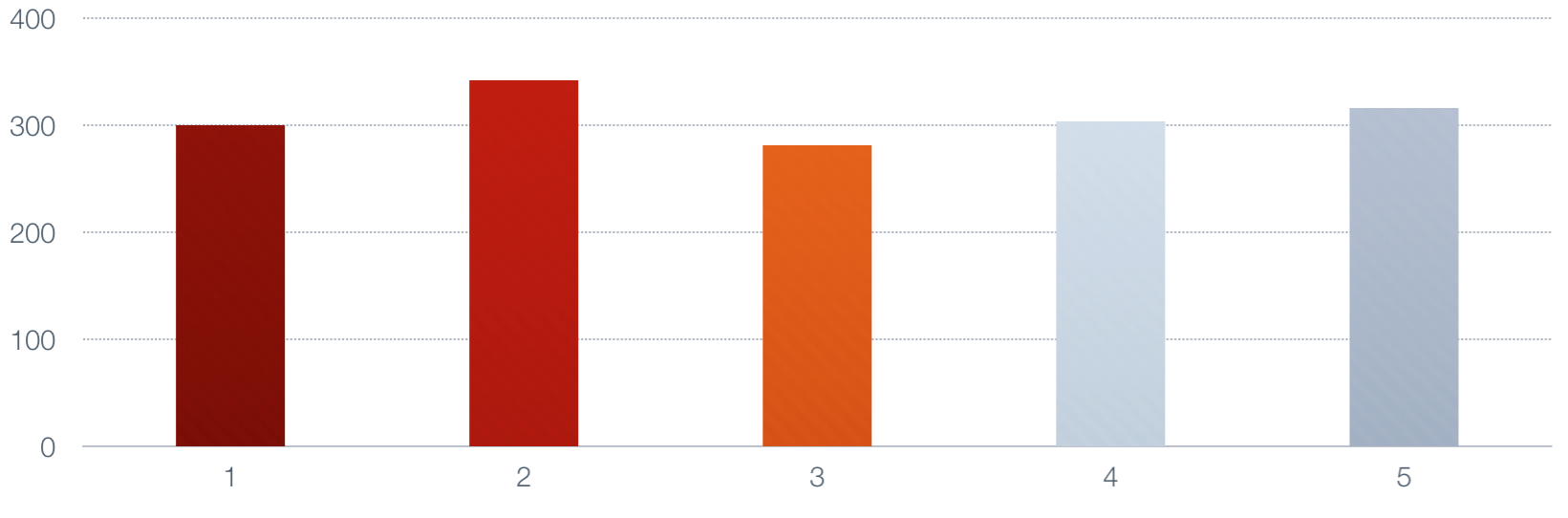--Now let's take the moving average of those numbers. First we set the average to the value-of the first number.--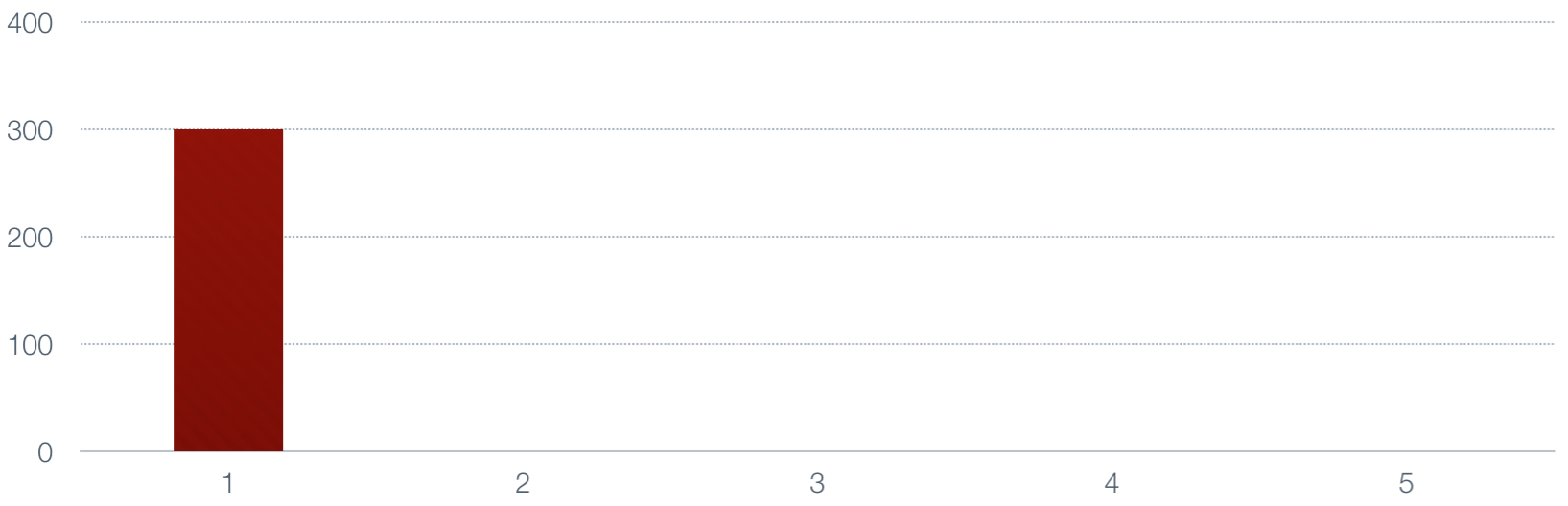--Next we multiply the next number by alpha, multiply the current value by 1-alpha, and add-them to generate a new value.--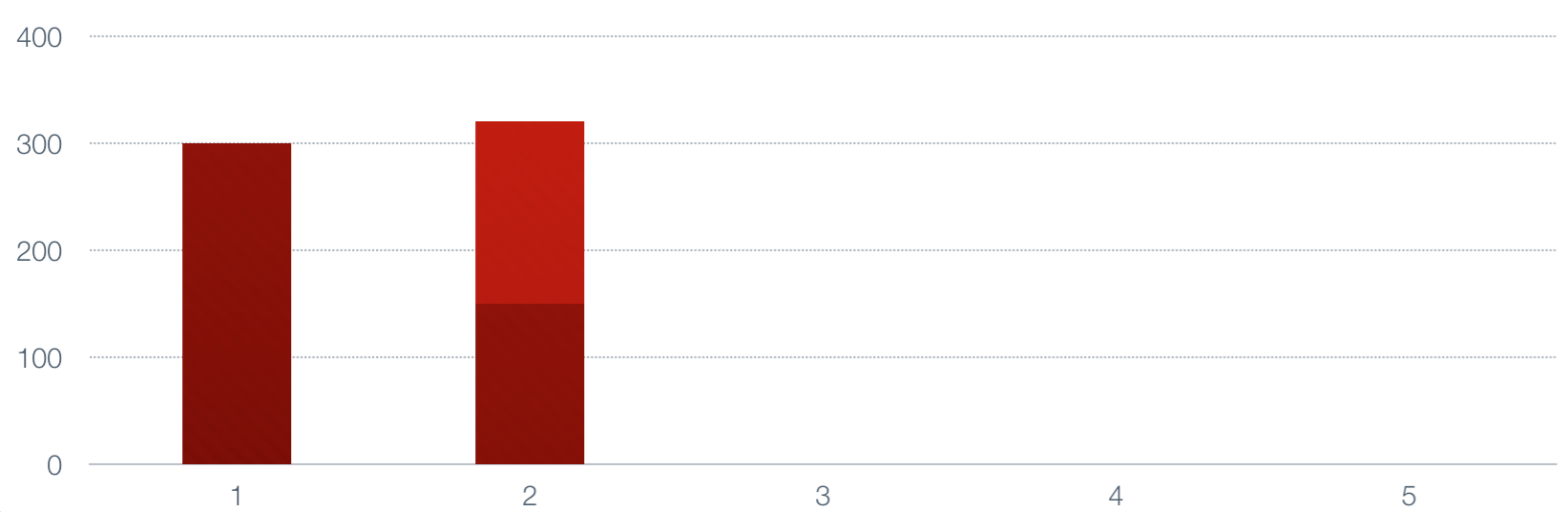--This continues until we are done.--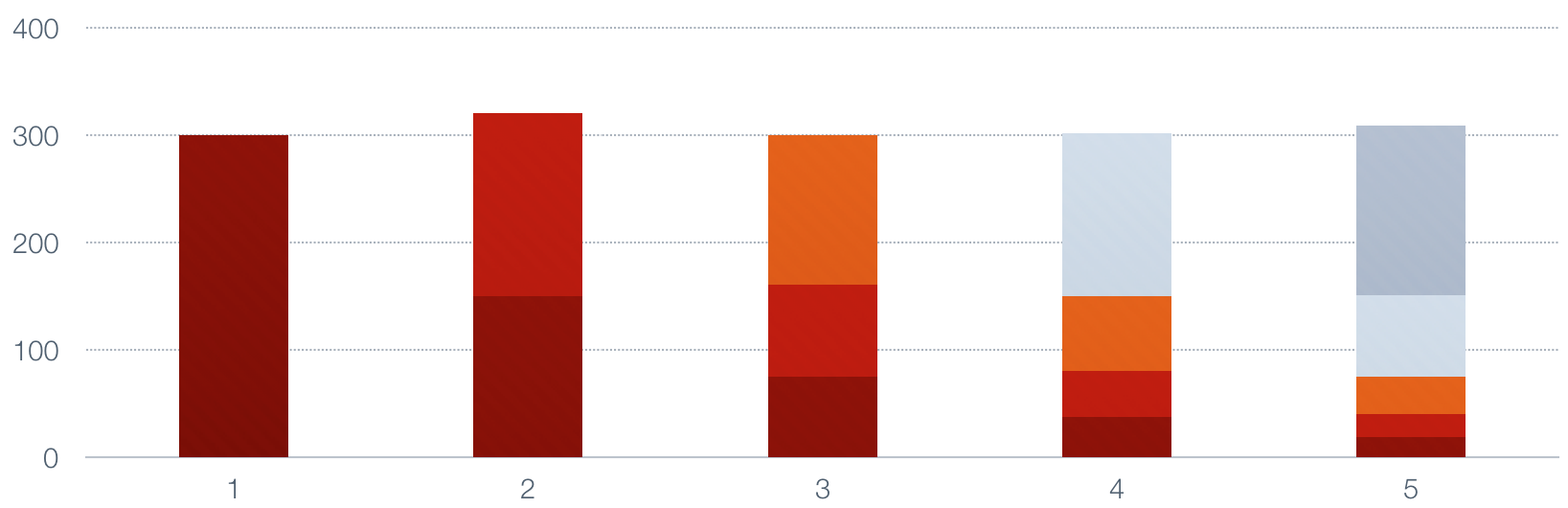--Notice how each of the values in the series decays by half each time a new value-is added, and the top of the bars in the lower portion of the image represents the-size of the moving average. It is a smoothed, or low-pass, average of the original-series.--For further reading, see [Exponentially weighted moving average](http://en.wikipedia.org/wiki/Moving_average#Exponential_moving_average) on wikipedia.--### Choosing Alpha--Consider a fixed-size sliding-window moving average (not an exponentially weighted moving average)-that averages over the previous N samples. What is the average age of each sample? It is N/2.--Now suppose that you wish to construct a EWMA whose samples have the same average age. The formula-to compute the alpha required for this is: alpha = 2/(N+1). Proof is in the book-"Production and Operations Analysis" by Steven Nahmias.--So, for example, if you have a time-series with samples once per second, and you want to get the-moving average over the previous minute, you should use an alpha of .032786885. This, by the way,-is the constant alpha used for this repository's SimpleEWMA.--### Implementations--This repository contains two implementations of the EWMA algorithm, with different properties.--The implementations all conform to the MovingAverage interface, and the constructor returns-that type.--Current implementations assume an implicit time interval of 1.0 between every sample added.-That is, the passage of time is treated as though it's the same as the arrival of samples.-If you need time-based decay when samples are not arriving precisely at set intervals, then-this package will not support your needs at present.--#### SimpleEWMA--A SimpleEWMA is designed for low CPU and memory consumption. It **will** have different behavior than the VariableEWMA-for multiple reasons. It has no warm-up period and it uses a constant-decay. These properties let it use less memory. It will also behave-differently when it's equal to zero, which is assumed to mean-uninitialized, so if a value is likely to actually become zero over time,-then any non-zero value will cause a sharp jump instead of a small change.--#### VariableEWMA--Unlike SimpleEWMA, this supports a custom age which must be stored, and thus uses more memory.-It also has a "warmup" time when you start adding values to it. It will report a value of 0.0-until you have added the required number of samples to it. It uses some memory to store the-number of samples added to it. As a result it uses a little over twice the memory of SimpleEWMA.--## Usage--### API Documentation--View the GoDoc generated documentation [here](http://godoc.org/github.com/VividCortex/ewma).--```go-package main-import "github.com/VividCortex/ewma"--func main() {- samples := [100]float64{- 4599, 5711, 4746, 4621, 5037, 4218, 4925, 4281, 5207, 5203, 5594, 5149,- }-- e := ewma.NewMovingAverage() //=> Returns a SimpleEWMA if called without params- a := ewma.NewMovingAverage(5) //=> returns a VariableEWMA with a decay of 2 / (5 + 1)-- for _, f := range samples {- e.Add(f)- a.Add(f)- }-- e.Value() //=> 13.577404704631077- a.Value() //=> 1.5806140565521463e-12-}-```--## Contributing--We only accept pull requests for minor fixes or improvements. This includes:--* Small bug fixes-* Typos-* Documentation or comments--Please open issues to discuss new features. Pull requests for new features will be rejected,-so we recommend forking the repository and making changes in your fork for your use case.--## License--This repository is Copyright (c) 2013 VividCortex, Inc. All rights reserved.-It is licensed under the MIT license. Please see the LICENSE file for applicable license terms.diff --git a/vendor/github.com/VividCortex/ewma/ewma.go b/vendor/github.com/VividCortex/ewma/ewma.godeleted file mode 100644index 44d5d53e3..000000000--- a/vendor/github.com/VividCortex/ewma/ewma.go+++ /dev/null@@ -1,126 +0,0 @@-// Package ewma implements exponentially weighted moving averages.-package ewma--// Copyright (c) 2013 VividCortex, Inc. All rights reserved.-// Please see the LICENSE file for applicable license terms.--const (- // By default, we average over a one-minute period, which means the average- // age of the metrics in the period is 30 seconds.- AVG_METRIC_AGE float64 = 30.0-- // The formula for computing the decay factor from the average age comes- // from "Production and Operations Analysis" by Steven Nahmias.- DECAY float64 = 2 / (float64(AVG_METRIC_AGE) + 1)-- // For best results, the moving average should not be initialized to the- // samples it sees immediately. The book "Production and Operations- // Analysis" by Steven Nahmias suggests initializing the moving average to- // the mean of the first 10 samples. Until the VariableEwma has seen this- // many samples, it is not "ready" to be queried for the value of the- // moving average. This adds some memory cost.- WARMUP_SAMPLES uint8 = 10-)--// MovingAverage is the interface that computes a moving average over a time--// series stream of numbers. The average may be over a window or exponentially-// decaying.-type MovingAverage interface {- Add(float64)- Value() float64- Set(float64)-}--// NewMovingAverage constructs a MovingAverage that computes an average with the-// desired characteristics in the moving window or exponential decay. If no-// age is given, it constructs a default exponentially weighted implementation-// that consumes minimal memory. The age is related to the decay factor alpha-// by the formula given for the DECAY constant. It signifies the average age-// of the samples as time goes to infinity.-func NewMovingAverage(age ...float64) MovingAverage {- if len(age) == 0 || age[0] == AVG_METRIC_AGE {- return new(SimpleEWMA)- }- return &VariableEWMA{- decay: 2 / (age[0] + 1),- }-}--// A SimpleEWMA represents the exponentially weighted moving average of a-// series of numbers. It WILL have different behavior than the VariableEWMA-// for multiple reasons. It has no warm-up period and it uses a constant-// decay. These properties let it use less memory. It will also behave-// differently when it's equal to zero, which is assumed to mean-// uninitialized, so if a value is likely to actually become zero over time,-// then any non-zero value will cause a sharp jump instead of a small change.-// However, note that this takes a long time, and the value may just-// decays to a stable value that's close to zero, but which won't be mistaken-// for uninitialized. See http://play.golang.org/p/litxBDr_RC for example.-type SimpleEWMA struct {- // The current value of the average. After adding with Add(), this is- // updated to reflect the average of all values seen thus far.- value float64-}--// Add adds a value to the series and updates the moving average.-func (e *SimpleEWMA) Add(value float64) {- if e.value == 0 { // this is a proxy for "uninitialized"- e.value = value- } else {- e.value = (value * DECAY) + (e.value * (1 - DECAY))- }-}--// Value returns the current value of the moving average.-func (e *SimpleEWMA) Value() float64 {- return e.value-}--// Set sets the EWMA's value.-func (e *SimpleEWMA) Set(value float64) {- e.value = value-}--// VariableEWMA represents the exponentially weighted moving average of a series of-// numbers. Unlike SimpleEWMA, it supports a custom age, and thus uses more memory.-type VariableEWMA struct {- // The multiplier factor by which the previous samples decay.- decay float64- // The current value of the average.- value float64- // The number of samples added to this instance.- count uint8-}--// Add adds a value to the series and updates the moving average.-func (e *VariableEWMA) Add(value float64) {- switch {- case e.count < WARMUP_SAMPLES:- e.count++- e.value += value- case e.count == WARMUP_SAMPLES:- e.count++- e.value = e.value / float64(WARMUP_SAMPLES)- e.value = (value * e.decay) + (e.value * (1 - e.decay))- default:- e.value = (value * e.decay) + (e.value * (1 - e.decay))- }-}--// Value returns the current value of the average, or 0.0 if the series hasn't-// warmed up yet.-func (e *VariableEWMA) Value() float64 {- if e.count <= WARMUP_SAMPLES {- return 0.0- }-- return e.value-}--// Set sets the EWMA's value.-func (e *VariableEWMA) Set(value float64) {- e.value = value- if e.count <= WARMUP_SAMPLES {- e.count = WARMUP_SAMPLES + 1- }-}diff --git a/vendor/github.com/VividCortex/ewma/ewma_test.go b/vendor/github.com/VividCortex/ewma/ewma_test.godeleted file mode 100644index 8060a859f..000000000--- a/vendor/github.com/VividCortex/ewma/ewma_test.go+++ /dev/null@@ -1,103 +0,0 @@-package ewma--// Copyright (c) 2013 VividCortex, Inc. All rights reserved.-// Please see the LICENSE file for applicable license terms.--import (- "math"- "testing"-)--const testMargin = 0.00000001--var samples = [100]float64{- 4599, 5711, 4746, 4621, 5037, 4218, 4925, 4281, 5207, 5203, 5594, 5149,- 4948, 4994, 6056, 4417, 4973, 4714, 4964, 5280, 5074, 4913, 4119, 4522,- 4631, 4341, 4909, 4750, 4663, 5167, 3683, 4964, 5151, 4892, 4171, 5097,- 3546, 4144, 4551, 6557, 4234, 5026, 5220, 4144, 5547, 4747, 4732, 5327,- 5442, 4176, 4907, 3570, 4684, 4161, 5206, 4952, 4317, 4819, 4668, 4603,- 4885, 4645, 4401, 4362, 5035, 3954, 4738, 4545, 5433, 6326, 5927, 4983,- 5364, 4598, 5071, 5231, 5250, 4621, 4269, 3953, 3308, 3623, 5264, 5322,- 5395, 4753, 4936, 5315, 5243, 5060, 4989, 4921, 4480, 3426, 3687, 4220,- 3197, 5139, 6101, 5279,-}--func withinMargin(a, b float64) bool {- return math.Abs(a-b) <= testMargin-}--func TestSimpleEWMA(t *testing.T) {- var e SimpleEWMA- for _, f := range samples {- e.Add(f)- }- if !withinMargin(e.Value(), 4734.500946466118) {- t.Errorf("e.Value() is %v, wanted %v", e.Value(), 4734.500946466118)- }- e.Set(1.0)- if e.Value() != 1.0 {- t.Errorf("e.Value() is %d", e.Value())- }-}--func TestVariableEWMA(t *testing.T) {- e := NewMovingAverage(30)- for _, f := range samples {- e.Add(f)- }- if !withinMargin(e.Value(), 4734.500946466118) {- t.Errorf("e.Value() is %v, wanted %v", e.Value(), 4734.500946466118)- }- e.Set(1.0)- if e.Value() != 1.0 {- t.Errorf("e.Value() is %d", e.Value())- }-}--func TestVariableEWMA2(t *testing.T) {- e := NewMovingAverage(5)- for _, f := range samples {- e.Add(f)- }- if !withinMargin(e.Value(), 5015.397367486725) {- t.Errorf("e.Value() is %v, wanted %v", e.Value(), 5015.397367486725)- }-}--func TestVariableEWMAWarmup(t *testing.T) {- e := NewMovingAverage(5)- for i, f := range samples {- e.Add(f)-- // all values returned during warmup should be 0.0- if uint8(i) < WARMUP_SAMPLES {- if e.Value() != 0.0 {- t.Errorf("e.Value() is %v, expected %v", e.Value(), 0.0)- }- }- }- e = NewMovingAverage(5)- e.Set(5)- e.Add(1)- if e.Value() >= 5 {- t.Errorf("e.Value() is %d, expected it to decay towards 0", e.Value())- }-}--func TestVariableEWMAWarmup2(t *testing.T) {- e := NewMovingAverage(5)- testSamples := [12]float64{1, 1, 1, 1, 1, 1, 1, 1, 1, 1, 10000, 1}- for i, f := range testSamples {- e.Add(f)-- // all values returned during warmup should be 0.0- if uint8(i) < WARMUP_SAMPLES {- if e.Value() != 0.0 {- t.Errorf("e.Value() is %v, expected %v", e.Value(), 0.0)- }- }- }- if val := e.Value(); val == 1.0 {- t.Errorf("e.Value() is expected to be greater than %v", 1.0)- }-}