
A modern terminal with a built-in multiplexer: close it and your sessions keep running. Run shells and tons of AI agents across your machines, then pick them up from desktop, browser, TUI and more. Written in Rust with no UI framework: interface drawn straight on the GPU. No Electron, GPUI or webview.
Rust agentagent-orchestrationaiai-agentsclaude-codecodexcoding-agentlinuxmacosmultiplayermultiplexerrustterminalterminal-emulatorterminal-multiplexertmuxtuiweztermwindows
#!/bin/bash
# Emits the body of a ThinkTerm release, as Markdown, on stdout.
#
# The download list is built from what is actually in the dist directory, so a
# release that skipped a platform links only to the packages it has. macOS is
# the exception: its zips are signed and notarized on a laptop and attached to
# the draft by hand, so that row is written from the names those uploads are
# expected to carry, and points at files that do not exist yet.
#
# Whoever finishes the release writes the "what changed" part above all this on
# the release page. Everything here is mechanical.
set -euo pipefail
tag="${1:?usage: release-notes.sh <tag> [dist-dir]}"
dist="${2:-dist}"
version="${tag#v}"
base="https://github.com/RoversX/thinkterm/releases/download/$tag"
# Every Linux and Windows package we build is one of these two. Anything
# unrecognized gets the x86_64 label rather than being dropped, so a new
# architecture shows up wrong rather than silently going missing. Windows
# passes "x64": ARM64 there is 64-bit too, and is what that word means.
arch_label() {
case "$1" in
*arm64* | *aarch64*) echo "ARM64" ;;
*) echo "${2:-64-bit}" ;;
esac
}
# "[64-bit](url) · [ARM64](url)" for every file matching a glob; a second
# argument replaces "64-bit". Returns 1 when the release contains none of
# them, so the caller can drop the whole row.
#
# Two passes so that 64-bit leads, whatever the filenames sort as: it is what
# most people want, and a row reads as a recommendation followed by the
# alternatives.
links_by_arch() {
local out='' f want
for want in x86 arm; do
for f in "$dist"/$1; do
[ -f "$f" ] || continue
f=$(basename "$f")
case "$f" in
*arm64* | *aarch64*) [ "$want" = arm ] || continue ;;
*) [ "$want" = x86 ] || continue ;;
esac
[ -z "$out" ] || out="$out · "
out="$out[$(arch_label "$f" "${2:-}")]($base/$f)"
done
done
[ -n "$out" ] || return 1
printf '%s\n' "$out"
}
# The same header on every release, from main: the tag does not exist until
# the draft is published, so a link through it would show broken in the draft.
echo "## $version"
echo
echo "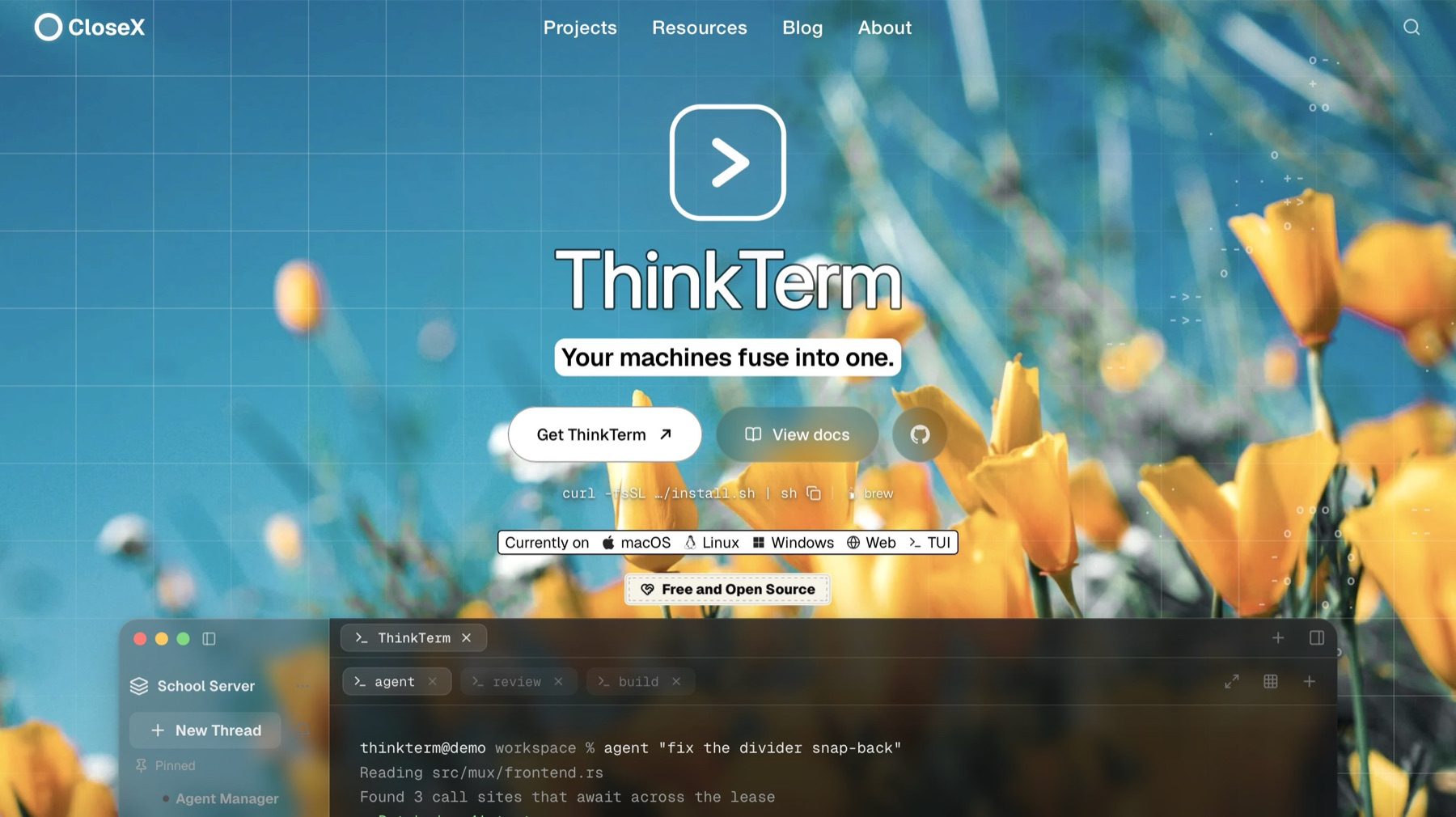"
echo
echo "🍺 Homebrew (macOS):"
echo
echo '```'
echo "brew install --cask roversx/tap/thinkterm"
echo '```'
echo
echo "🌐 Website: [closex.org/thinkterm](https://closex.org/thinkterm)"
echo
echo "📚 Documentation: [docs.closex.org/thinkterm](https://docs.closex.org/thinkterm)"
echo
echo "<!-- What changed in this release goes here. Then delete this line. -->"
echo
echo "## Downloads"
echo
echo "### macOS"
echo
echo "[Apple silicon]($base/ThinkTerm-macos-arm64-$version.zip) · [Intel]($base/ThinkTerm-macos-x86_64-$version.zip) — or \`curl -fsSL https://raw.githubusercontent.com/RoversX/thinkterm/main/install.sh | sh\`, which picks the right one, verifies it and puts the command-line tools on PATH"
echo
win_setup=$(links_by_arch 'ThinkTerm-*-setup.exe' x64) || win_setup=''
win_zip=$(links_by_arch 'ThinkTerm-windows-*.zip' x64) || win_zip=''
if [ -n "$win_setup$win_zip" ]; then
echo "### Windows"
echo
[ -z "$win_setup" ] || { echo "Installer: $win_setup"; echo; }
[ -z "$win_zip" ] || { echo "Portable zip: $win_zip"; echo; }
fi
linux=''
# The tarballs are what install.sh fetches; the links are here for anyone who
# would rather unpack by hand. The desktop glob pins the digit after the
# name so it cannot also match thinkterm-server-*, and the server glob the
# 64 of the arch so it cannot also match the build for older glibc.
desktop=$(links_by_arch 'thinkterm-[0-9]*-linux-*.tar.gz') || desktop=''
server=$(links_by_arch 'thinkterm-server-*-linux-*64.tar.gz') || server=''
server_old=$(links_by_arch 'thinkterm-server-*-glibc*.tar.gz') || server_old=''
server_xz=$(links_by_arch 'thinkterm-server-*-linux-*64.tar.xz') || server_xz=''
server_old_xz=$(links_by_arch 'thinkterm-server-*-glibc*.tar.xz') || server_old_xz=''
if [ -n "$desktop$server$server_old" ]; then
linux="$linux
**Install script** — \`curl -fsSL https://raw.githubusercontent.com/RoversX/thinkterm/main/install.sh | sh\` puts ThinkTerm under \`~/.local\` without root and asks which variant you want; \`--desktop\` or \`--server\` (headless remote host, no GUI) skips the question
"
[ -z "$desktop" ] || linux="$linux
Desktop tarball: $desktop
"
[ -z "$server" ] || linux="$linux
Server tarball (gzip): $server
"
[ -z "$server_xz" ] || linux="$linux
Server tarball (smaller xz download): $server_xz
"
[ -z "$server_old_xz" ] || linux="$linux
Server tarball for older glibc (xz): $server_old_xz
"
[ -z "$server_old" ] || linux="$linux
Server tarball for older glibc (Ubuntu 20.04, Debian 11; OpenSSL built in): $server_old
"
fi
if appimage=$(links_by_arch '*.AppImage'); then
linux="$linux
**AppImage** — \`chmod +x\` and run it; nothing is installed
$appimage
"
fi
# The globs pin the digit after the name so thinkterm-* cannot also match
# thinkterm-server-*. Only one of the two packages may be installed at a time.
if deb=$(links_by_arch 'thinkterm-[0-9]*.deb'); then
linux="$linux
**DEB (Debian / Ubuntu)** — \`sudo apt install ./<file>.deb\`
$deb
"
fi
if deb_server=$(links_by_arch 'thinkterm-server-[0-9]*.deb'); then
linux="$linux
**DEB, server only** (headless remote host, no GUI and no graphics libraries) — \`sudo apt install ./<file>.deb\`; replaces the desktop package if that is installed
$deb_server
"
fi
if rpm_desktop=$(links_by_arch 'thinkterm-[0-9]*.rpm'); then
linux="$linux
**RPM (Fedora / RHEL)** — \`sudo dnf install ./<file>.rpm\`
$rpm_desktop
"
fi
if rpm_server=$(links_by_arch 'thinkterm-server-[0-9]*.rpm'); then
linux="$linux
**RPM, server only** (headless remote host, no GUI and no graphics libraries) — \`sudo dnf install ./<file>.rpm\`; replaces the desktop package if that is installed
$rpm_server
"
fi
if [ -n "$linux" ]; then
echo "### Linux"
echo "$linux"
fi